AIRCO Opens New Pennsylvania Hub to Scale CO2-to-Synthetic Fuels Conversion for Aviation and Land Fleets
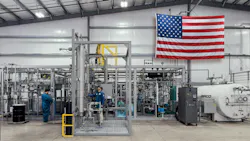
Instead of treating captured carbon as waste by burying it underground, e-fuel companies like AIRCO (formerly Air Company) use CO2 as a raw material to reset the liquid hydrocarbons used in aviation, maritime shipping and heavy-duty transport.
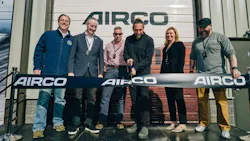
On Wednesday, the Brooklyn, New York-based startup unveiled its new operations facility during a ribbon-cutting ceremony in New Britain, Pennsylvania. The event drew local and state officials, including U.S. Representative Brian Fitzpatrick of Pa., who joined company leadership for the opening.
The New Britain hub will focus on scaling domestic manufacturing of its power-to-liquid fuel production systems across multiple sectors, including U.S. military operations. Nicolas Steinke, AIRCO director of government and defense programs, noted during a private tour after the event that 1,000 gallons of synthetic drop-in diesel fuel will be produced monthly at the new plant.
“Everything that’s powering this event today is running on diesel fuel that we made,” said AIRCO co-founder and CEO Greg Constantine during the ribbon-cutting event. “For as long as we had fuel, it’s always worked the same way. You find it in the ground and you refine it somewhere far away and then you transport it…every stop around that transportation piece adds costs and vulnerability.”
To build off of this fundamental approach, Constantine views these efforts as the beginning of addressing renewable, global fuel supply alternatives. Constantine added: “What if you didn’t have to move that fuel at all? What if you could produce it exactly where it was and where it is needed?”
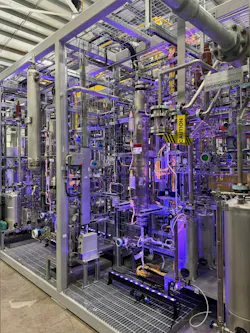
AIRCO plans to address those concerns with its MAD (mobile, adaptable, dynamic platform) Fuel System at its new Pennsylvania facility. Powered by its proprietary AIRMADE technology, this hardware platform produces sustainable aviation fuel (SAF) for jets and synthetic diesel fuel for ground vehicles by converting CO2 and H2 through AIRMADE’s catalyst pathway, eliminating the need for traditional fuel transport and resupply logistics. These fuel reactors are then transported to where they’re needed directly from the site.
“We’ve invented these chemical process technologies that use CO2, hydrogen, and electricity and make fuels,” Constantine told EnergyTech, which covered the ribbon-cutting event. “What we’ve also done is develop a hardware capability where we’ve taken what is normally a massive refinery and shrunk it into a shipping container size.”
AIRCO’s leaders say that the benefit for the broader commercial market is being able to deploy these modular container units worldwide, anywhere power is available, to essentially make fuel on-demand.
Power-to-liquid pivot: From consumer concept to commercial scaling
Founded in 2017, AIRCO initially raised roughly $108 million in venture capital. That later led to a $69 million Series B round in 2024 backed by aviation investors like JetBlue Ventures, Alaska Airlines and Toyota Ventures.
While companies like AIRCO are beginning early-stage demonstration projects, the Transportation Energy Institute projects that U.S. e-fuel production capacity will scale to 4.7 billion gallons annually by 2040. Although this will reportedly represent about 1.5% of the total domestic petroleum consumption, other analyses expect e-fuels to cut U.S. carbon dioxide emissions by over 50 million metric tons annually.
Power-to-liquid synthesis led the global e-fuels market with roughly a 49% share in 2024, valued at over $33 billion, according to global consulting firm Polaris Market Research.
As for AIRCO, the company first began utilizing this AIRMADE SAF tech in 2019 through a consumer product called Air Vodka. The carbon-negative spirit, made from captured CO2, water and solar power to split the H2O molecules, provided AIRCO with a consumer proof-of-concept to further its development in the commercial market.
That same carbon-negative philosophy, Constantine stated, carries over into the decarbonization efforts behind its drop-in fuel production today.
Currently, AIRCO holds a $65 million defense contract with the U.S. Department of Defense’s Defense Innovation Unit along with multi-million-dollar NASA partnerships to demonstrate how its e-fuels can be synthesized directly at remote locations. This tech aims to grant commercial users the flexibility of deploying power-agnostic fuel reactors that utilize local, on-site distributed energy resources—such as geothermal, solar and wind to generate fuel when fielded.
“The reason this is a very compelling product for the U.S. military is that, one, we’re cheaper because we’re competing with the fully vertical cost of fuel. Fuel you have to truck, transport and fly to these really remote locations is very expensive,” said Constantine. “Secondly, we negate the vulnerability in the supply chain with the distance associated with that.”
For the military specifically, Constantine noted that the supply of water and fuel is among the biggest targets in times of conflict. For industries like aviation, as AIRCO begins to mass-produce these modular in-field units, cutting down the cost of goods will allow them to serve other markets and “open their investment door.”
Under separate memorandums of understanding, New York airline JetBlue agreed to buy 25 million gallons of AIRCO’s fuel between 2027 and 2032. British airline Virgin Atlantic also agreed to purchase up to 100 million gallons of AIRCO’s fuel over 10 years as the global aviation industry finds ways to reduce carbon emissions and meet the 2050 net-zero emissions target set by the International Air Transport Association (IATA) in 2021.
Aerospace company Boom Supersonic partnered with AIRCO in 2022 to acquire 5 million gallons annually over the duration of its Overture flight test program.
About the Author
 Eric Moody
Staff Writer
Related

 Paramount Facility