Hazy Shades of Progress: Analyzing the 2025 U.S. Carbon Footprint and Its Drivers

Carbon dioxide emissions are on the rise again in the U.S. despite two decades of intermittent but steady declines, according to data from the federal Energy Information Administration.
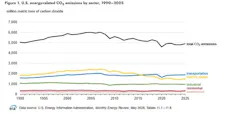
Don’t panic yet, as it’s not as bad as you might think from a historical context. Total U.S. C02 emissions from all economic and population sectors is nearly 5 billion metric tons produced in 2025, but that’s about 17% lower than the 6 billion metric tons calculated around 2007, according to the EIA.
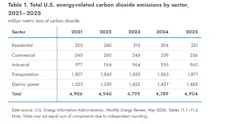
Don’t focus the blame on the manufacturing sector or automobiles. Electric power accounted for the largest increase in emissions of 58 million metric tons to 1.485 billion metric tons last year; that’s a 4% rise.
One might assume that this elevated electrification role in CO2 emissions is due to expanding demand from hotter weather, cloud-based computing and automation load. Net electricity generation topped a record 119 Terawatthours (TWh), surpassing the previous high reached in 2024.
“Changes in the electricity generation mix also influenced sectoral CO2 emissions, with both net growth in fossil fuel-fired generation and relative growth in coal-fired generation, which emits more CO2 per kilowatthour than natural gas when combusted,” reads the EIA report.
Overall, the U.S. total CO2 emissions were 4.9 billion metric tons in 2025, 2% higher than the 4.789 billion metric tons ignited into the American sky one year earlier, the EIA data shows.
U.S. greenhouse gas emissions, least in CO2 terms, have gradually declined over the past two decades. Industrial emissions, perhaps partially due to earlier shifts to manufacturing overseas and factory efficiency gains, are maintaining at around 1 billion metric tons per year, while transportation sector CO2 emissions are nearly 2 billion metric tons emitted annually by U.S. consumers and commercial entities, according to the EIA.
“Emissions increases in the industrial and transportation sectors were small, with energy efficiency gains and switches to less carbon-intensive fuels curbing growth,” reads the federal report.
The new load pressures facing a utility grid sector which was anticipating flat load growth only a handful of years ago is sparking the rise in coal-fired power dispatch. Coal-fired electricity generation increased 13% and raised its portion of CO2 emissions by 78 million metric tons, according to the EIA.
The rising coal dependency comes despite the retirement of dozens of coal-fired generation units since 2000. Some 170 GW of coal-fired capacity have been taken out of the U.S. generation resource mix since then.
It is also why some data center hyperscalers and power generators are working to restart recently retired nuclear units and build advanced reactor projects. Nuclear reactors do not emit CO2 at the point of use, but deliver the highest generation capacity factor among all commercial resources. The controversial and expensive Vogle reactor expansion in Georgia now is the nation’s largest single generation source of carbon-free power.
Gas-fired generation, which has dominated the overall U.S. electricity resource mix in the past decade, actually dropped by 4%, eliminating about 23 million metric tons.
Historical perspective: Exactly 30 years ago U.S. CO2 emissions totaled about 5.4 billion metric tons, increasing to 6 billion MT early in the 2000s. Perhaps long-term the U.S. is headed in the right direction, but certain economic pressures are going to cause intervals of ups and downs in greenhouse gas emissions.
Global fossil related carbon emissions are a record high of about 38 billion metric tons in 2025. The U.S. output is about 13% of that environmental total, from a technologically advanced nation with roughly 4% of the world population but generating 25% of global gross domestic product.
About the Author
 Rod Walton, EnergyTech Managing Editor
Rod Walton, EnergyTech Managing Editor
Managing Editor
For EnergyTech editorial inquiries, please contact Managing Editor Rod Walton at [email protected].
Rod Walton has spent 17 years covering the energy industry as a newspaper and trade journalist. He formerly was energy writer and business editor at the Tulsa World. Later, he spent six years covering the electricity power sector for Pennwell and Clarion Events. He joined Endeavor and EnergyTech in November 2021.
Walton earned his Bachelors degree in journalism from the University of Oklahoma. His career stops include the Moore American, Bartlesville Examiner-Enterprise, Wagoner Tribune and Tulsa World.
EnergyTech is focused on the mission critical and large-scale energy users and their sustainability and resiliency goals. These include the commercial and industrial sectors, as well as the military, universities, data centers and microgrids. The C&I sectors together account for close to 30 percent of greenhouse gas emissions in the U.S.
He was named Managing Editor for Microgrid Knowledge and EnergyTech starting July 1, 2023
Many large-scale energy users such as Fortune 500 companies, and mission-critical users such as military bases, universities, healthcare facilities, public safety and data centers, shifting their energy priorities to reach net-zero carbon goals within the coming decades. These include plans for renewable energy power purchase agreements, but also on-site resiliency projects such as microgrids, combined heat and power, rooftop solar, energy storage, digitalization and building efficiency upgrades.