Is China Leading the Way in Electrification? Energy Institute Report Reveals Huge Sino Edge in Renewables and Falling Carbon Intensity
Key Highlights
- - Global energy supply increased by 1.7% in 2025, with renewables like solar leading the way, surpassing traditional sources such as oil, gas, and coal in growth terms.
- - The decoupling of GDP growth from fossil fuel consumption is becoming more evident, driven by efficiency policies and increased renewable energy integration.
- - Asia-Pacific, led by China and India, is at the forefront of electrification, with significant investments in solar, wind, and battery storage, shaping the global energy transition.

Before we get to the stats revealing how and where a modern energy revolution might evolve, how about a quick history lesson.
For more than a century, the momentum of industrial and economic growth in developed and developing nations was quantified through a tight, time-tested correlation between increasing gross domestic product (GDP) and access to fossil-fueled energy. GDP became the primary benchmark for measuring a nation's economic health, reinforcing the idea that greater energy consumption and economic prosperity were inseparable.
The countries that thrived were those who used the most dense and accessible energy.
Coal initially drove the first industrial revolution, but oil and gas have dominated since early in the 20th century. The link has weakened somewhat since the early 1980s, but the adage that “energy is power” has always, and will continue, to make more sense as a combustible level… or will it?
Electrification emerging as its own entity at forefront of change

It’s certainly not time to turn out the lights on the fossil-fuel party, but new ways of powering are certainly illuminating the path where we may be headed. The world is changing, dear reader. The global rise in electrification and renewables is stretching the gap between GDP and fossil fuel supply to an unprecedented level of separation, according to the 75th annual Energy Institute 2026 Statistical Review of World Energy.
The rise in demand from AI, data computing and reindustrialization may require carbon-intense forms of energy in a short term, but many nations are also embracing unprecedented capacities of solar, battery storage and electrification to soften their environmental impacts as they strive to keep pace in global economic competition.
The Statistical Review of World Energy report noted that total energy supply from all forms increased 1.7% to more than 600 exajoules (EJ) or about 600 quintillion joules of energy. Solar generation and renewables account for 3.3 EJs, outpacing oil, gas, coal and nuclear in terms of percentage growth.
And electricity growth outpaced overall total energy supply by rising 3% year over year, according to the report.
“All forms of energy reached another year of record highs for the second consecutive year,” Nick Wayeth, CEO of the London-based Energy Institute, which oversaw the report, said in a webcast with energy media this week. “We’ve not had two consecutive years of growth for 27 years.”
Energy Institute developed the 75th Statistical Review of World Energy in tandem with research and data partners at Ember and in collaboration with KPMG and Kearney. It was presented in partnership with the Houston-based Baker Institute Center for Energy Studies (CES) within Rice University.
The road to Net Zero is taking some detours
And, yes, that pressurized growth is impeding current decarbonization efforts as fossil fuel supply met 60% of the growth, while renewables met 40%, according to the review. In the oil and gas-rich U.S., nearly 90% of that growth was supplied with fossil fuels.
Rising AI and data center demand drove much of that expansion as hyperscalers and developers race to meet supercomputing load with more speedy deployment of power generation. In the U.S., current presidential policy also ended incentives for electric vehicles and low-carbon energy projects.
Worldwide, greenhouse gas emissions “grew by 1.1% to 41 gigatons in 2025,” Wayeth noted. “U.S. emissions grew four times the rate of China, representing 40% of emissions growth. China is still the No. 1 emitter.”
Micro trends may rise and fall in years, but macro trends certainly reveal themselves over decades of data. What’s happening globally, the stats show, is that China’s rush to achieve dominance in economics has forced it to build out its energy portfolio with all the so-called above, including coal and imported oil and gas.
However, China is now outpacing the U.S. on electrification progress and dominates the world in newly installed renewable energy capacity.
“Forty-eight percent of the end user growth in China was met by electricity in 2025,” Wayeth said. “It was only 27% in the U.S., and it’s a rate of change that’s so stark.
“In generation terms, China grew 5% while the global rate of growth was 3%,” he added. “China added the equivalent of Germany to its grid in one year. That growth trajectory shows few signs of slowing.”
Sino of the Times: China’s energy transition chasing the wind and sun

In fact, China reduced its fossil generation for the first time, as even coal generation declined, according to the Energy Institute report. The world’s second biggest economy added more renewables and electrification than the rest of the world combined, Wayeth noted.
The Energy Institute's findings find backup in research by the Brookings Institution, which notes that China already manufactures a supermajority of the world's solar modules, electric vehicles and wind turbines. Clean energy investment also accounts for about 10% of China's recent GDP growth.
Electrification is leading the way in the heart of Asia Pacific, according to the stats.
“U.S emissions grew four times faster rate than China,” Wayeth said. “We are at a potential inflection point with electrification.”
One must be careful to draw too many conclusions from a single year that invariably includes economic bubbles, busted bubbles and geopolitical traumas driving economic and energy reactions, he added.
Carbon intensity of energy falling nearly everywhere but the U.S.
Even so, the momentum evident in long strings of statistical analysis shows historic trends at play in energy development transitions around the world. In Pakistan, for instance, aversion to dependance on imported fossil fuels has driven a tripling of solar power capacity to more than 23 GW.
Meanwhile, India is still relying on coal to help meet its citizens' growing economic and energy needs, but its coal consumption is increasing at a much slower pace. In fact, India's coal consumption rose by less than 1%, compared with its average annual growth rate of 3.6% over the past decade. The U.S., despite not building a single coal-fired power plant in recent years, increased its coal consumption by 10% as soaring natural gas prices shifted the economics of power generation.
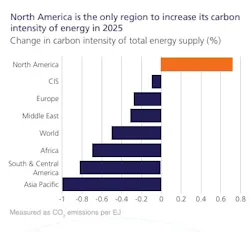
Globally, the picture is changing in favor or lower carbon-intensity resources. North America, driven mainly by U.S. fossil-fuel demand, was the only region increasing its carbon intensity last year, according to the Energy Institute report. U.S. CO2 equivalent (CO2e) emissions belched 4.75 billion metric tons into the sky, while Mexico and Canada together emitted less than 1 billion metric tons of CO2e.
Renewables in 2025 accounted for the largest source of energy supply growth for the first time outside of a recession. And electrification at both the residential and industrial levels is increasing far faster in the Asia Pacific than through the rest of the economically advanced world such as U.S. and Europe.
The share of electricity in China’s total energy supply has hit 24%, nearly quintupling its share in the last 40 years, according to the Energy Institute report. Europe’s electrification rate is nearly 20% of total energy supply, while the U.S. is closer to 18%. Electric motors and drives are touted as more efficient than internal combustion engines and processes, according to numerous expert evaluations.
Perhaps much of the world, led by China, is starting to weaken the link between the fossil fuels and economic growth, a tethered combination that stood for many decades.
“In the last decade, fossil fuel consumption has grown at an average growth rate of 1% per year, while (worldwide) GDP has grown by 2.7%,” reads the report. “Policies to improve efficiency in end-use sectors (especially transport), combined with the phaseout of more inefficient fossil generation in the power sector, have helped drive this decoupling, with sources of renewable supply playing more of a role in meeting growing total energy supply in the last two decades.”
It’s worth noting that the Asia-Pacific region remains heavily coal-dependent, consuming close to 83% of global coal consumption. Yet the region led by China and India is a global leader in renewables expansion.
Is China showing the way forward?
China is emerging as a world-leading “electrostate,” according to the Energy Institute report. It deployed 315 GW of solar capacity last year, which was triple German’s total installed capacity. And electric vehicle sales are half of China’s new car sales as of 2025.
Battery storage capacity growth and new chemistries accelerating in China to such a level that, if you put all of its stationery and transportation battery output together, it could deliver 140 GW of instantaneous power. That’s enough to electrify all of France and Germany for a few hours, Wayeth noted.
China is the world leader in new installed capacity for wind, solar, e-mobility and electrification, in general. Its embrace of 21st century resources may inspire more developed nations such as in Europe to shift from Russian gas, American LNG and coal to secure more renewables and advanced grid technologies.
“My sense is where China leads the rest of the world will inevitably follow,” he said.
Wayeth spent much of his career at global energy producer bp shepherding the annual review. Responsibility for the World Statistical Energy Review shifted from bp to Energy Institute about four years ago.
The full report deals with much more than fossil fuels, renewables or carbon emissions. Click to gain a link to the entire review.
The Baker Institute Center for Energy Studies researches and reports on national and international roles of regulations, policy and economics in the performanc and evolution of energy markets. It is part of the larger Baker Institute for Public Policy located on the campus of Rice University in Houston.
About the Author

Rod Walton, EnergyTech Managing Editor
Managing Editor
For EnergyTech editorial inquiries, please contact Managing Editor Rod Walton at [email protected].
Rod Walton has spent 17 years covering the energy industry as a newspaper and trade journalist. He formerly was energy writer and business editor at the Tulsa World. Later, he spent six years covering the electricity power sector for Pennwell and Clarion Events. He joined Endeavor and EnergyTech in November 2021.
Walton earned his Bachelors degree in journalism from the University of Oklahoma. His career stops include the Moore American, Bartlesville Examiner-Enterprise, Wagoner Tribune and Tulsa World.
EnergyTech is focused on the mission critical and large-scale energy users and their sustainability and resiliency goals. These include the commercial and industrial sectors, as well as the military, universities, data centers and microgrids. The C&I sectors together account for close to 30 percent of greenhouse gas emissions in the U.S.
He was named Managing Editor for Microgrid Knowledge and EnergyTech starting July 1, 2023
Many large-scale energy users such as Fortune 500 companies, and mission-critical users such as military bases, universities, healthcare facilities, public safety and data centers, shifting their energy priorities to reach net-zero carbon goals within the coming decades. These include plans for renewable energy power purchase agreements, but also on-site resiliency projects such as microgrids, combined heat and power, rooftop solar, energy storage, digitalization and building efficiency upgrades.