Charging to the Fore: US Battery Storage Capacity Raced to Another Record in 2025
Times being what they are, it’s obvious power generators, energy customers and renewable enthusiasts can generate fierce debate over the best way forward for utility-scale and distributed energy in the coming years. Attend the energy conference of your choice and you'll soon know what I mean.
Natural gas, nuclear, solar and wind are all positioned to contribute to a diverse grid mix, although each has its limitations and detractors.
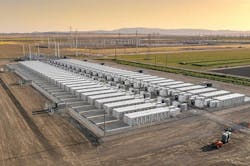
One thing proving constant over recent years is the exceptional rise of utility-scale battery storage to balance whatever resource may be generating. In fact, the latest annual outlook by the Solar Energy Industries Association indicates that stationary battery storage installation achieved yet another record year in 2025.
Battery energy stationary storage (BESS) surpassed 28 GW of new installations in 2025, 28% higher than 2024, according to the key findings of SEIA’s Energy Storage Market Outlook Q1 2026 released in partnership with Benchmark Mineral Intelligence. This new battery storage is capable of 57 GWh in generation capacity, including 12 GW of behind-the-meter distributed BESS installations.
The overall 28 GW of battery energy storage installation is roughly 30 percent of the total US nuclear energy fleet capacity of 97 GW.
“This record-breaking year for energy storage is just the beginning of its rise as a cornerstone of America’s energy future,” said Darren Van’t Hof, Interim President and CEO of the Solar Energy Industries Association, in a statement. “Whether it’s paired with solar or standing on its own, energy storage lowers consumer costs, makes the grid more reliable, and keeps the power on in homes during outages. Deployment is rising fast, but without a course correction from federal actions targeting the industry, Americans will face higher electricity prices and a less resilient energy system.”
Much was made in the past year of the political divide over the resilience and sustainability value of certain energy resources. Red states are seen as pro-fossil and blue states as renewable backers with little purple carryover. This is a simplistic reading of the situation but one which persists in such a divided time.
The 2025 battery storage numbers contradict that political narrative, however, with two-thirds of all utility-scale BESS capacity built in states won by President Trump in the 2024 election, according to SEIA. The Trump Administration set its sights on rolling back advances in offshore wind, renewable and vehicle electrification, but stationary battery storage project development has survived the cut and proves to be thriving.
In fact, automobile manufacturers such as GM and Ford have shifted some of their long-term plans for EV batteries toward stationary energy storage for the grid and microgrids. As of 2025, lithium-ion battery cell manufacturing for stationary BESS applications rose to more than 21 GWh, according to SEIA, while new innovations are being reported for li-ion alternatives such as sodium-ion.
“The US energy storage market has entered a new phase of sustained, high volume-deployments,” said Iola Hughes, Head of Research at Benchmark Minerals. “As policy, manufacturing and market demand align, storage is playing a pivotal role in meeting peak demand, reducing price volatility and improving overall system resilience. At a time of rising electricity demand, driven in part by the growth of data centers and AI infrastructure, energy storage will be critical to ensuring the grid can scale reliably and efficiently.”
In the past year, EnergyTech.com has covered major energy storage installations completed such as Duke Energy’s $100 million BESS project atop a former coal-fired power plant site in North Carolina. Jupiter Power, Plus Power and Energy Vault completed utility-scale projects nationwide, while New York Governor Kathy Hochul issued a request for proposals for 1 GW of bulk energy storage in the Empire State.