Electrochemistry Foundry Forges Collaboration to Create Next-Gen Batteries
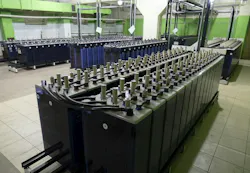
The energy storage research team at University of California, Santa Barbara (UCSB) has joined a new group of collaborators creating a new nonprofit aimed at expanding next-generation battery chemistries and manufacturing.
This nonprofit, called the Electrochemistry Foundry (ECF), was launched this year to help accelerate advanced energy storage technology efforts in California. ECF was awarded $28 million by the California Energy Commission, which enabled the organization to move forward with developing its 20,000-square-foot Hayward facility to establish a shared-use battery pilot manufacturing line.
Scheduled to open in late 2026, the facility is strategically located to leverage local hardware-engineering talent and support economic growth in the Bay Area, ECF stated.
By providing startup developers the access to this facility, ECF believes it can improve the commercial availability of innovative technology resources in the electrochemistry space. Electrochemistry explores the relationship between chemical reactions and electrical energy.
The nonprofit’s creators point to high associated costs of laboratory research at an industrial level as the reasons for creating this entity. A new startup that’s producing a battery cathode through its initial phases can now show investors without building its own $10 million facility, ECF explained about this new pilot line.
UCSB is experimenting with solar liquid batteries to store the sun’s energy for a rainy day or a cold night when solar panels are not working. Experts view this as a fundamental hurdle in the renewable energy space.
Chemists at UCSB claim they have developed a solution that doesn’t require electrical grids or bulky batteries through utilizing a modified organic molecule called pyrimidone. UCSB Associate Professor Grace Han and her team detailed pyrimidone in a journal published by the American Association for the Advancement of Science. She stated pyrimidone captures sunlight and stores it within chemical bonds—and releases it as heat on demand.
Han’s team described the chemical battery concept as “reusable and recyclable,” and the latest advancement in Molecular Solar Thermal (MOST) energy storage. This is just one example of the work UCSB aims to scale, alongside UC Berkeley, UC Riverside, the Volta Foundation, the Catalyst Innovation Group, and Lawrence Berkeley National Laboratory under this nonprofit partnership.
ECF will also reportedly bring manufacturing expertise from the South Korean company Top Material to provide virtual operational support in flexible Li-ion manufacturing lines from their home office.
“I’ve seen too many brilliant breakthroughs stall out in the pilot-scale gap,” ECF CEO Brenna Teigler said in a statement. “Our vision is a world powered by electrochemistry, where the path from scientific discovery to societal impact is open to all innovators.”
Teigler, whose background includes roles with the U.S. Department of Energy, added that the next “great battery breakthrough” should not be stopped simply due to infrastructure costs that a startup or established company couldn’t justify building alone.
“I’ve seen too many brilliant breakthroughs stall out in the pilot-scale gap,” Teigler added.
Digital Infrastructure Needs Diverse Energy Playbook
Free E-Book from EnergyTech: Get it here
About the Author
 Eric Moody