EPRI Research: Li-Ion Battery Storage Failure Risk Down 98% Since 2018
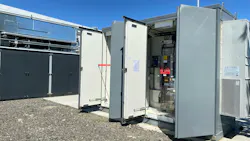
As battery storage deployment accelerates across the U.S., a new report by the Electric Power Research Institute highlights that safety performance is significantly improving in newer systems than in vintage lithium-ion battery energy storage system (BESS) designs.
According to EPRI’s “Risk Factors and Failure Statistics of Lithium-Ion BESS” white paper within its Battery Energy Storage System Failure Incident Database, annual BESS failures per deployed GWh declined 98% between 2018 and 2025. The analysis found that BESS safety risk overall is comparable to oil-filled transformers, which reportedly maintain a 0.1% annual failure rate as a long-established power grid technology.
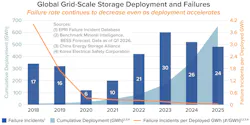
EPRI attributes these lessons learned from early failures that caused destructive fires to having been incorporated into the latest designs and best practices. The institute explained that some of its incident research dates back to 2011.
Still, drawing on more than a decade of cumulative incident data, the institute urges operators to conduct safety reviews and retrofits for early-vintage systems to mitigate fire risks. These concerns are underscored by previous incidents at high-profile facilities.
The fires at Moss Landing, Morris and Surprise
Vistra Corp.’s battery energy storage facility at the Moss Landing Power Plant in Monterey County, California, serves as an early example of these early-vintage risks.
A major lithium-ion battery fire in January 2025 damaged over half of the site’s 300-MW system. The Moss Landing facility suffered a second fire in September 2026 due to leftover, damaged batteries that reignited during ongoing cleanup efforts.
In 2021, another major fire incident took place at the Superior Battery Inc. warehouse in Morris, Illinois, which contained roughly 180,000 to 200,000 pounds of lithium batteries. While the U.S. Environmental Protection Agency conducted extensive air quality testing around the incident, investigators determined that the blaze was triggered by a water reaction from a severe roof leak. Rainwater reportedly dripped onto the batteries, sparking an initial reaction.
Before those disasters, a thermal runaway event in Surprise, Arizona, severely injured eight firefighters in 2019. An internal cell defect within the utility-sized lithium batteries used on-site for storage and distribution of solar energy at the APS McMicken substation triggered the failure, according to an Arizona Public Service analysis.
As these batteries fail, technical safety flaws, such as escaping gases, create intense and potentially devastating fire dangers to utility-scale BESS made up of lithium-ion chemistry.
BESS advancements driving down failure rates
All of these incidents occurred during the period of EPRI’s research, which highlights that while the rate of battery storage failures is becoming less frequent relative to massive-scale deployment, they can still be severe.
EPRI noted that the 2019 BESS failure incident in Arizona was part of a wider BESS safety research effort, initiated to inform energy storage industry stakeholders and the public. Residential energy storage system failures were not tracked in this research.
Managing these risks, however, remains a critical focus as BESS installations accelerate nationwide, driven by utilities dealing with grid constraints and the growing power demands of AI data centers. Currently in the U.S., installed capacity has passed 52 GW and has grown at an average rate of 70% per year over the last three years, according to the U.S. Energy Information Administration.
Lakshmi Srinivasan, principal team lead of Energy Storage at EPRI, told EnergyTech that key aspects evaluated that weren’t known before include statistical analysis on the impact of indoor versus outdoor BESS architecture.
Srinivasan noted that the data “demonstrates that modularization and spacing can limit the amount of a system that is damaged in an incident, also limiting first response needs and environmental and public health impacts.”
These latest BESS advances have reportedly yielded major benefits in California, where utility-scale storage capacity grew to 13 GW by the end of 2024. According to EPRI, this has directly reduced the state's reliance on “Flex Alerts,” which are voluntary calls for residents to reduce consumption during peak demand periods, typically on hot summer days.
“The number of Flex Alerts has dropped to zero (in 2023 and 2024) from 11 in 2022, due to the use of energy storage to reduce supply constraints,” said Srinivasan.
Safely scaling future storage deployments
EPRI aims to help power operators apply these standards to accelerate large-scale renewable integration. This guidance is particularly critical as operators navigate thermal risks for lithium-ion BESS across various project types, including behind-the-meter installations.
To mitigate these risks, Srinivasan explained that conducting safety analyses of older systems can “help ensure the latest safety designs and practices are being implemented for all systems operating today.”
While safety improvements are a continuous process, Srinivasan emphasized that dedicated research and development efforts are actively reducing risks in both existing and new BESS deployments. These advancements ultimately aim to deliver tangible benefits to the grid and local communities.
“These benefits include supporting grid flexibility, reliability and resilience through applications such as renewable integration and peak demand reduction,” she added.
Although lithium-ion remains a dominant mix for energy storage due to its high energy density and quick discharge, the industry is actively seeking alternatives to mitigate foreign supply chain risks and thermal safety concerns. For many aging systems, simply replacing older units or funding modernization upgrades may not always be the most cost-effective.
Next-generation battery chemistries like sodium-ion are demonstrating the potential of long-duration, weather-resistant and safety viability in early market deployments that can compete directly with lithium-ion.
Companies like ESS Tech, Inc. and Alysm Energy are advancing this transition, scaling non-flammable, longer-duration sodium-ion battery solutions to diversify the energy storage market.
About the Author
 Eric Moody