NASA Taps Air Products for 36.5M Lbs Liquid Hydrogen to Fuel Space Travel
Hydrogen supplier Air Products will deliver liquid H2 (LH2) for the National Aeronautics and Space Administration’s sites under a $140 million contract.
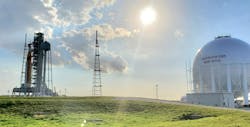
Air Products will supply the industrial-scale hydrogen for the Cape Canaveral Space Force Station and the massive hydrogen sphere at NASA’s Kennedy Space Center, among other destinations. The contract totals close to 36.5 million pounds of liquid hydrogen for the NASA sites in Florida, Alabama and Mississippi.
“From the inception of the United States (U.S.) space program, Air Products has supported NASA's mission by supplying the critical industrial gases needed from the initial Apollo 11 moon landing to the upcoming Artemis II moon mission," said Francesco Maione, Air Products' President, Americas, in a statement. "For decades, Air Products has consistently demonstrated our ability to supply world-scale levels of liquid hydrogen and other industrial gases safely and reliably through our robust supply chain. We're proud to play a role in helping NASA confidently continue its important work."
Air Products aided NASA last year in the first fill of what they called the world’s largest hydrogen sphere—reportedly measuring 90 feet tall and 83 feet in diameter—at the Kennedy Space Center. To complete the fill, Air Products delivered over 50 trailer loads of liquid hydrogen—over 730,000 gallons in all—to NASA's new sphere.
NASA uses LH2 as a cryogenic, Energy-dense fuel for rocket engines. The federal Space agency is currently working on its Artemis mission to return and establish long-term operations on the moon.
Last month, the U.S. Department of Energy (DOE) and NASA announced a renewed commitment to jointly researching and developing plans for a lunar surface nuclear fission system. President Trump has said he wants to deploy a lunar surface reactor by 2030.