Silicon Valley Bank: Climate Tech Investment Showing Resilience Despite Downward Funding, Policy Shifts

Silicon Valley Bank (SVB), which specializes in venture capital for tech startups, released its annual investment-focused report highlighting the recent industry trends surrounding the future of climate tech.
The news is good: Key details in this year's “The Future of Climate Tech” report revealed that early-stage fundraising and deal volume in the climate technology sector have continued to decline.
In 2025, U.S. growth funds and venture capital raised just under $6 billion across roughly 50 closed funds. These levels have not been seen since before the COVID-19 pandemic, according to the report.
Despite a sudden cool-down, the report shows that valuations have still trended upward for climate tech companies. SVB states that 37% of the top-performing climate tech companies have raised extension rounds or bridge rounds for short-term funding needs in the last 12 months.
SVB Back from the Brink: See EnergyTech's Full Coverage
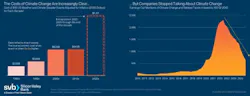
Overall investments surrounding climate tech, which focus on efforts designed to reduce greenhouse gas emissions, reached $29 billion in 2025. It’s a 44% increase from the prior year and marks the third-highest annual total despite deals being down.
But the changes in federal support, such as fewer tax incentives, funding cuts, and adverse permitting policies, resulted in last year’s downward trend in deals.
There have reportedly been a number of federal actions that have created uncertainty for climate technology projects. A major roadblock was the “One Big Beautiful Bill Act” signed in July 2025 that targeted renewable energy credits in a push towards fossil fuels and nuclear.
This includes several billion dollars in federal loan guarantees that have been cut for renewable energy companies that received conditional Inflation Reduction Act (IRA) and U.S. Department of Energy (DOE) program funding.
There’s been a growing demand for nuclear energy among many investors, with 15 top U.S. nuclear startups raising at least $100 million from venture capitalists. SVB says that these projects still have secured buyers amid the growing demand for nuclear energy.
Nearly a fifth of the U.S.’s utility-scale energy comes from nuclear power annually, and some officials consider it one of the most reliable resources in America. It supports the strong push for decarbonization efforts and other zero-emission goals set for 2050.
Other industry reports backed up SVB's findings. Global investments into this energy transition have reached a record $2.3 trillion last year, according to an annual Bloomberg NEF report; that is up 8% from the prior year, but the Energy Transition Investment Trends (ETIT) research found that hydrogen ($7.3 billion) and nuclear ($36 billion) didn’t see a rise in their investment levels.
The U.S. clean energy power generation continues to accelerate, with renewable energy solutions leading the charge.
According to the U.S. Energy Information Administration (EIA), solar energy accounted for 51% of the maximum potential output in 2026. Energy storage accounted for 28% of planned capacity additions, which SVB says will help balance the grid amid increasing penetrations of intermittent renewables.
Federal initiatives, such as the roughly $1.9 billion SPARK project to accelerate critical upgrades for the nation’s power grid, help present some federal support towards renewable energy optimism. Not only for climate technology investors, but also for the necessary renewable energy funding that some projects depend on to advance their research.