Texas Leads U.S. Electricity Load Growth Amid Renewable Expansion
Key Highlights
- Renewable energy sources, particularly solar and wind, now constitute the majority of new capacity additions in North America, with batteries playing a key supporting role.
- Despite rapid growth in renewables, natural gas remains a significant part of the U.S. energy mix, providing nearly 38% of utility-scale power generation.
- The U.S. power grid faces challenges in keeping pace with demand, especially in regions like ERCOT, MISO and PJM, where load growth is high and capacity additions are critical.
Electricity load growth is happening throughout the U.S., although if you spread it out not as dramatically as what some forecasts are saying about the predicted rise of artificial intelligence and data center load demand.
That’s because the growth is concentrated, and if you want to know where load is skyrocketing look no higher than the Lone Star State. A new Grid Pulse report by Hitachi Energy notes that in the past 12 months load growth in the Electric Reliability Council of Texas (ERCOT) system rose 9%, more than four times the roughly and relatively modest 2% national average of the United States.
And what’s causing this racing load growth in Texas? It’s the same everywhere, although ERCOT is clearly the outlier.
“Load growth in the U.S. over the last six months has been quite aggressive,” Debashis Bose, a senior advisor to Hitachi Energy, said during a call with business media to add perspective to the Grid Pulse results. “It’s driven by high density demand like data centers and Bitcoin mining.”
Texas like whole other country in power generation
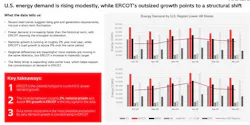
This week’s Grid Pulse report is the first publicly released by Hitachi Energy, which normally shares the results with industry firms directly. The research has curated information from more than 3,000 sources and focused mainly on 6- and 12-month stretches ending late March of this year but also explored comparisons with previous periods.
The rise of Texas demand might be a concern if power generation capacity addition doesn’t match demand load. ERCOT’s grid nearly collapsed five years ago during a winter storm that knocked out a sizable chunk of multiple generation sites, and its reserve margin occasionally has shrunk dangerously low during summer heatwave peak demand alerts.
The Lone Star state also is a leader in adding multiple generation resources, not only its historical base of oil and gas but also solar and utility-scale battery storage. From October 2025 to the end of March, Texas led all states with about 6.8 GW of new resource additions within ERCOT, although the Midwest’s Midcontinent ISO (MISO) was a close second at 6.4 GW, according to the Hitachi Energy Grid Pulse.
Together, ERCOT and MISO accounted for nearly half of all U.S additions of roughly 28 GW in the six months ending March. California’s ISO added 3.1 GW, while data center-heavy PJM Interconnection installed less than 2 GW of new generation resources.
PJM’s territory includes northern Virginia, where data center concentration is highest in the U.S. The capacity addition is barely keeping up with load growth there, according to reports.
“PJM load has grown about 4%, which is also quite high,” Hitachi Energy’s Bose pointed out during the media presentation.
The story arc of a new Industrial Compute Age has focused on the need for baseload and flexible generation which points mainly to future nuclear and natural gas. Various forecasts predict a need for at least 125 GW of new electricity capacity just to handle AI and data center growth in the early 2030s.
Renewables renewing the U.S. electricity portfolio

The truth unfolding around new generation installment is more of a renewables story. According to the Hitachi Energy Grid Pulse and other reports over the past year, solar and wind and battery storage are dominating new installed capacity rankings.
“Solar and battery energy storage systems (BESS) were the primary drivers of U.S. additions from October 2025 to March 2026, contributing 13.1 GW and 7.4 GW, respectively,” reads the Hitachi Energy report.
Utility-scale solar energy increased by 22 GW and accounted for 47% of new capacity additions throughout North America in those six months, the report shows, while BESS took a 27% portion of that continental growth. Wind energy, despite some active resistance from the Trump Administration toward offshore wind, added nearly 4 GW and was 14% of new capacity additions.
Altogether, the decarbonizing mix of solar, battery storage and wind made up about 88% of total North American newly installed capacity in those six months. The numbers were very similar throughout the U.S. Even oil-and-gas focused and relatively small Oklahoma elevated itself into the top six states with 1.4 GW of added capacity, nearly all of its renewable solar and wind power and none of it natural gas generation.
“We’re looking at the forces reshaping the U.S. power system,” Hitachi Energy’s Bose pointed out, noting the leading edge of wind, solar and BESS. “These three technologies are providing a big chunk of the generation.
Natural gas, which is seen as the bridge power solution to meet faster timelines for AI and data center projects, ranked fourth by adding 2.8 GW or 10% of the U.S. capacity additions, the Hitachi Energy Grid Pulse data shows.
It is worth noting that in the complete snapshot of where the U.S. generation resource portfolio is right now, natural gas still leads by generating close to 38% of utility-scale power, following by nuclear at 19%, coal 17%, wind 12% and solar 6%. So conventional generation still accounts for nearly three-fourths of overall electricity created, the carbon-free portion is now 37% with wind, solar and nuclear.
Total installed utility-scale power generation capacity in the U.S. is about 1,400 GW (or 1.4 terawatts). North American combined capacity is closer to 1,600 GW, according to the Grid Pulse statistics.
About the Author
 Rod Walton, EnergyTech Managing Editor
Rod Walton, EnergyTech Managing Editor
Managing Editor
For EnergyTech editorial inquiries, please contact Managing Editor Rod Walton at [email protected].
Rod Walton has spent 17 years covering the energy industry as a newspaper and trade journalist. He formerly was energy writer and business editor at the Tulsa World. Later, he spent six years covering the electricity power sector for Pennwell and Clarion Events. He joined Endeavor and EnergyTech in November 2021.
Walton earned his Bachelors degree in journalism from the University of Oklahoma. His career stops include the Moore American, Bartlesville Examiner-Enterprise, Wagoner Tribune and Tulsa World.
EnergyTech is focused on the mission critical and large-scale energy users and their sustainability and resiliency goals. These include the commercial and industrial sectors, as well as the military, universities, data centers and microgrids. The C&I sectors together account for close to 30 percent of greenhouse gas emissions in the U.S.
He was named Managing Editor for Microgrid Knowledge and EnergyTech starting July 1, 2023
Many large-scale energy users such as Fortune 500 companies, and mission-critical users such as military bases, universities, healthcare facilities, public safety and data centers, shifting their energy priorities to reach net-zero carbon goals within the coming decades. These include plans for renewable energy power purchase agreements, but also on-site resiliency projects such as microgrids, combined heat and power, rooftop solar, energy storage, digitalization and building efficiency upgrades.