Repricing Climate Risk in the AI Era: Storm Prep for Resilient Digital Infrastructure

Only a year ago, storms and other natural catastrophes wreaked nearly $300 billion worth of havoc on the global stage, including some 55 climate events causing at least $1 billion in damage apiece.
The insurance industry is struggling to keep up with this advancing pace of weather chaos, as you may already know. Premiums and payouts are going up astronomically in some regions.
Part of the problem may lie in understandable confusion. The latest, novel challenge is how to price climate risk during the era of AI computing and data center-related capital investment.
It’s fast becoming the trillion-dollar question in the digital infrastructure, built environments and energy sectors.
Starting from scratch: Repricing computing and climate impacts

“Climate risk has become a financial variable for every physical asset—factories, ports, power grids, real estate, transport networks,” reads ‘The Repricing of Compute: The Economics of Climate Risk and Resilience for AI-Era Capital,’ a new study by the Schneider Electric Research Institute and consulting wing SE Advisory Services. “Yet across asset classes it remains recognized but not priced: markets can name the hazard without quantifying what it costs, where it concentrates, or whether it can be reduced.”
The growth of artificial intelligence and digital infrastructure is the hot topic among multiple sectors, including energy and construction entities. Of that $296 billion in global natural-catastrophe losses incurred last year—of which insurers covered less than half—the financial risk impact to data centers again exceeded $1 billion of added property insurance expense, according to the Schneider Electric report.
A billion here, a billion there, and soon you’re talking about real money, right?
“Capital cannot be priced efficiently against a risk no one has measured,” the report added. “Operators, investors and insurers lack the metrics to distinguish a resilient facility from an exposed one, to quantify how much value each hazard erodes, or to test whether adaption generates a positive return.”
AI-enabled digital infrastructure installation and energy demand is expected to grow by perhaps 125 GW or more in the coming decade. AI and automation are putting huge demands on the energy sector, leading to new growth in fossil-fueled power generation.
It’s not all data centers’ fault—and it should be noted that the skills of AI can also help with energy efficiency and sustainability strategies—but they are increasingly incurring the wrath of accelerating climate events just like any other built environment.
The pace of destruction and insurance retreat quickens
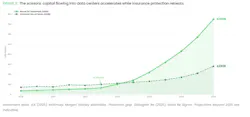
No doubt that AI computing capacity is a key investment strategy for the coming decades. In fact, hyperscalers and cloud-based computing developers could spend closer to $1 trillion of capital expenditure on new construction annually.
The insurance industry, however, is not inclined to protect at the same pace, with uninsured natural catastrophe losses rising from $100 billion this year to $280 billion projected by 2030, according to this SE research graphic.
In only 40 years, climate events causing at least $1 billion damage each have grown 800%, according to NASA and the U.S. National Oceanic and Atmospheric Administration.
These storms not only damage the facilities such as homes, businesses and data centers, but also the utility grids supplying electricity to those areas. Extreme weather accounts for close to 80% of major grid outages, according to RMI and other outlets, and those lapses in power can cause billions of dollars in lost productivity and other damages.
The “Repricing of Compute” report by Schneider Electric Research Institute finds that proactive measures such as renewable power purchase agreements to decarbonize the grid, liquid cooling, microgrids and climate-informed siting can both restore enterprise value by at least 30% and perhaps reduce climate impacts on the facilities.
“Adaptation is most valuable when anticipated at the front end,” reads the research summary. “The design choices being made today set climate exposure for the next quarter century and building resilience is far cheaper than retrofitting it later. Anticipation creates value; delay destroys it.”
Scope of global computing capacity: It’s resiliency
The Schneider Electric research looked at more than 8,500 geocoded facilities in operation across 120 countries, including traditional data centers and more energy intensive AI factories. The data was modeled on several growth scenarios through 2050, including an ambitious “abundance without boundaries” projection of 385 GW in new capacity.
The energy supply matters in sustainability, but it’s not among the key factors driving climate risk to capital investment, the report notes.
“The sustainability agenda for AI infrastructure has been built around the wrong constraint. Physical resilience, not energy sourcing, is what determines whether a $10 billion training cluster survives a climate event,” the report concludes. “Cooling architecture, geographic diversification, supply chain redundancy, and operational continuity planning are the levers that matter most for protecting multi-billion-dollar training investments from climate disruption.”
The report’s authors are Rémi Paccou, doctoral researcher with Schneider Electric Research Institute, and Thomas Epelbaum, of SE Advisory Services.
Dynamic Bridge to the Secure Energy Future
How Distributed Energy Connects Resiliency and Flexibility
New EnergyTech QuickChat with PowerSecure
About the Author
 Rod Walton, EnergyTech Managing Editor
Rod Walton, EnergyTech Managing Editor
Managing Editor
For EnergyTech editorial inquiries, please contact Managing Editor Rod Walton at [email protected].
Rod Walton has spent 17 years covering the energy industry as a newspaper and trade journalist. He formerly was energy writer and business editor at the Tulsa World. Later, he spent six years covering the electricity power sector for Pennwell and Clarion Events. He joined Endeavor and EnergyTech in November 2021.
Walton earned his Bachelors degree in journalism from the University of Oklahoma. His career stops include the Moore American, Bartlesville Examiner-Enterprise, Wagoner Tribune and Tulsa World.
EnergyTech is focused on the mission critical and large-scale energy users and their sustainability and resiliency goals. These include the commercial and industrial sectors, as well as the military, universities, data centers and microgrids. The C&I sectors together account for close to 30 percent of greenhouse gas emissions in the U.S.
He was named Managing Editor for Microgrid Knowledge and EnergyTech starting July 1, 2023
Many large-scale energy users such as Fortune 500 companies, and mission-critical users such as military bases, universities, healthcare facilities, public safety and data centers, shifting their energy priorities to reach net-zero carbon goals within the coming decades. These include plans for renewable energy power purchase agreements, but also on-site resiliency projects such as microgrids, combined heat and power, rooftop solar, energy storage, digitalization and building efficiency upgrades.