The Alchemy: Harmonizing Power Couples in Industrial and Energy Sectors Can Speed Electrification
Key Highlights
- Strong partnerships between utilities and industries are essential for overcoming grid constraints and enabling large-scale electrification.
- Data centers and other distributed assets can serve as flexible grid resources, creating new monetization opportunities.
- Europe's 'Power Couples' concept exemplifies multi-layered collaborations that drive decarbonization and industrial competitiveness.

It took the star wattage of Taylor Swift and Travis Kelce to entice thousands of celebrities into Madison Square Garden for a wedding this hot summer.
That proves the very definition of a power couple, but another kind of star wattage could be instrumental to changing the tune for electrification across the commercial and industrial sectors. Utilities and large-scale customers should be courting one another from the very beginning, paving the way for a long-term future together.
Andrea Falciai, who is global power generation lead for professional services firm Accenture, sees first-hand the formidable challenge as companies recognize electrification as the best path forward, whether it’s in AI factories or steel plants, commercial real estate or manufacturing. A lack of up-to-speed system readiness in the grid and interconnection arena, however, is creating roadblocks that will need partnerships to advance. That’s true everywhere.
AI is the irresistable force, but energy partners must be movable

“If we talk about grid congestion and grid constraint, our view is that we need a better understanding of each other,” Falciai told EnergyTech.com, speaking of communication and collaboration between the energy and industrial sectors. “The energy system is something that everyone needs to understand better and learn to work hand-in-hand with each other.”
Not only is momentum rising for behind-the-meter and distributed energy solutions to meet accelerating AI, data center and industrial automation demand, but also the real elevation happens when bringing all the parties together at the beginning, from utilities to on-site power project developers and site customers.
AI is forcing gigawatt-level change, and there’s no stopping that force. It just takes teamwork.
“We are seeing a rise in terms of asks from the energy market and also increasing willingness from utilities and industries to sit down together to understand each other’s challenges,” Falciai added. “That collaboration needs to be standardized and built into how we optimize the entire system going forward.”
Before taking on the role of global power generation lead at Accenture, Falciai served the company’s utilities lead for the European, Middle East and Africa markets, helping guide research collaborations between Accenture and Eurelectric.
The most recent of these Europe-focused reports is “Power Couples: Enhancing Industrial Competitiveness Through Electrification.” Industrial electrification should be a key driver in both innovation and competition to both reduce emissions and improve efficiency.
The challenge is no less of a priority in the United States, although the U.S. holds a much stronger position in terms of baseload power such as natural gas and nuclear power. Although the “Power Couples” report focuses on Europe’s stake in decarbonization and cleaner industrialization, similar types of collaborations between government and private industry are being pushed by President Trump on both the energy and data center frontiers.
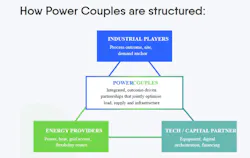
“Power Couples could be a new class of multi-layer partnership that brings together industrial players, energy providers, technology and capital partners in integrated, outcome-driven models that jointly optimize system- level coordination across industrial demand, low-carbon supply and infrastructure design,” reads one key point in the Accenture-Eurelectric research report.
Eurelectric is the federation that represents more than 3,500 electric utilities in Europe. This latest research collaboration with Accenture analyzed more than 3,500 market signals and dozens of projects.
It’s aimed at understanding return on investment with respect to cleaner energy and electrification value propositions across those projects. These challenges include grid access and delivery, system integration, policies and project bankability.
Flexibility is the new digital infrastructure energy value proposition
One focus on improving bankability is the value proposition of using data center energy as a grid asset, whether it’s participating in demand response, distributed energy aggregation or process heat deployment.
For instance, a Microsoft data center in Dublin turned its backup power assets into a grid service that helped monetize the project’s flexibility. Another collaboration in Stockholm utilized waste heat to make it tradable across a city-wide platform.
“We actually think there’s room for flexibility for data centers, which is not what the provider is usually saying at the beginning of (project) conversations,” Accenture’s Falciai pointed out. “Some are now asking, ‘If we do that, if we make it flexible, what do we get in return?’”
Expanding options can increase the value proposition of unique project partnerships between utilities, developers and end-user companies.
“This is something that needs to be explored as different stakeholders get together to talk about the energy system they need and how to optimize it,” he added.
Even low-key Taylor and Travis probably struggled to start up a conversation early. Power coupling takes time and energy. If at first it doesn’t make sense, shake it off and find the best way forward.
Mastering Requirements, Standards and Risk
in a Digitally Transformed Energy Sector
Join us for July 21 EnergyTech Webinar with Siemens
About the Author

Rod Walton, EnergyTech Managing Editor
Managing Editor
For EnergyTech editorial inquiries, please contact Managing Editor Rod Walton at [email protected].
Rod Walton has spent 17 years covering the energy industry as a newspaper and trade journalist. He formerly was energy writer and business editor at the Tulsa World. Later, he spent six years covering the electricity power sector for Pennwell and Clarion Events. He joined Endeavor and EnergyTech in November 2021.
Walton earned his Bachelors degree in journalism from the University of Oklahoma. His career stops include the Moore American, Bartlesville Examiner-Enterprise, Wagoner Tribune and Tulsa World.
EnergyTech is focused on the mission critical and large-scale energy users and their sustainability and resiliency goals. These include the commercial and industrial sectors, as well as the military, universities, data centers and microgrids. The C&I sectors together account for close to 30 percent of greenhouse gas emissions in the U.S.
He was named Managing Editor for Microgrid Knowledge and EnergyTech starting July 1, 2023
Many large-scale energy users such as Fortune 500 companies, and mission-critical users such as military bases, universities, healthcare facilities, public safety and data centers, shifting their energy priorities to reach net-zero carbon goals within the coming decades. These include plans for renewable energy power purchase agreements, but also on-site resiliency projects such as microgrids, combined heat and power, rooftop solar, energy storage, digitalization and building efficiency upgrades.