GE Vernova Invests in Advanced Gas Turbine Training and Community Partnerships
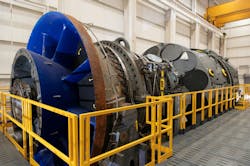
Power generation equipment manufacturer GE Vernova has expanded its Houston Learning Center which is one of the company's U.S. facilities focused on training employees in advanced gas turbine technologies and services.
GE Vernova completed the modernization of the Houston Learning Center (HLC) at a time when the company is targeting $600 million in new investment on upgrading U.S. factories, advanced repair capabilities and technologies.
At HLC, GE Vernova trains its workforce on power generation technologies and includes hands-on training bays anchored by the 7HA.03 gas turbine.
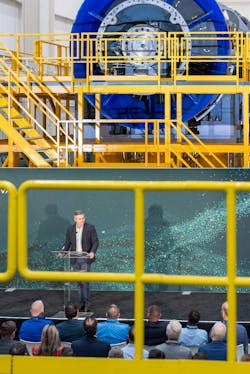
“GE Vernova is committed to helping build the workforce of the future and reflects our belief that world-class technologies require a world-class workforce,” said Steve Kessinger (pictured left), Vice President of Global Services, GE Vernova’s Gas Power business, in a statement. “By investing in facilities like the Houston Learning Center and expanding our training capabilities, we’re helping ensure our teams, customers, and partners are equipped to meet the growing global demand for highly skilled energy professionals to support the energy systems of today and tomorrow.”
GE Vernova is one of the world’s largest turbine manufacturers, a competitive group which also includes Siemens Energy and Mitsubishi Power globally. All of these original equipment manufacturers, known as OEMS, are striving to meet the future power generation load expected from cloud-based computing, industrial automation and artificial intelligence training factories.
This anticipated load growth from automation and AI could exceed 125 GW of additional capacity in the coming decades. If fully realized, these new and growing markets will require OEMs to develop next-generation workforces on the latest advancements in gas-fired, nuclear and renewable energy resources.
To that end, GE Vernova also has initiated educational partnerships with three Houston school districts. The HLC provides training across gas turbines, steam turbines, generators, control systems and more.
“We’re proud to continue investing in advanced training assets and collaborations with local school districts like Deer Park, Channelview and Alief to strengthen our pipeline of talent needed to support customers today and the energy transition ahead,” added Jim Vono, One Field Services Leader, GE Vernova’s Gas Power business. “These collaborations aim to expose students to real-world industrial environments, advanced energy technologies, and career pathways in high-demand, technical fields.”
Last summer, AI infrastructure firm Crusoe announced it was ordering 19 natural gas turbines from GE Vernova. Mitsubishi Power also touted a significant uptick in gas-fired turbine orders in the past quarter.
Paralyzed by Digital Transformation? Start Here
March 10 Webinar on Creating Value from Digital Complexity
Led by Siemens and Presented by EnergyTech.com
About the Author
EnergyTech Staff
Rod Walton is head of content for EnergyTech.com. He has spent 17 years covering the energy industry as a newspaper and trade journalist.
Walton formerly was energy writer and business editor at the Tulsa World. Later, he spent six years covering the electricity power sector for Pennwell and Clarion Events. He joined Endeavor and EnergyTech in November 2021.
He can be reached at [email protected].
EnergyTech is focused on the mission critical and large-scale energy users and their sustainability and resiliency goals. These include the commercial and industrial sectors, as well as the military, universities, data centers and microgrids.
Many large-scale energy users such as Fortune 500 companies, and mission-critical users such as military bases, universities, healthcare facilities, public safety and data centers, shifting their energy priorities to reach net-zero carbon goals within the coming decades. These include plans for renewable energy power purchase agreements, but also on-site resiliency projects such as microgrids, combined heat and power, rooftop solar, energy storage, digitalization and building efficiency upgrades.