Yokogawa to Lead Automation for New U.S. Gulf Coast LNG Export Terminal
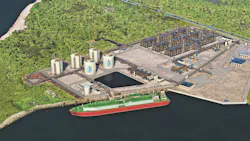
Yokogawa Corp. of America will be the main automation contractor for a U.S. Gulf Coast liquified natural gas export terminal under construction.
Primary engineering, procurement and construction (EPC) contractor Technip Energies selected Yokogawa to deliver automation design, control, safety and system integration services for the Commonwealth LNG facility. Developed by owner Caturus, Commonwealth LNG is anticipated to process, liquefy and export about 9.5 million metric tons of LNG per year once it’s operational in 2030.
The U.S. is the world’s largest exporter of LNG, while the Commonwealth project is expected to increase that lead in a few years. LNG export terminals process U.S. natural gas, liquify it by chilling and making it stable and more energy dense for shipping compared with compressed natural gas.
Commonwealth LNG is being built along the Calcasieu Pass region of the Louisiana Gulf of Mexico coastline. Caturus recently made a positive final investment decision on the facility, which already has an agreement with a subsidiary of Saudi Arabian energy firm Aramco to acquire one million metric tons of LNG exported through Commonwealth.
Integrated Lifecycle Management
For Petrochemical Environments
New White Paper by Siemens
Once completed, the facility is designed to include six liquefaction trains, LNG storage infrastructure and export facilities. Cheniere Energy’s Sabine Pass, already completed along the Louisiana coast, is the nation’s largest LNG export terminal at close to 30 million metric tons in annual capacity.
Last year, U.S. LNG terminals average close to 15 billion cubic feet per day in natural gas processing and liquefaction, according to federal Energy Information Administration statistics. The daily flow could grow to nearly 30 billion cubic feet by 2030.
Much of the U.S. LNG is shipped to countries in Europe and Asia which are not rich in natural gas resources such as gas but need to meet expanding demand from data centers and industrial electrification.
Mastering Requirements, Standards and Risk
in a Digitally Transformed Energy Sector
Join us for July 21 EnergyTech Webinar with Siemens