Baker Hughes Supplying Refrigerant Technologies for 29-MTPA CP2 LNG Terminal Under Construction
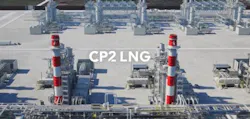
Energy infrastructure services firm Baker Hughes will supply the hyper refrigerant technologies required for a liquified natural gas (LNG) export terminal project off the Louisiana coast of the Gulf of Mexico.
Developer Venture Global LNG selected Baker Hughes to supply six liquefaction blocks for the CP2 LNG expansion. Altogether CP2 LNG will contain 12 liquefaction modules.
LNG is U.S. natural gas pipelined down to the terminals then liquified and made stable for shipping. LNG is produced by chilling natural gas to about minus 261 degrees Fahrenheit and reducing its volume significantly for containment.
Baker Hughes and Venture Global have been collaborating on development aspects of the CP2 LNG terminal since the $8.6 billion second phase project was announced.
"Baker Hughes has been a trusted partner across our LNG developments, and we are pleased to extend this collaboration as we advance the next phase of CP2,” said Mike Sabel, CEO of Venture Global, in a statement.
Each liquefaction block of the LNG facility will include two mixed-refrigerant modules and compression trains with Baker Hughes’ centrifugal compressor technology. The scope of the blocks also includes cold boxes, air coolers and integrated control systems.
"Our continued collaboration reflects the strength of our partnership and our shared commitment to scaling modular LNG solutions that accelerate U.S. supply and support global energy security,” Baker Hughes chairman and CEO Lorenzo Simonelli said.
The full, two-phase CP2 LNG project is estimated at costing more than $15 billion. Venture Global LNG has secured close to $19 billion in initial customer commitments for the project estimated to produce and export close to 20 million metric tons initially and rising to 29 million metric tons (MTPA) of LNG annually once operations hit expected peak levels later this decade.
The prolific U.S. shale natural gas plays have deepened reserves and expanded production to historic levels, elevating the nation into the top spot globally for LNG exports. U.S. LNG liquefaction and export terminals ship millions of metric tons in natural gas to customers in Europe, Asia and Africa.
Some of the shipments go to companies based out of regions with low energy resource capabilities and European countries which also want to lessen their reliance on Russian natural gas since that nation’s invasion and war with Ukraine starting in 2022.