Energy Transition Comes Home: Next-Gen Electrification Manufacturing Expanding in the U.S.

The return of manufacturing of advanced battery cells, solar module hardware and heavy grid infrastructure for supply chains is accelerating across the U.S., driving a broader domestic energy transition.
Some of the largest multinational manufacturers have scaled up new U.S. efforts through massive construction projects to establish gigawatt-scale commercial factory operations. As the U.S. Energy Information Administration (EIA) recently highlighted, record energy output is expected this year and in 2027 to meet expanding large-scale demand amid increased manufacturing activity and AI data center development in the commercial and industrial sectors.
To fortify this evolving grid, companies like Hitachi Energy recently announced a $1.5 billion investment in its U.S. manufacturing, highlighted by its planned $528 million transformer factory in Gallman, Mississippi. The Gallman facility will reportedly double the production capacity of Hitachi’s existing Crystal Springs transformer plant, marking the company’s largest single investment in the U.S.
Construction is expected to begin late this year, according to the company, with transformer production scheduled to start in 2029.
Array debuts solar tracker production site
Rising power dynamics are also driving the expansion of solar module and battery manufacturing facilities to reduce dependency on traditional fossil fuels, offset greenhouse gas emissions and deliver sustainable, carbon-free energy to the grid. This includes ARRAY Technologies, a global provider of solar tracking technology, which recently celebrated the opening of its $50 million manufacturing facility in Albuquerque, New Mexico.
The 216,000-square-foot facility represents a significant advancement for domestic production of American solar hardware, specifically focusing on the structural components solar modules must sit on to operate efficiently in the field. ARRAY states the new facility enables them to now bring production in-house for components historically sourced from outside suppliers.
So far, several key players in particular are also establishing a strong domestic footprint as it relates to this growing manufacturing energy landscape.
LG Energy Solution
South Korean utility-scale and e-mobility battery supplier LG Energy Solution began production in August at its 226-acre battery manufacturing facility in Lansing, Michigan. The plant produces lithium-iron phosphate (LFP) battery cells for both energy storage systems (ESS) and electric vehicles.
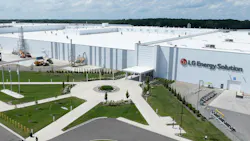
According to a company release, the Michigan plant is aiming to reach more than 35 GWh of annual battery-making capacity at full-scale production. LG’s cells are integrated by its U.S. energy storage division, LG Energy Solution Vertech, for utility and other grid-scale storage applications.
As U.S. power demand grows, LG-produced energy storage batteries at the Lansing plant will help area utilities like Detroit's DTE Energy store and dispatch energy more reliably across the grid.
“Domestic battery production is foundational to America's energy future—reducing dependence on foreign adversaries, driving good-paying American jobs and advancing the American Energy Dominance Agenda," said Secretary of the Interior Doug Burgum in a statement.
Subscribe Free to ET's Transitions ENL
Three Updates Weekly on the C&I Energy Transition
ESS developers with mature pipelines are rapidly securing supply agreements with domestic manufacturers. Over the next two to four years, research firm Wood Mackenzie reported that sourcing components free from Foreign Entities of Concern is emerging as a critical market bottleneck behind this manufacturing momentum in the U.S.
Since 2022, LG has reportedly invested over $2 billion in the Lansing facility, with additional plans for a massive Arizona facility to begin manufacturing EV batteries later this year in the town of Queen Creek. The Queen Creek plant would cover more than 1.4 million square feet on a 109-acre site, according to town records.
QCells North America
Solar manufacturer Qcells expanded production at its Cartersville, Georgia, facility to build what it says is the first fully vertically integrated solar manufacturing operation in the U.S. According to the U.S. Department of Energy (DOE), it marks the largest U.S. ingot and wafer plant ever built and the first American factory to produce ingots, wafers, cells and panels under one roof in at least eight years.
In 2024, the DOE Loan Programs Office announced a $1.45 billion loan guarantee that supported and fully backed the development of Qcells’ solar supply chain facility. The clean energy company handles responsibilities for all pre-stage activities under engineering, procurement and construction (EPC) services before handing over the finished installation to its customers.
The Cartersville module assembly facility is producing about 16,700 panels daily at full capacity. Once solar cell production is fully operational, Qcells states the facility will produce 3.3 GW each of raw silicon ingots, wafers and functional solar cells, delivering 3.5 GW of modules a year.
With everything under one roof, Qcells establishes itself domestically as a premier hub, controlling every major step of the solar supply chain in a single location. By Q3 2026, the company states the Cartersville facility will help bring its total expected U.S. production output to 8.6 GW, equivalent to the energy needed to power roughly 1.3 million American homes for a year.
SEG Solar
Module manufacturer SEG Solar has completed its second Texas manufacturing facility in a little over two years. Following the completion of its $60 million 2-GW Houston plant in 2024, SEG celebrated the opening of its 4-GW Tomball PV module manufacturing facility in August.
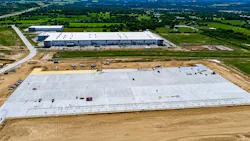
The more than 500,000-square-foot facility represents an investment of reportedly $200 million. SEG’s Tomball plant features four advanced production lines dedicated to manufacturing next-gen heterojunction technology (HJT). Silicon heterojunction solar cells are composed of three layers of photovoltaic (PV) material.
"Seeing another SEG manufacturing facility stand on American soil is a proud moment for all of us," said founder Jun Zhuge of SEG in a statement. "The rapid growth of artificial intelligence and data centers is driving unprecedented demand for reliable electricity and accelerating the need for new energy infrastructure.”
SEG’s latest facility, which comes ahead of its third plant planned in the greater Houston area, is expected to bring its annual U.S. module manufacturing capacity to 10.6 GW. The 1.15 million-square-foot facility, targeted for May 2027, will support its growing transition into next-gen HJT.
State of Market Report: Power Quality Fluctuations
New White Paper by Ubicquia
About the Author
 Eric Moody