LNG Developer Glenfarne Celebrates $50B (or so?) in South Korean Investment for Alaskan Export Terminal
Key Highlights
- The project includes an 807-mile pipeline from North Slope fields to a coastal terminal capable of exporting nearly 20 million metric tons of LNG annually.
- Glenfarne has secured preliminary LNG supply deals with Asian countries, including Japan, Korea, Taiwan, and Thailand, totaling about 11 million metric tons per year.
- Final investment decisions and construction timelines are still pending, with the goal of completing the LNG terminal by the early 2030s.
- South Korea imports a majority of its fossil-fuel energy and plans to invest nearly $1 trillion in AI and digital infrastructure capacity over the coming decade.
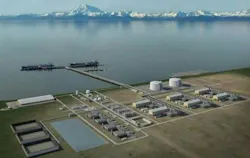
South Korea investors will bring more than $50 billion in additional capital—or maybe less than that, depending on future decisions—to fund a developing liquified natural gas (LNG) project in Alaska.
Alaska LNG developer and owner Glenfarne Group this week celebrated the announcement by President Trump of $50 billion-plus in new investment led by the South Korean government, according to the president. At the same time, South Korea’s Industry Ministry has contested some of the details in that announcement.
Either way, even a sizable portion of that financing would be key to Glenfarne’s ambitions for building out the natural gas liquefaction and export terminal along the Alaskan coast. A final investment decision and construction still awaits before starting construction and completing the LNG terminal by the early 2030s.
“We came to Alaska to build this project, and every decision we make starts with what will move us closer to delivering affordable, reliable gas and long-term economic benefits for Alaskans,” Glenfarne Group Brendan Duval said in a statement. “Today’s announcement brings together the capital needed to accelerate Alaska LNG to a final investment decision and construction. We are ready to deliver on the opportunity Alaska LNG represents for Alaska and the United States.”
If fully realized, the Alaska LNG project would include an 807-mile pipeline delivering natural gas from the North Slope fields to a coastal terminal processing close to 20 million metric tons of LNG annually. The U.S. is the world’s largest exporter of LNG and has gained customers around the world.
The Wall Street Journal reported that the South Korean government said it hadn’t agreed on a dollar figure yet, despite the Trump Administration’s public announcement.
South Korea exports close to 98% of its fossil-fuel needs, according to the U.S. Energy Information Administration. Considered a global top 20 economy, South Korea also plans to invest nearly $1 trillion in artificial intellience and digital infrastructure, including some 10 GW of AI-enabled data center capacity by 2035.
Late last year, Glenfarne reported it had secured preliminary commercial LNG supply deals with customers from Japan, Korea, Taiwan and Thailand totaling close to 11 million metric tons per year. Glenfarne also finalized a deal with steel producer POSCO International Corp. to build the Alaska LNG Project terminal along the Pacific Coast.
The U.S. began commercial exporting domestic natural gas as LNG in 2016 and has become the world’s largest exporter with more than 15 billion cubic feet per day of capacity as of this summer. LNG is natural gas chilled to liquify it and make it stable for shipping.
Most of the nation’s biggest LNG liquefaction and export terminals are located along the Louisiana and Texas coastlines with the Gulf of Mexico. These include Cheniere Energy’s Sabine Pass, which moves close to 29 million metric tons of LNG annually, to the Freeport, Corpus Christi and Calcasieu Pass terminals operated, respectively, by Zachary Hastings, Sempra Energy and Venture Global LNG.
Statistics from the state-formed Alaska Gasline Development Corp. estimate the North Slope fields contain close to 35 trillion cubic feet of proved natural gas reserves, plus another 200 trillion cubic feet in potential reserve with advanced technology.
“These resources make the project viable for the long term,” the AGDC website reads. “Alaska will continue to be a world-class leader in supplying energy resources to the global economy for ages.”
Better Midstream Decisions Start with Better Data
New White Paper from Siemens
About the Author
 Rod Walton, EnergyTech Managing Editor
Rod Walton, EnergyTech Managing Editor
Managing Editor
For EnergyTech editorial inquiries, please contact Managing Editor Rod Walton at [email protected].
Rod Walton has spent 17 years covering the energy industry as a newspaper and trade journalist. He formerly was energy writer and business editor at the Tulsa World. Later, he spent six years covering the electricity power sector for Pennwell and Clarion Events. He joined Endeavor and EnergyTech in November 2021.
Walton earned his Bachelors degree in journalism from the University of Oklahoma. His career stops include the Moore American, Bartlesville Examiner-Enterprise, Wagoner Tribune and Tulsa World.
EnergyTech is focused on the mission critical and large-scale energy users and their sustainability and resiliency goals. These include the commercial and industrial sectors, as well as the military, universities, data centers and microgrids. The C&I sectors together account for close to 30 percent of greenhouse gas emissions in the U.S.
He was named Managing Editor for Microgrid Knowledge and EnergyTech starting July 1, 2023
Many large-scale energy users such as Fortune 500 companies, and mission-critical users such as military bases, universities, healthcare facilities, public safety and data centers, shifting their energy priorities to reach net-zero carbon goals within the coming decades. These include plans for renewable energy power purchase agreements, but also on-site resiliency projects such as microgrids, combined heat and power, rooftop solar, energy storage, digitalization and building efficiency upgrades.