Fermi America and Hyundai E&C Take Early Steps Toward Nuclear-Powered AI Campus in West Texas
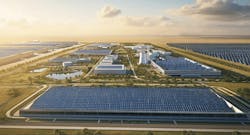
A data center developer and off-grid energy project startup co-founded by former U.S. Energy Secretary Rick Perry is expanding its vision of a massive computing campus in west Texas to include future nuclear power generation.
Fermi America has brought Hyundai Engineering & Construction into the fold to handle front-end engineering design (FEED) for the planned Project Matador outside Amarillo, Texas. Project Matador is proposed as an 11-GW private energy, data center and artificial intelligence (AI) computing site.
Hyundai E&C is handling FEED duties to support future installation of four Westinghouse AP1000 reactor units which are planned for Project Matador. Nuclear energy would offer baseload and carbon-free power with high-capacity factors, but Fermi is also anticipating installation of off-grid gas-fired power units and solar panels.
"AI-driven load growth is accelerating faster than most people realize," said Mesut Uzman, Chief Nuclear Construction Officer of Fermi America and CEO of Fermi Nuclear, in a statement. "The next decade will be defined by those who can build power infrastructure fast enough to support AI and industrial growth."
Fermi America and Hyundai E&C are moving ahead with FEED activities including site layout planning, cooling system evaluations, and cost and schedule development. The efforts are intended to strengthen project readiness and support progress toward a potential engineering, procurement, and construction (EPC) pathway.
"It's a very short line of companies eager to do nuclear here in America," said Toby Neugebauer, CEO and Co-Founder of Fermi America. "The list is even shorter when you consider the projects with a COL (combined license) accepted for review, active NRC (U.S. Nuclear Regulatory Commission) engagement, and a highly characterized site that are ready to break ground this year.”
Fermi America was co-founded by a team that includes American private equity investor Neugebauer and Perry, who was the energy secretary in President Donald Trump’s first administration and Texas governor from 2000 to 2015. The company is named after Italian physicist Enrico Fermi, who played a significant role in the Manhattan Project to develop nuclear power during World War II.
The proposed first phase of the Amarillo project plans to connect six Siemens Energy SGT800 gas-fired turbines and one SST600 steam turbine to deliver about 478 MW of co-located and combined heat and power for the proposed AI campus in the Texas Panhandle.
Earlier this month, Fermi America announced it had secured a $500 million financing commitment from MUFG Bank to fund acquisition of the Siemens Energy gas turbines.
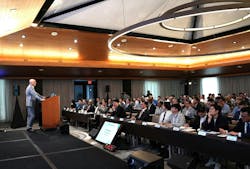
As a sign of its nuclear commitment, Fermi America participated in Hyundai E&C's Large-Scale Nuclear Technology Seminar at The Westin Dallas Downtown on February 10. The event brought together leaders from across the U.S. construction and nuclear sectors for sessions to build large-scale nuclear projects in today's market.
The seminar covered construction disciplines and execution topics including nuclear construction standards, modular construction concepts and procedures, mechanical installation disciplines, specialized nuclear construction works, heavy lifting, nuclear plant building systems, and workforce development and training for skilled nuclear personnel. Texas-based construction companies and stakeholders across the U.S. nuclear and construction sectors participated in the event.
Only one utility-scale nuclear project—the Vogtle 3 and 4 expansions in Georgia—has been constructed in the U.S. over the past decade due to high project expenses and previous flat load growth. The rising demand from AI, cloud-based computing and industrial electrification is motivating a nationwide push for more nuclear capacity, including small modular reactors.
The Texas Commission on Environmental Quality (TCEQ) has preliminarily approved plans for an initial 6 GW in off-grid natural gas power for the project.
Paralyzed by Digital Transformation? Start Here
March 10 Webinar on Creating Value from Digital Complexity
Led by Siemens and Presented by EnergyTech.com
About the Author

Rod Walton, EnergyTech Managing Editor
Managing Editor
For EnergyTech editorial inquiries, please contact Managing Editor Rod Walton at [email protected].
Rod Walton has spent 17 years covering the energy industry as a newspaper and trade journalist. He formerly was energy writer and business editor at the Tulsa World. Later, he spent six years covering the electricity power sector for Pennwell and Clarion Events. He joined Endeavor and EnergyTech in November 2021.
Walton earned his Bachelors degree in journalism from the University of Oklahoma. His career stops include the Moore American, Bartlesville Examiner-Enterprise, Wagoner Tribune and Tulsa World.
EnergyTech is focused on the mission critical and large-scale energy users and their sustainability and resiliency goals. These include the commercial and industrial sectors, as well as the military, universities, data centers and microgrids. The C&I sectors together account for close to 30 percent of greenhouse gas emissions in the U.S.
He was named Managing Editor for Microgrid Knowledge and EnergyTech starting July 1, 2023
Many large-scale energy users such as Fortune 500 companies, and mission-critical users such as military bases, universities, healthcare facilities, public safety and data centers, shifting their energy priorities to reach net-zero carbon goals within the coming decades. These include plans for renewable energy power purchase agreements, but also on-site resiliency projects such as microgrids, combined heat and power, rooftop solar, energy storage, digitalization and building efficiency upgrades.