European Commission Joins Next-Gen Nuclear Push for SMR Commercial Development
Key Highlights
- - The EU plans to invest €200 million to support the development and deployment of small modular reactors (SMRs) across Europe.
- - Global efforts, including US and Chinese projects, are accelerating the commercialization of next-generation nuclear reactors, driven by technological innovation and rising energy demands.
- - The EU's structured framework targets early 2030s for deploying commercial SMR projects, aligning with international trends toward cleaner, reliable energy sources.
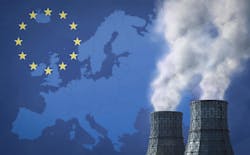
The executive cabinet of the European Union is committing that continent to future work on commercial next-gen nuclear reactors.
The European Commission issued strategies aimed at developing small modular reactor (SMR) projects in Europe over the next decade and beyond. The commission is ready to start with 200 million Euros (or $230 million US) of investment in support of an initial SMR rollout for commercial power plants.
“The publication of the SMR strategy is a clear recognition of the important role which SMRs will play in Europe.” Emmanuel Brutin, director-general of Brussels-based trade association nucleareurope, said in a statement. “We welcome, in particular, the proposal to establish an additional temporary InvestEU top-up of (approximately) $230.12 million to further support the deployment of the initial commercial units of innovative nuclear technologies. However more financial support will be needed given the investments required in all nuclear technologies, including lifetime extension and new large reactors.”
InvestBU, formerly known as European Fund for Strategic Investments, is a joint effort of the European Investment Bank and the EV to mobilize private financing for critical projects.
Building structured framework for SMR nuclear commercial development
The European Commission SMR strategy will push for building an industrial next-gen nuclear ecosystem, develop a competitive EU supply chain and create skilled jobs across the ecosystem. SMRs are next-gen reactors design to generate at 300 MW or less, and use passive safety features while offering potential of less expensive projects compared to conventional nuclear.
Nuclear power plants produce baseload, carbon-free generation and account for close to 9% of global utility-scale electricity (18% in the U.S. and 23% in Europe). The world has several hundred conventional-scale nuclear reactors, but no SMR projects so far have entered operation except in Russia and China, according to reports.
The EC strategy sets a structured framework for deploying commercial SMR projects in the early 2030s. It also encourages a key role involving the European Industrial Alliance on SMRs, which includes nucleareurope as a partner.
In the U.S., both the Biden and Trump Administrations announced and supported acceleration of SMR technologies. President Trump issued an executive order pushing for next-gen nuclear development, while his administration's Department of Energy chose nearly a dozen startup SMR projects to fast-track pathways to criticality and, eventually, commercialization.
“Nuclear energy both is vital to this effort and has never held so much promise,” reads the president’s executive order posted in May 2025. “Decades of research and engineering have produced prototypes of advanced nuclear technologies that incorporate passive safety mechanisms, improve the physical architecture of reactor designs, increase reactor operational flexibility and performance, and reduce risk in fuel disposal.
“Advanced reactors — including microreactors, small modular reactors, and Generation IV and Generation III+ reactors — have revolutionary potential,” the presidential executive order continued. “They will open a range of new applications to support data centers, microchip manufacturing, petrochemical production, healthcare, desalination, hydrogen production, and other industries.”
AI, industrial automation and load growth impetus for SMR rise
Chemical conglomerate Dow is working with SMR designer X-energy to install a reactor powering its Seadrift manufacturing operation along the Texas Gulf Coast. That project and several other U.S. SMR designs are under review by the Nuclear Regulatory Commission.
Rising global artificial intelligence use, cloud-based computing, industrial automation and transportation electrification are all factors driving the need for expanding power generation capacity to meet growing demand.
Nuclear power plants deliver the highest capacity factor of any electricity generation resource, according to reports. The capacity factor—which is the percentage of time generating units are able to function at capacity—is close to 90% for U.S. reactors.
A New Era of Energy Efficiency: Innovations for Today and Tomorrow
New EnergyTech White Paper by Ameresco
About the Author

Rod Walton, EnergyTech Managing Editor
Managing Editor
For EnergyTech editorial inquiries, please contact Managing Editor Rod Walton at [email protected].
Rod Walton has spent 17 years covering the energy industry as a newspaper and trade journalist. He formerly was energy writer and business editor at the Tulsa World. Later, he spent six years covering the electricity power sector for Pennwell and Clarion Events. He joined Endeavor and EnergyTech in November 2021.
Walton earned his Bachelors degree in journalism from the University of Oklahoma. His career stops include the Moore American, Bartlesville Examiner-Enterprise, Wagoner Tribune and Tulsa World.
EnergyTech is focused on the mission critical and large-scale energy users and their sustainability and resiliency goals. These include the commercial and industrial sectors, as well as the military, universities, data centers and microgrids. The C&I sectors together account for close to 30 percent of greenhouse gas emissions in the U.S.
He was named Managing Editor for Microgrid Knowledge and EnergyTech starting July 1, 2023
Many large-scale energy users such as Fortune 500 companies, and mission-critical users such as military bases, universities, healthcare facilities, public safety and data centers, shifting their energy priorities to reach net-zero carbon goals within the coming decades. These include plans for renewable energy power purchase agreements, but also on-site resiliency projects such as microgrids, combined heat and power, rooftop solar, energy storage, digitalization and building efficiency upgrades.