Once Ill-Fated California Nuclear Plant Now On Track to Generate for Two More Decades
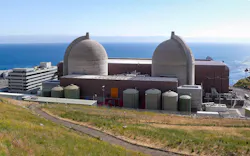
Diablo Canyon Power Plant has gained a new lease on operational life, about 10 years after it was originally marked for shutdown.
The U.S. Nuclear Regulatory Commission (NRC) has approved a 20-year license renewal application for extending operations at the 2.2-GW Diablo Canyon in San Luis Obispo County. Utility owner and operator Pacific Gas and Electric applied for the license extension of the 40-year nuclear facility that at one time was being forced to close.
In 2016, PG&E was preparing for the eventual closure of Diablo Canyon, California’s final operational reactor units, after the state called for an end to nuclear generation.
In the decade since, however, Diablo Canyon and other U.S. reactors found renewed favor for their baseload and carbon-free generation capacity in this new era of data center, artificial intelligence and industrial automation technology load.
Under the initial state plans, Diablo Canyon would have been retired by now. With the NRC approvals it should be licensed to operate until at least the 2040s.
"Throughout the license renewal process and our more than 40-year history, we've demonstrated our constant commitment to operating Diablo Canyon with safety at the forefront," said PG&E senior vice president and Chief Nuclear Officer Paula Gerfen in a statement. "It's a privilege to continue powering California's clean energy future, and we realize we must earn the right to do so every day by operating at the highest levels of safety, performance and reliability."
Diablo Canyon’s two Westinghouse 4-loop pressurized water reactors generate about 1.1 GW each at capacity. Annually the plant averages 18,000 GWh of electricity which is nearly one-tenth of California’s total and nearly one-fifth of its emissions-free generation in the state, according to reports.
The NRC's approval determined that Diablo Canyon is safe and environmentally feasible to operate for another 20 years, though extending operations past 2030 will require the California Legislature’s consent. The three-year license renewal process also included approvals from state and regional agencies including the California Public Utilities Commission, the State Lands Commission, the California Coastal Commission and the Central Coast Regional Water Quality Control Board.
It was state officials more than 10 years ago, in the wake of rising generation costs and the meltdown at Japan’s Fukushima nuclear plant, who decided to force retirement of California’s two reactor stations in San Onofre and Diablo Canyon. Other states did the same in planning retirements for units such as Three Mile Island 1 in Pennsylvania, Duane Arnold in Iowa and Clinton in Illinois.
"I am sorry to see it go, because from a national energy policy standpoint, we need greenhouse gas-free electricity", then PG&E CEO Anthony Earley said in media reports around 2016. "But we are regulated by the state of California, and California's policies are driving this."
During that period safety concerns and the lowering prices for renewables installation, plus the rise of cheaper natural gas, drove the movement for shutting down many of the nation’s nuclear units. It was also a period of forecasted flat load growth.
Since then, the rise of AI, cloud-based computing, industrial and transportation electrification has joined with the reshoring of manufacturing to create a potential generation capacity crisis in the U.S. The presumed lack of future power is driving many Big Tech companies to finance behind-the-meter and off-grid projects to support AI and cloud-based computing.
The North American Electric Reliability Council (NERC), PJM Interconnection and others have warned that power generation infrastructure is lagging demand growth.
“NERC finds that 13 of 23 assessment areas face resource adequacy challenges over the next 10 years,” reads the report executive summary. “Projections for resource and transmission growth lag what is needed to support new data centers and other large loads that drive escalating demand forecasts. Most new resources in development to come on-line in the next five years consist of battery storage and solar photovoltaic (PV), which are inverter-based and weather-dependent resources that increase the complexity of planning and operating a reliable grid.”
The federal executive branch in both the Biden and Trump Administrations instituted new support for reviving legacy nuclear generation and promoting next-gen small modular reactors.
Diablo Canyon’s two units were planned for retirement in 2024 and 2025. The 2020 heat wave which necessitated statewide rotating power outages also motivated California lawmakers to pass new legislation directing the plant to run at least through 2030.
PG&E submitted its license renewable application to the NRC in 2023.
The U.S. has more than 90 operating nuclear reactors units which together account for about 18% of total utility-scale generation. Those nuclear plants also account for about half of carbon-free generation nationwide.
Only one utility-scale nuclear energy project has been built and commissioned in the U.S. over the past decade. Two years ago, Georgia Power finally completed work on its Vogtle 3 and 4 expansion which cost close to $33 billion and took nearly a decade to complete.
About the Author

Rod Walton, EnergyTech Managing Editor
Managing Editor
For EnergyTech editorial inquiries, please contact Managing Editor Rod Walton at [email protected].
Rod Walton has spent 17 years covering the energy industry as a newspaper and trade journalist. He formerly was energy writer and business editor at the Tulsa World. Later, he spent six years covering the electricity power sector for Pennwell and Clarion Events. He joined Endeavor and EnergyTech in November 2021.
Walton earned his Bachelors degree in journalism from the University of Oklahoma. His career stops include the Moore American, Bartlesville Examiner-Enterprise, Wagoner Tribune and Tulsa World.
EnergyTech is focused on the mission critical and large-scale energy users and their sustainability and resiliency goals. These include the commercial and industrial sectors, as well as the military, universities, data centers and microgrids. The C&I sectors together account for close to 30 percent of greenhouse gas emissions in the U.S.
He was named Managing Editor for Microgrid Knowledge and EnergyTech starting July 1, 2023
Many large-scale energy users such as Fortune 500 companies, and mission-critical users such as military bases, universities, healthcare facilities, public safety and data centers, shifting their energy priorities to reach net-zero carbon goals within the coming decades. These include plans for renewable energy power purchase agreements, but also on-site resiliency projects such as microgrids, combined heat and power, rooftop solar, energy storage, digitalization and building efficiency upgrades.