3,000 Shots Closer to Commercial Fusion? Livermore National Lab Touts Pulse Energy Breakthrough
Key Highlights
- - The innovative IMG system stacks pulses to deliver 60 GW in a 100-nanosecond pulse, demonstrating high power output.
- - Reliable components capable of lasting 30 years and 3,000 shots are key to future fusion accelerator development.
- - Achieving 60 GW could generate enough electricity for over 30 million homes, marking a significant step toward clean energy solutions.

Nuclear fusion researchers at Lawrence Livermore National Laboratory are celebrating what they contend is a milestone in pulsed-power achieving thousands of high-voltage electrical discharges to release stored energy.
These could prove to be a critical step toward scaling high-density, low-carbon energy from the pulsed power prototype designed and built at the national lab in Livermore, California. Is this the pathway to eventual commercial fusion energy?
Time will tell down that long and winding road, but researchers with the national lab and its private industry partner are feeling “siriusly” good about the breakthrough.
"Credible shot at high-yield fusion this decade"
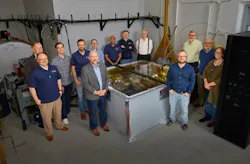
The Sirius prototype, called a four-stage prototype impedance-matched Marx generator, or IMG, brings together Livermore National Lab researchers and commercial energy developer Pacific Fusion. LLNL and the company say they achieved 3,000 shots, or that many high-voltage electrical discharges, which is reportedly a record output for fusion experimentation.
“This is a concrete example of what government-industry collaboration can deliver when both sides are committed,” said Keith LeChien, co-founder and chief technology officer of Fremont-Calif.-based Pacific Fusion, in a statement. “We are taking innovation from the lab and moving quickly to build and scale systems that serve America’s needs. The result is a credible shot at high-yield, high-gain fusion this decade — and a path to turning U.S. scientific leadership into a critical capability that will keep the U.S. ahead of China.”
From zero to 60 GW in 100 nanoseconds

The IMG was co-invented by LeChien and Livermore National Lab researcher Bill Stygar. The engineered innovation in the IMG is to stack waves using a pulser by charging capacitors in parallel and then discharging them in a single step onto a transmission line.
According to Pacific Fusion and Livermore National Lab, the pulses achieved in the Sirius experiment delivered 60 GW to a resistive load in a 100-nanosecond pulse.
“For a future IMG-powered accelerator concept, reliability is a key requirement,” Stygar said. “Such systems could need components capable of operating over long service lives, potentially at up to 100 shots per year for 30 years. We needed to show that our components could last 3,000 shots and that their reliability was high enough for a next-generation machine.”
Nuclear fusion is a sort of a holy grail for next-gen power generation, trying to replicate the lasting power process of the sun under controlled circumstances to create utility-scale power with zero carbon emissions. Conventional nuclear fission, the reaction which powers all 94 U.S. commercial reactor plants and nearly 20% of the nation’s electricity mix, creates energy by splitting the nuclei/ The work at Livermore, Pacific Fusion and other startups is focused on fusing the nuclei in an energy-dense plasma containing deuterium, tritium and helium, among other possible isotropes.
The collaboration between Livermore National Lab (LLNL) and Pacific Fusion is managed through the Livermore Institute for Fusion Technology (LIFT).
"We are at a unique moment in time when science and technology advances have made the possibility of commercial fusion energy very real,” LLNL Director Kim Budil said in a statement on the LIFT web page. “LIFT is being created to enable the growing fusion energy industry to leverage our unique expertise and capabilities in fusion and high-energy density science to catalyze innovation and accelerate their path to commercialization. This is a place where our critical national security missions and the goal of energy dominance are truly aligned."
The U.S. Department of Energy is squarely in support of not only current nuclear capacity but also creating a regulatory and financial path for eventual fusion success. The Fusion Science and Technology (FS&T) Road Map got its first public share last year at the U.S. Fusion Energy Enterprise Event in Washington D.C. Prior to that, DOE contributed $134 million in funding for fusion development programs for national laboratories as well as private startups such as Tokamak Energy, Stellerax, Commonwealth Fusion Systems and others.
LIvermore National Lab also has collaborated with Amazon Web Services on integrating generative models into energy work.
Last year, Google committed to a 200-MW offtake agreement with Commonwealth Fusion Systems once the latter’s power plant is built and commissioned in Virginia.
“By entering into this agreement with CFS, we hope to help prove out and scale a promising pathway toward commercial fusion power,” Michael Terrell, head of advanced energy at Google, said in a statement announcing the deal last summer. “We’re excited to make this longer-term bet on a technology with transformative potential to meet the world’s future energy demand, and support CFS in their efforts to reach the scientific and engineering milestones needed to get there.”
Sixty-gigawatt capacity is the equivalent of about 60 commercial nuclear fission reactor units. If contained and controlled, that could be enough electricity for more than 30 million homes and thousands of commercial properties.
About the Author
 Rod Walton, EnergyTech Managing Editor
Rod Walton, EnergyTech Managing Editor
Managing Editor
For EnergyTech editorial inquiries, please contact Managing Editor Rod Walton at [email protected].
Rod Walton has spent 17 years covering the energy industry as a newspaper and trade journalist. He formerly was energy writer and business editor at the Tulsa World. Later, he spent six years covering the electricity power sector for Pennwell and Clarion Events. He joined Endeavor and EnergyTech in November 2021.
Walton earned his Bachelors degree in journalism from the University of Oklahoma. His career stops include the Moore American, Bartlesville Examiner-Enterprise, Wagoner Tribune and Tulsa World.
EnergyTech is focused on the mission critical and large-scale energy users and their sustainability and resiliency goals. These include the commercial and industrial sectors, as well as the military, universities, data centers and microgrids. The C&I sectors together account for close to 30 percent of greenhouse gas emissions in the U.S.
He was named Managing Editor for Microgrid Knowledge and EnergyTech starting July 1, 2023
Many large-scale energy users such as Fortune 500 companies, and mission-critical users such as military bases, universities, healthcare facilities, public safety and data centers, shifting their energy priorities to reach net-zero carbon goals within the coming decades. These include plans for renewable energy power purchase agreements, but also on-site resiliency projects such as microgrids, combined heat and power, rooftop solar, energy storage, digitalization and building efficiency upgrades.