Georgia Power is Expanding its Nuclear Capacity, and Google is Paying for Much of the Uprate
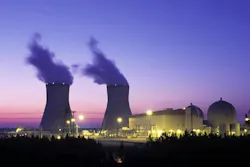
Baseload and carbon-free power come at a premium these days, and apparently Google is willing to pay nearly $1 billion for it.
The search engine and AI development giant will help finance a $900 million deal to expand Georgia Power’s Vogtle and Hatch nuclear stations by 96 MW in additional or uprated capacity, according to the companies. The deal still requires Georgia regulatory approval in a request for a new extended power uprate (EPU) at Plant Hatch, with an EPU for Plant Vogtle Units 1 and 2 already approved by the state’s Public Service Commission.
This utility-scale agreement follows earlier long-term power purchase agreements by data center hyperscalers such as Microsoft, Google and Meta to pursue next-gen nuclear or even restart retired reactor units.
Nuclear power plants can operate with high-capacity factors while not generating carbon emissions. They only must be refueled every 18 months or so.
"Many of our large customers have specific clean energy goals, and we continue to work with the Georgia PSC to create programs that not only help them meet their goals, but align with our Customer Protection Pledge, enhancing the reliability and resiliency of the power grid and creating savings for all customers," said Aaron Mitchell, Senior Vice President of Strategic Growth for Georgia Power, in a statement. "We appreciate Google's continued leadership in this space and partnership in developing this program, which we see as the latest example of how large-load growth can benefit all electric customers."
Google is helping pay for the nuclear uprate (NU) itself through what is called a subscription-based program. For example, Google will subscribe to a new NU-1 tariff and receive Zero-Emissions Credits (ZECs) from the carbon-free environmental attributes of nuclear power generation.
The tech giant does not reveal specific GW-scale of its data center infrastructure, but it has multiple computing facilities in Georgia. Data Centre Magazine ranks Google Cloud as the No. 3 biggest hyperscaler across digital infrastructure, just behind Amazon Web Services and Microsoft.
Plant Vogtle’s first two units were commissioned in the late 1980s and generate close to 1.15 GW each. Georgia Power led a decade-long and more than $30 billion expansion to build and complete Units 3 and 4 earlier this decade, bringing the Plant Vogtle total generation capacity to more than 4 GW.
About the Author
 Rod Walton, EnergyTech Managing Editor
Rod Walton, EnergyTech Managing Editor
Managing Editor
For EnergyTech editorial inquiries, please contact Managing Editor Rod Walton at [email protected].
Rod Walton has spent 17 years covering the energy industry as a newspaper and trade journalist. He formerly was energy writer and business editor at the Tulsa World. Later, he spent six years covering the electricity power sector for Pennwell and Clarion Events. He joined Endeavor and EnergyTech in November 2021.
Walton earned his Bachelors degree in journalism from the University of Oklahoma. His career stops include the Moore American, Bartlesville Examiner-Enterprise, Wagoner Tribune and Tulsa World.
EnergyTech is focused on the mission critical and large-scale energy users and their sustainability and resiliency goals. These include the commercial and industrial sectors, as well as the military, universities, data centers and microgrids. The C&I sectors together account for close to 30 percent of greenhouse gas emissions in the U.S.
He was named Managing Editor for Microgrid Knowledge and EnergyTech starting July 1, 2023
Many large-scale energy users such as Fortune 500 companies, and mission-critical users such as military bases, universities, healthcare facilities, public safety and data centers, shifting their energy priorities to reach net-zero carbon goals within the coming decades. These include plans for renewable energy power purchase agreements, but also on-site resiliency projects such as microgrids, combined heat and power, rooftop solar, energy storage, digitalization and building efficiency upgrades.