Global Wind Power Expansion Surges Despite U.S. Setbacks
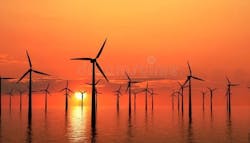
At a time when the Trump Administration is stopping development of both onshore and offshore wind power in the U.S., multiple utility-scale wind projects are progressing elsewhere around the globe.
Turbine producer GE Vernova signed an agreement with Greenvolt Power to supply the Gurbanesti wind farm in Romania. This follows GE Vernova’s contract to supply 42 turbines for the Lalomita wind farm also in Romania.
Around the same time, EDF and Énergie Renouvelable Granit Inc. successfully closed construction and term financing for the 124-MW Haute-Chaudière Wind project in Quebec, Canada. Altogether, the three projects in Europe and Canada total more than 600 MW of new wind power capacity at a time when nations are seeking more utility-scale capacity to meet demands from data center and industrial computing development.
“Securing this financing is a powerful demonstration of confidence in the Haute-Chaudière project and our partnership with the local communities,” Amy Lloyd, CFO at EDF power solutions North America, in a statement about the Quebec wind farm construction. “This project will not only add significant low-carbon capacity to the Hydro-Québec grid, but will also deliver substantial, long-term economic benefits directly to the region. Further, this financing marks the first construction financing for EDF power solutions Canada in nearly a decade, paving the way for future transactions.”
In the U.S., meanwhile, President Trump issued an executive order earlier this year temporarily withdrawing all areas of the outer continental shelf from offshore wind leasing. Trump’s Department of Interior even stopped work orders on the Revolution Wind offshore project despites previous approval and construction work by developers Ørsted and Skyborn Renewables was already 80% completed.
The White House temporary order cited various factors as justifying the withdrawal of permissions, from concerns about marine life to ocean currents, fishing and energy affordability. The administration, however, also said the “withdrawal does not apply to leasing related to any other purposes such as, but not limited to, oil, gas, minerals, and environmental conservation.”
China leads the world in total installed wind turbine capacity at about 522 GW, more than three times the U.S. wind power. Denmark, Scotland and Latvia are quickly expanding wind capacity as a percentage of their power generation resources.
Canada, meanwhile, has added more than 4 GW of utility-scale wind power to its generation portfolio. Its wind capacity grew 35% in the previous five years, according to the Canadian Renewable Energy Association.
The Trump Administration’s Department of Energy also has reversed about $7.6 billion worth of previously approved federal loan guarantees for decarbonizing energy projects such as carbon capture and renewables.
Global Battery Storage Race is On?
E-Book on Battery Chemistry and Competition from EnergyTech
About the Author

Rod Walton, EnergyTech Managing Editor
Managing Editor
For EnergyTech editorial inquiries, please contact Managing Editor Rod Walton at [email protected].
Rod Walton has spent 17 years covering the energy industry as a newspaper and trade journalist. He formerly was energy writer and business editor at the Tulsa World. Later, he spent six years covering the electricity power sector for Pennwell and Clarion Events. He joined Endeavor and EnergyTech in November 2021.
Walton earned his Bachelors degree in journalism from the University of Oklahoma. His career stops include the Moore American, Bartlesville Examiner-Enterprise, Wagoner Tribune and Tulsa World.
EnergyTech is focused on the mission critical and large-scale energy users and their sustainability and resiliency goals. These include the commercial and industrial sectors, as well as the military, universities, data centers and microgrids. The C&I sectors together account for close to 30 percent of greenhouse gas emissions in the U.S.
He was named Managing Editor for Microgrid Knowledge and EnergyTech starting July 1, 2023
Many large-scale energy users such as Fortune 500 companies, and mission-critical users such as military bases, universities, healthcare facilities, public safety and data centers, shifting their energy priorities to reach net-zero carbon goals within the coming decades. These include plans for renewable energy power purchase agreements, but also on-site resiliency projects such as microgrids, combined heat and power, rooftop solar, energy storage, digitalization and building efficiency upgrades.