Vermont Gas Utility Pioneering Geothermal as a Service for Affordable Housing Project
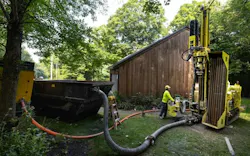
Geothermal is coming home, so to speak, as a Vermont natural gas utility embraces a type of energy-as-a-service model to bring renewable subterranean heating and cooling energy to an affordable housing project under development in the Green Mountain State.
Geothermal thermal developer Dandelion Energy and utility Vermont Gas Services are teaming up to deliver geothermal capacity through newly drilled infrastructure to serve the Riggs Meadow addition planned in Hinesburg.
Riggs Meadow will include 44 town homes and apartments designed for low- and moderate-income renters and owners. Vermont Gas Services (VGS) is working with real estate developers Champlain Housing Trust and Evernorth to integrate the planned housing with geothermal infrastructure.
What’s so unique about the Riggs Meadow-geothermal connection is a business model somewhat like the “energy-as-service” provided by microgrid developers, in which they bear the upfront and long-term operations cost and responsibilities of the geothermal infrastructure and energy delivery.

Calling this a “first-in-the-nation partnership,” VGS president and CEO Neale F. Lunderville said the utility will finance, own and maintain the underground geothermal infrastructure as a utility asset. Customers will simply pay for the service monthly.
“Geothermal’ s upfront costs, including drilling and equipment, are a barrier for affordable housing developers,” Lunderville pointed out. “Most cannot absorb these expenses, which has kept developers and their eventual residents locked into conventional heating and cooling systems.
“This treats thermal infrastructure like a traditional gas main,” Lunderville added. “It mirrors the simplicity of hooking up to natural gas, a family and established model that developers and property owners value.”
Dandelion Energy will partner in its role as end-to-end geothermal system designer and driller. Geothermal captures underground temperatures which are steady and offer renewable heating for winter and cooling in summer.
“Each building has their own individual geothermal heat pump system that consists of a ground loop and heat pump,” Dandelion Energy CEO Dan Yates said in an emailed response to questions by EnergyTech.com. “A ground loop is a U-shaped plastic pipe buried in a borehole deep enough to reach consistent year-round temperatures (from 300 to 500 feet deep). It acts as a heat exchanger, allowing the geothermal heat pump to draw heat from the earth or release heat back into it. Temperatures below ground stay relatively steady, helping the system work efficiently through Vermont’s cold winters and hot summers.”
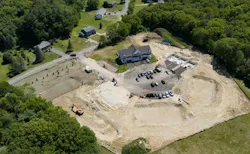
Dandelion Energy will begin drilling boreholes and ground loop installation by early 2027, Yates noted. The work will align with overall construction schedules in the Riggs Meadow housing.
Once ground loops are in, heat pump integration follows as the buildings and residences are framed out. The partners expect work to take about 12 to 15 months from start of drilling to beginning of geothermal service for customers.
VGS is funding its upfront costs through the Climate Action and Innovation program. Apartment customers will likely pay about $25 a month in a tariffed utility fee, with town halls charging perhaps $10 more per month.
The heat pumps also will be electric and raise those bills slightly, Lunderville noted.
“Shared thermal networks and district energy are widely adopted across Europe and parts of Canada, where energy policy has long supported collective heating infrastructure,” Dandelion Energy CEO Yates said. “In the U.S., it has historically been an individual, private homeowner investment, so this project is a game changer.”
Since 2017, Dandelion Energy has installed more than one million linear feet of ground loops and thousands of geothermal heat pumps across the U.S. VGS has close to 56,000 residential and business customers in its region of Vermont.
The United States leads the world in geothermal electricity capacity with about 4 GW, while federal Department of Energy analysis has revealed the potential for at least 300 GW of reliable, flexible geothermal power on the U.S. grid by 2050.
Artificial Lift Optimization Begins with Data-Not AI
New Research and White Paper by Siemens
About the Author
 Rod Walton, EnergyTech Managing Editor
Rod Walton, EnergyTech Managing Editor
Managing Editor
For EnergyTech editorial inquiries, please contact Managing Editor Rod Walton at [email protected].
Rod Walton has spent 17 years covering the energy industry as a newspaper and trade journalist. He formerly was energy writer and business editor at the Tulsa World. Later, he spent six years covering the electricity power sector for Pennwell and Clarion Events. He joined Endeavor and EnergyTech in November 2021.
Walton earned his Bachelors degree in journalism from the University of Oklahoma. His career stops include the Moore American, Bartlesville Examiner-Enterprise, Wagoner Tribune and Tulsa World.
EnergyTech is focused on the mission critical and large-scale energy users and their sustainability and resiliency goals. These include the commercial and industrial sectors, as well as the military, universities, data centers and microgrids. The C&I sectors together account for close to 30 percent of greenhouse gas emissions in the U.S.
He was named Managing Editor for Microgrid Knowledge and EnergyTech starting July 1, 2023
Many large-scale energy users such as Fortune 500 companies, and mission-critical users such as military bases, universities, healthcare facilities, public safety and data centers, shifting their energy priorities to reach net-zero carbon goals within the coming decades. These include plans for renewable energy power purchase agreements, but also on-site resiliency projects such as microgrids, combined heat and power, rooftop solar, energy storage, digitalization and building efficiency upgrades.