Fujifilm Offsetting 100% of North American Ops with Solar and Energy Storage Partnership
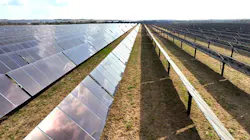
Document solutions and imaging firm Fujifilm recently announced that 100% of its corporate electricity usage in the U.S. and Canada will be offset through a new renewable energy partnership.
Fujifilm will support the generation of 300,000 MWh annually through renewable energy certificates from the Texas-based Blevins Solar & Storage Project. The move follows the company’s efforts to lower its global carbon footprint after a Virtual Power Purchase Agreement (VPPA) was made in November 2023.
Minnesota-based Geronimo Power completed construction on the 2,300-acre solar park in late 2025 and the site became fully operational in March.
This 270-MW solar/360-MWh battery storage project in Falls County, Texas, aims to displace an estimated 457,300 metric tons of human-produced carbon dioxide (CO2) emissions annually. According to the report, this is equivalent to more than 101,000 cars off the road for a year.
The project aligns with goals by Texas, which leads the country in total CO2 emissions per state, to reduce 592 million metric tons of greenhouse gas (GHG) emissions between 2025 and 2050 through its Priority Action Plan (PAP).
Along with displacing fossil-fuel generation from the nation’s energy grid systems, the Blevins Solar & Storage Project also looks to help impact the local economy of Falls County. These efforts surround job creation, annual contributions, and the anticipated tax revenue generated from the project during the first 20 years of operation.
FUJIFILM Holdings America Corporation, which has several U.S.-based offices, including its headquarters in Westchester County, New York, purchased roughly 46% of the project’s nameplate capacity from Geronimo Power. That’s estimated to be 125 MW of renewable energy attributes.
Those renewable energy certificates (RECs) under the VPPA will be accounted for as an offset to their emissions to help fund future project development. The VPPA customer does not receive the renewable energy directly, but its contractual commitment helps finance decarbonizing projects interconnected into the utility grid.
“As this project comes online, it aligns with Fujifilm's transition strategy, combining support for the development of new renewable electricity capacity with broader efforts to achieve measurable reductions in the environmental impacts of our operations over time,” said Fujifilm’s corporate vice president and general manager of Environmental, Social & Governance (ESG) Division, Chisato Yoshizawa, in a statement.
According to the agreement, Fujifilm estimates roughly 90,000 metric tons of CO2 emissions annually will be eliminated as a result of this project. This reportedly only accounts for about 10% of the Fujifilm Group’s global annual CO2 emissions.
The company looks to further target and address climate change through net-zero emissions goals by fiscal year 2030. These steps include reducing GHG emissions across the entire product life cycle by 50%.
Texas ranked second nationally with about 11 GW of newly installed solar capacity in 2025, according to statistics from the Solar Energy Industries Association. The Lone Star State is also second only to California in total installed solar at 52 GW.
Energy storage installed capacity statewide rose to 26 GWh in the same period, according to SEIA.
EnergyTech 2050: What Will Power the Future?
Take the Poll, Please