Decarbonizing Urban Thermal Infrastructure: How Vicinity Energy is Advancing US Sustainability Targets through eSteam

As organizations work to address major environmental hurdles and align with broader U.S. decarbonization objectives, companies like Vicinity Energy have spent decades managing urban energy infrastructure to help bridge financial gaps across multiple industry sectors.
That gap often stems from the large capital required for high-upfront facility retrofits and traditional building electrification. To avoid these costs, companies frequently defer the maintenance of legacy assets, further delaying vital renewable modernization.
But Vicinity Energy, headquartered in Boston, Massachusetts, operates district energy systems across 12 U.S. cities, powering many of these industries with renewable, carbon-free thermal energy through a unified underground network that differs from geothermal.
District energy systems, typically located on military bases, university, hospital or research campuses, are central plants that produce hot water. As the U.S. Department of Energy explains, steam and/or chilled water flows through a network of insulated pipes to provide hot water, space heating, and/or air conditioning for nearby buildings.
Major U.S. cities like New York, Boston, Philadelphia and San Francisco have district energy system infrastructure in place as a renewable resource to offset vital carbon-emission goals and help reduce energy costs through next-gen technology. Vicinity Energy’s eSteam product is generated through a mix of large-scale electrification technologies to create a renewable distributed energy resource for its customers.
Vicinity Energy is reportedly recognized as the largest overall owner and operator of district energy portfolios in the country. On Sept. 30, independent private equity firm Antin Infrastructure Partners agreed to sell a majority stake in Vicinity Energy to global investment management firm Harrison Street Asset Management, valued at $2.92 billion.
Next-gen thermal systems powering renewable footprint
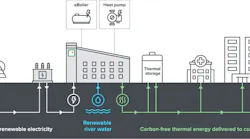
The company’s plant infrastructure includes electric boilers and industrial-scale heat pumps powered by off-peak renewable electricity. These heat pumps are paired with thermal storage systems (like molten salt batteries) that capture this generated heat to efficiently distribute eSteam while mitigating local grid stress during peak demand hours.

This eSteam process avoids drilling into the earth's crust, which is typically required in geothermal heating processes to tap into heated water temperatures deep underground miles below. Instead, Vicinity utilizes surface-water-source heat pumps, as done at their flagship Kendall Square complex in Cambridge, Massachusetts. In Cambridge, Vicinity extracts heat from the Charles River to produce clean steam. The same process is deployed via the Schuylkill River in Philadelphia.
Once the cold river water is pulled, raw heat is extracted by the heat pumps and processed into the plant’s internal closed-loop system. The boilers then maintain and elevate that process inside these facilities, converting the water into eSteam to later travel to designated buildings.
Philadelphia, home to one of Vicinity’s largest systems, is anchored by the Grays Ferry Cogeneration Plant. With about 41 miles of underground pipe throughout the city, the 163-MW Grays Ferry plant serves roughly 400 buildings, covering as much as 95 million square feet with a maximum nameplate capacity of 193 MW.
This eSteam system, the company notes, is even utilized by the Philadelphia Museum of Art as one of its clients to protect artifacts, maintaining strict temperature and humidity tolerances to prevent canvas paint and sensitive materials from breaking down and degrading. For healthcare clients, Vicinity’s steam infrastructure provides precise heating and humidification needed for the direct sterilization of vital medical equipment for patient care under strict regulatory standards.
In Baltimore, Vicinity’s services have even assisted the Maryland Stadium Authority during major snowstorms to accelerate melting of snow piled in stadium parking lots by routing district steam into specialized snow-melting pits equipped with internal steam baffles. This method, the company stated, is gaining traction across other East Coast cities, such as Philadelphia, as a critical winter management strategy.
Vicinity Energy claims its eSteam system helps avoid 382,000 tons of carbon emissions annually in Philadelphia, up from nearly 300,000 before eSteam was introduced in 2022. This is done by leveraging electric boilers powered by grid-purchased renewable electricity to boil water and produce steam without burning fossil fuels.
In cities like Philadelphia and Boston, the company also uses recycled waste cooking oil from the local food service industry as a low-carbon alternative to traditional heating oil, repurposing restaurant grease into biofuel for its central district boilers as part of sustainability targets for its clients.
Operational leadership: The boots on the ground making it happen
Transitioning complex decarbonization infrastructure to real-world adoption often requires dedicated industry leadership that understands these environmental values for communities overlooking a rapidly evolving energy landscape.
The question one may ask is: who helps communicate this vision to city leaders and customers to connect the district energy system resources through one big unified pipeline? One of those folks helping in the process is Vicinity Energy’s chief commercial officer and senior vice president, Pamela Clark.
Clark, who brings more than 25 years of experience in the energy industry, first joined the company in 1999 as a designer for the engineering team. In this role, she created technical drawings and identified areas requiring maintenance or capital projects.
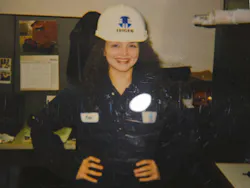
“I started in Baltimore…worked in Baltimore for the majority of my career. I relocated to Philadelphia about five years ago,” Clark told EnergyTech. “I worked in the engineering department and documented over 400 manholes. So, the bulk of my early career was steel toes, hard hats, full protective suits and harnesses going down into steam manholes.”
Clark later transitioned into operations, spending years maintaining distribution systems and plants in customer service, which landed her where she is today. She credits her boss at the time, who asked, “What do you think about going over into customer service? Because you have the technical and the operations aptitude to bring with you and it really could be a benefit.”
Those foundations of engineering, operations and project management, Clark stated, taught her how to maintain and rebuild the infrastructure that communities depend on. But when she moved into customer service and sales roles with commercial oversight of 12 different cities and 19 different district systems, Clark explained she learned a different lesson.
“The technical expertise may give you the credibility to talk about your work, but the relationships that I built when I moved into customer service and sales built the trust,” she said, crediting the sales and account management organization she helps lead with guiding U.S. cities' broader sustainability goals. “My title is not the real story.”

The Society of Women Environmental Professionals (SWEP) of Greater Philadelphia honored Clark on Nov. 5 with its 2026 Touchstone Award at the Merion Tribute House in Merion Station, Pennsylvania. The award recognizes environmental professionals whose commitment to community service has made a lasting impact on the industry and region.
“It's a real honor. I'm much more comfortable talking about other people. So it's very humbling to me that my team nominated me and that I was selected for this award,” Clark said. “ I truly believe in the benefit of district energy. I have for nearly three decades. But it also gives me the opportunity to, you know, relay and pay back some of the opportunities that I've been given over my career.”
Clark is pursuing a Master of Environmental Studies degree at the University of Pennsylvania. She earned her bachelor's degree from Notre Dame of Maryland University.
Kevin Hagerty, president and CEO of Vicinity Energy, added: “She has worked across the full energy lifecycle, from designing manholes to operations and field work to leading sales and customer relations and beyond. That range is rare, shaping Vicinity’s growth as well as championing innovative energy solutions that deliver real environmental benefits.”
About the Author
 Eric Moody
Staff Writer
Related
 Department of Energy
 district_energy