Getting Ahead of Thermal Runaway: Myers, Jinko Pass New UL Standards to Combat Fire Threats of Li-Ion
Key Highlights
- The UL 9540A 6th edition standard is the most stringent safety test for large-scale energy storage, focusing on thermal runaway and fire risk mitigation.
- Both Myers and Jinko's SunTera ESS units demonstrated critically reduced fire spread risks under demanding testing conditions.
- Growing energy storage capacity in the U.S. underscores the importance of enhanced safety standards to prevent devastating BESS fires.
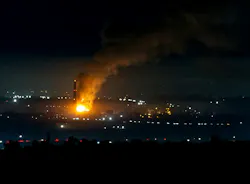
Thermal runaway and escaping gas dangers create intense and potentially devastating fire dangers in utility-scale battery storage made up of lithium-ion chemistry.
New technologies are aiming to reduce those risks for future installations as commercial and industrial demand grows for batteries added to the power generation mix.
U.S.-based Myers Emergency & Power Systems this week announced that its EnerShed 2.0 Battery Energy Storage System (BESS) successfully passed UL’s sixth-edition 9540A large-scale fire testing edition. Myers says it is the first North American company to pass the cutting-edge UL standard focused on fire safety in energy storage.
“At Myers, safety is not a checkbox. It is a core engineering principle that shapes every product decision we make,” said Troy Renken, Chief Product Officer of Myers, in a statement. “Successfully completing the UL 9540A 6th Edition Large-Scale Fire Test reflects our commitment to designing systems that customers and communities can trust, while also staying ahead of evolving codes and standards. Being the first in our industry to achieve this milestone cements Myers’ position as an emerging market leader in the BESS category.”
Myers joins China-based Jinko’s SunTera ESS battery in obtaining the UL 9540A 6th edition standard globally. Testing by both companies was certified by laboratories with CSA Group.
UL, long known as Underwriters Laboratories, released the latest and most stringent testing method for 9540A certification earlier this year. The UL 9540A sixth edition tests safety behaviors for BESS which have design and installation conditions exceeding limits set by the National Fire Protection Association’s 855 standard or the International Fire Code.
“UL 9540A is the only consensus standard explicitly cited in NFPA 855 for large-scale fire testing and the only national standard in the U.S. and Canada for fire safety testing methods for battery ESS,” reads the UL announcement about its sixth edition testing standards for mitigating thermal runaway in battery storage.
The testing for Myers’ EnerShed 2.0 BESS, which the company is working toward commercializing, involved demanding conditions with units only two inches apart. Myers designed the testing with air-cooled architecture, passive barriers and open module design which survived the UL testing scenarios undertaken by CSA.
“As BESS safety standards continue to evolve, large-scale fire testing under UL 9540A, 6th Edition is critical to demonstrating system compliance under real-world fire conditions,” Dana Parmenter, Commercial Vice President, Industrial, CSA Group, said in the statement. “To support these requirements, CSA Group has invested in specialized capabilities and technical expertise to deliver rigorous, high-precision large-scale fire testing.”
Jinko ESS also reported that its SunTera units also endured and passed rigorous CSA testing adhering to the UL 9540A 6th edition standard. According to a statement by Wu Wei, who is commercial director of CSA Group China’s Industrial Unit, testing results showed Jinko’s SunTera showed critically reduced fire spread risks.
Lithium-ion currently dominates the battery storage chemistry market at about 90% of installations, due to its energy density and scaling properties. Cell failure, however, creates risks such as uncontrollable thermal runaway and off gases.
These dangers generated several devastating BESS fires in the past decade. Those include the Moss Landing thermal runaway event in California last year and the Arizona Public Service’s Surprise BESS fire.
U.S. energy storage installed capacity is expected to grow by more than 24 GW this year, according to the federal Energy Information Administration. This makes up nearly 30% of all new utility-scale generating assets installed this year, the EIA says.
About the Author

Rod Walton, EnergyTech Managing Editor
Managing Editor
For EnergyTech editorial inquiries, please contact Managing Editor Rod Walton at [email protected].
Rod Walton has spent 17 years covering the energy industry as a newspaper and trade journalist. He formerly was energy writer and business editor at the Tulsa World. Later, he spent six years covering the electricity power sector for Pennwell and Clarion Events. He joined Endeavor and EnergyTech in November 2021.
Walton earned his Bachelors degree in journalism from the University of Oklahoma. His career stops include the Moore American, Bartlesville Examiner-Enterprise, Wagoner Tribune and Tulsa World.
EnergyTech is focused on the mission critical and large-scale energy users and their sustainability and resiliency goals. These include the commercial and industrial sectors, as well as the military, universities, data centers and microgrids. The C&I sectors together account for close to 30 percent of greenhouse gas emissions in the U.S.
He was named Managing Editor for Microgrid Knowledge and EnergyTech starting July 1, 2023
Many large-scale energy users such as Fortune 500 companies, and mission-critical users such as military bases, universities, healthcare facilities, public safety and data centers, shifting their energy priorities to reach net-zero carbon goals within the coming decades. These include plans for renewable energy power purchase agreements, but also on-site resiliency projects such as microgrids, combined heat and power, rooftop solar, energy storage, digitalization and building efficiency upgrades.