Cross-Sector Convergence: How the Race for Critical Resources is Uniting Energy Producers and Redefining Global Supply Chains
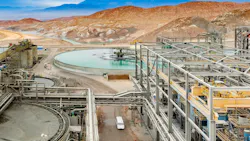
Today's intensifying competition for critical minerals is connecting sectors across the energy and technology landscapes in entirely new ways.
This shift is driven by a global decline in new resource discoveries for copper, cobalt and other essential materials even as demand for them has grown significantly amid the rapid expansion of artificial intelligence (AI) and data centers. To secure domestic supply chains, cross-industry convergence among sectors like energy, industrial technology and national security is accelerating to drive the infrastructure required to power next-gen clean energy systems and high-tech applications.
A prime example is U.S. battery storage critical minerals supplier EVelution Energy’s $850 million long-term off-take agreement with Japanese general trading company Mitsui & Co. EVelution is currently advancing an American commercial-scale, solar-powered cobalt processing facility in Yuma County, Arizona.
Demonstrating this trend where industrial and tech intersect with energy, U.S. solar producer ES Foundry is joining the Massachusetts Institute of Technology (MIT)’s Initiative for New Manufacturing. ES Foundry is committing $1.5 million over three years to the alliance, leveraging data from its 3-GW crystalline solar cell operation to anchor AI-driven manufacturing research.
These convergence efforts will focus on strengthening domestic manufacturing to ensure the U.S. remains globally competitive.
"We have made a significant investment in bringing solar cell manufacturing back to the United States,” said Alex Zhu, CEO of ES Foundry, in a statement. “This commitment to MIT's Initiative for New Manufacturing is an investment in making that manufacturing stronger.”
Geopolitical alliances
In January, President Donald Trump signed a critical minerals executive order (EO) that explicitly tied U.S. critical minerals security to global partnerships. The order emphasizes international cooperation to strengthen national mineral security, given that the U.S. reportedly imports 12 critical minerals and relies on imports for more than half of its total consumption.
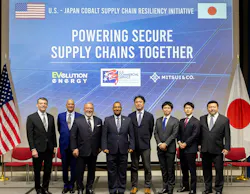
This vulnerability underscores the growing importance of alliances with key partner countries like Japan, as displayed in the EVelution-Mitsui partnership designed to reduce dependence on non-allied foreign sources such as China. Such collaboration reinforces a broader strategy established in a separate executive order in August. In it, President Trump cited severe security, foreign policy and economic risks from certain foreign actors that are “increasingly creating and exploiting vulnerabilities” in the U.S. power grid.
The administration noted that these threats stemmed primarily from the importation of foreign-made equipment serving critical bulk-power infrastructure needs across the country.
Over the next two to four years, sourcing components free from Foreign Entities of Concern (FEOC) status could emerge as a critical market bottleneck, research firm Wood Mackenzie outlined in its U.S. Energy Storage Monitor Q2 2026 report. This highlights a massive imbalance in the U.S. clean energy transition between domestic mining ambitions and actual chemical processing capabilities.
Bridging the domestic capital gap
China is still going to dominate for a while. As noted by the McKinsey Global Institute, China is projected to maintain its market dominance well beyond 2030, compounding this challenge. The country's deep supply chain integration and lower production costs structurally position it to remain a net exporter to multiple global markets.
“China’s advantage is not simply geology; it is the scale and integration of the industrial ecosystem that has been built around critical minerals. Mining is only the first step,” said Oliver Wright, a global law firm partner of DLA Piper who advises companies and investors on mining, critical minerals, project development, financing and M&A. “China has substantial capacity across refining, processing, component manufacturing and, increasingly, recycling, with those pieces connected to large pools of downstream demand and capital.”
In the U.S., domestic lithium cell manufacturing capacity reportedly sits at roughly 12%. Projects like the $850 million Arizona EVelution Energy-Mitsui collaboration underscore the intensive capital expenditure required to establish localized, solar-powered processing baselines needed to scale Western supply chain independence.

The International Energy Agency (IEA) outlined in its Global Critical Minerals Outlook 2026 report that even if all global planned rare earth refining projects come online as scheduled, China's 85% market share as of 2025 is projected to fall to 70%-73% by 2035. The drop from 90% in 2023, the IEA highlighted, was attributed to investment in rare earth refining by the U.S. and Malaysia, which helped reduce China's global supply concentration in this segment.
Wright added in an exclusive EnergyTech interivew that a key U.S. challenge in this equation is trying to build several parts of that ecosystem at once. These areas include permitting and infrastructure constraints for mining, the need to secure feedstock for processors, sourcing requirements and even the need for a long-term purchaser before lenders approve construction financing.
“The U.S. has begun responding with a broader mix of grants, loans, procurement support and international arrangements, but scale ultimately requires those different pieces to operate as a coherent market rather than as isolated projects,” he said.
Supply resilience: The 2030 path forward
A major focus Wright outlined is how he and his team are advising domestic companies and investors to navigate these bottlenecks. This advice involves viewing a critical-minerals project as a supply-chain transaction rather than simply a mining or processing project.
“Developers increasingly need to think about their customer and financing strategy much earlier,” said Wright.
As a result, he supports the idea that there is real value in connecting U.S. sectors for improving broader strategy, such as creating closed-loop domestic supply chains that link miners and processors with automakers, battery manufacturers, utilities, technology companies and defense contractors.
In the battle for critical minerals, Wright views the U.S. as having made significant progress toward electrification and self-reliance ambitions to establish a more independent critical minerals supply chain by the end of the decade.
“The U.S. has moved considerably beyond simply identifying critical-mineral dependence as a strategic risk and is now using a wide range of legal and financial tools to address it,” he explained.
Despite canceling nearly $7.6 billion in clean energy grants approved by the former Biden administration on “political grounds,” the current Trump administration detailed in August that 160 critical minerals deals have been signed or approved during this term. The amount totals roughly $40 billion since January 2025 to secure critical materials sectors.
This includes the DOE Office of Critical Minerals and Energy Innovation distributing $500 million across seven projects to expand critical mineral, material processing and battery manufacturing in the U.S. However, Wright said the scale of this challenge still “remains significant” and views “resilience” as the better benchmark target for the U.S. by the end of the decade.
“By 2030, it is realistic to expect significantly more domestic mining, processing and recycling capacity in selected commodities, coupled with more diversified supply from countries such as Australia, Canada and other partners,” he added.
About the Author
 Eric Moody