NScale Acquires 8-GW Monarch Compute Campus Project in West Virginia
Key Highlights
- The project integrates 8+ GW of power, natural gas generators, battery storage, and microgrid legislation to support future AI factories and large-scale data processing needs.
- Partnerships with Microsoft and NVIDIA enhance the platform's AI compute capacity, with commitments of over 1.35 GW of AI infrastructure at Monarch.
- The deal exemplifies the rising trend of multi-billion-dollar mergers driven by AI and cloud computing, emphasizing sustainable energy solutions and strategic global collaborations.
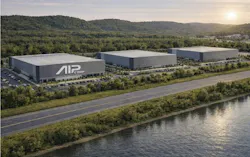
Need a worldly use case showcasing the rise of artificial intelligence (AI) and cloud computing in driving multi-billion-dollar mergers and acquisitions?
This one spans the globe: A British-based hyperscale data center developer founded by an Australian former coal miner is acquiring one of the biggest computing energy projects in the United States.
American Intelligence & Power Corp., owner of the 8-GW Monarch Compute Campus project in West Virginia, has agreed to be acquired by Nscale Global Holdings Ltd. The combination will create an integrated and AI-enabled energy-to-compute platform built around co-located and off-grid power.
Fidelis was the original developer of the ambitious Monarch Compute Campus concept and co-founded American Intelligence & Power (AIPCorp) with partner 8090 Industries.
AIPCorp was envisioned as the company platform to own and operate Monarch, and contracted power gen-set maker Caterpillar and its regional distributor, Boyd CAT, to deliver 2 GW of fast-response natural gas generators. The gas-fired gen-sets will be paired with battery energy storage systems designed to handle high-level demand loads from future artificial intelligence factories in Mason County.
The 2,250-acre, 8+ GW Monarch data center also is supported by recent microgrid friendly legislation from West Virginia state leaders. Those gas-fired gen-sets will be fueled with production from the Marcellus Shale gas field through multiple pipelines, including the 30-mile Prosperity Line.
"The AIPCorp and Fidelis team has spent years building something we believe in deeply — an energy-to-compute platform that does not ask communities to choose between affordable power and the promise of AI. Joining Nscale means we can now deliver that vision at a global scale, with the financial discipline, the compute infrastructure, and the partnerships to make it real," said Daniel Shapiro, the co-founder and CEO of AIPCorp who now will lead as chief power & energy officer with the Nscale Global Energy & Power subsidiary.
No financial terms for the acquisition were announced. Various reports indicate the value of a data center at between $10 million per MW for construction costs and $20 million per MW for AI-enabled factories. By 2030, research firm McKinsey forecasted, companies will spend close to $7 trillion on building out data center infrastructure.
Nscale’s CEO and founder Josh Payne started early in his career working in an Australian coal mine. Payne then gained support for starting Ncale through a partnership with industrial conglomerate Aker and, later, a $2 billion investment from global processing unit giant NVIDIA and other funding from 8090 Industries.
On the same day that Nscale announced its acquisition of the Monarch Compute Campus project, Nscale also revealed a letter of intent with Microsoft to provide 1.35 GW of AI compute capacity at Monarch.
The Microsoft commitment is connected to deployment of NVIDIA’s next-generation Vera Rubin NVL72 graphic processing units (GPUs).
“This collaboration with Microsoft marks a pivotal milestone both for Nscale and the development of the Monarch Campus," Nscale CEO Payne said in a statement. "By integrating our specialized AI infrastructure with Microsoft’s global platform, we are creating a foundation for innovation that can scale alongside the most ambitious AI models in the world.”
Morgan Stanley & Co LLC was financial advisor to Nscale, Greenhill served AIPCorp in that role for AIPCorp.
Monarch will need every bit of the Caterpillar G3500 series natural gas generator sets for the coming GPU load. Caterpillar and Boyd CAT are scheduled to deliver the initial gas-fired gen-sets from September through August 2027.
The Caterpillar installation is expected to reach 2 GW by the first half of 2028.
In announcing the Monarch acquisition and the Microsoft AI computing deal, both Nscale and AIPCorp credited the West Virginia legislature and Gov. Patrick Morrisey for creating a regulatory framework friendly to the data center and energy combination. Last year, West Virginia state leaders passed HB 2014, known to some as the state’s “microgrid” bill.
More from EnergyTech on the Commercial and Industrial Energy Transition
What’s Around the Corner for C&I Energy Customers?
US Battery Storage Capacity Raced to Another Record in 2025
The Microgrid Knowledge Conference May 4-5 in Orlando
About the Author

Rod Walton, EnergyTech Managing Editor
Managing Editor
For EnergyTech editorial inquiries, please contact Managing Editor Rod Walton at [email protected].
Rod Walton has spent 17 years covering the energy industry as a newspaper and trade journalist. He formerly was energy writer and business editor at the Tulsa World. Later, he spent six years covering the electricity power sector for Pennwell and Clarion Events. He joined Endeavor and EnergyTech in November 2021.
Walton earned his Bachelors degree in journalism from the University of Oklahoma. His career stops include the Moore American, Bartlesville Examiner-Enterprise, Wagoner Tribune and Tulsa World.
EnergyTech is focused on the mission critical and large-scale energy users and their sustainability and resiliency goals. These include the commercial and industrial sectors, as well as the military, universities, data centers and microgrids. The C&I sectors together account for close to 30 percent of greenhouse gas emissions in the U.S.
He was named Managing Editor for Microgrid Knowledge and EnergyTech starting July 1, 2023
Many large-scale energy users such as Fortune 500 companies, and mission-critical users such as military bases, universities, healthcare facilities, public safety and data centers, shifting their energy priorities to reach net-zero carbon goals within the coming decades. These include plans for renewable energy power purchase agreements, but also on-site resiliency projects such as microgrids, combined heat and power, rooftop solar, energy storage, digitalization and building efficiency upgrades.