The Grid Short: PJM’s Future Capacity Auction Reveals Power Constraints in Looming Era of Higher Electrification Load
Key Highlights
- PJM's capacity auction indicates a looming shortfall, with reserve margins falling below safety thresholds, risking grid reliability during peak demand periods.
- The rapid growth of data centers and industrial load is outpacing new generation, leading to increased interest in decentralized, behind-the-meter power solutions.
- Decarbonization efforts are incremental, with natural gas playing a central role, while renewables and storage are still emerging in the market.
If you’ve wondered whether AI might be hyped-up chatter from ambition-drunk speculators, you’re not alone with the serious questions about a frenzied space at the crowded digital bar (virtually speaking).
Even so, if you’ve also marveled at why data centers, artificial intelligence factories and the hyperscale developers are suddenly cutting deals to secure behind-the-meter power at a quickening pace, focus no further than sobering recent news from the largest grid operator in the United States.
What PJM is saying may help you grasp what’s causing digital infrastructure leaders to order their first sips of the off-grid elixir. It may be bottoms up or missing out.
PJM Interconnection’s latest long-term auction report highlights the looming crisis in grid-tied power, even more critically in a region that serves perhaps the highest concentration of data center and industrial load nationwide. PJM works to balance electricity supply and demand across transmission systems in 13 states serving close to 67 million people in the eastern region of the country.
Failing the market structure test while new generation lags

PJM’s new detailed report for matching generation to load in the 2028-2029 time frame is even more negative than last year’s alarming insights on the 2027-2028 auction. The PJM Interconnection’s Base Residual Auction (BRA) procured almost 150 GW of grid capacity, but that is below expectations of what is needed for safety during extremely rare but possible peak demand events.
In fact, the PJM BRA showed that the regional transmission organization’s (RTO) installed reserve margin two-plus years away will be only 14.4%, nearly 6 percentage points below the 20% desired to protect against a “one day in 10 year” peak load or another grid supply crisis.
“The RTO, as a whole, failed the market structure test...resulting in the application of market power mitigation to all existing generation capacity resources,” read PJM’s executive summary.
The bottom line is affordability, and this market squeeze is raising electricity rates across that region that includes residential, commercial and industrial customers in Virginia, Maryland, District of Columbia, Pennsylvania, New Jersey, Michigan, North Carolina, West Virginia and six other midwest states.
Mastering Requirements, Standards and Risk
in a Digitally Transformed Energy Sector
Join us for July 21 EnergyTech Webinar with Siemens
Generation supply increased in PJM’s auction but new generation and uprate totals dropped to their lowest level in years. All of this points a shaky finger at widening grid constraints during a time when electrification demand is expected to skyrocket from computing, automation and industrial customers.
The primary utilities in the region such as PSEG, Dominion and PEPCO are offering what they’ve got, totaling close to 138 GW in cleared capacity for 2028-2029. This cleared total looks impressive at face value, but is nearly 30 GW less than what was cleared at auction 10 years ago.
Utility-scale plant retirements are taking their toll on capacity … clearly. And while utility and power generation experts are not unanimously challenging coal-fired and nuclear plant retirements, they’ve long questioned whether those closures are happening too quickly without allowing for next-gen resources coming online to match the drop.
New generation or uprating at existing rates, meanwhile, increased only by an estimated 527.6 MW, the lowest uptick in at least the last 10 years, according to PJM.
DERs not rushing to fill the gap yet
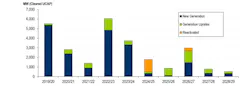
Decarbonization within the resource mix may only happen incrementally and the coming build-out will feature new natural gas-fired capacity at the center because the prolific and accessible Marcellus Shale gas formation lies beneath much of the PJM region. Natural gas-fired power emits less carbon dioxide than coal by half again, but it’s not as “net zero” friendly as solar, wind or hydropower.
“Intermittent and Capacity Storage Resources (solar, wind, water, battery/hybrid) offered increased by 1,078 MW, while coal megawatts offered decreased by 3,541 MW, primarily due to planned deactivations. Natural gas offered increased substantially...,” reads the report summary.
Six years ago, the Federal Energy Regulatory Commission passed Order 2222. FERC Order 2222 required regional grid operators to allow distributed energy resources (DERs) to participate in whole electricity markets into competitive wholesale electricity markets such as PJM.
FERC Order 2022 was celebrated by advocates as a pivotal turning point for DER developers to bring their generation into direct interaction and value proposition with conventional utility capacity. It’s still early days, but the impact is null in this first-ever available auction.
“Distributed Energy Resources (DER) under Order 2222 were eligible to participate for the first time, but PJM received no offers,” reads the PJM executive summary.
At this year’s Microgrid Knowledge Conference in Orlando, numerous distributed generation developers noted the large grid’s impending supply-and-demand imbalance in the so-called Industrial Compute Age. Behind-the-meter, microgrid and other on-site or co-located dedicated power projects were the most reliable path forward for hyperscalers and other industrial customers that require electricity resiliency and resource adequacy.
“The key point is the frailty of the grid; the grid right now is in dire straits,” e2 Companies CEO James Richmond said during the MGK Conference event in early May. “When the EIA (U.S. Energy Information Administration) forecasts that outages will go up 100X by 2030 and it doesn’t hardly make the news, people are asleep at the wheel.
“The world is asleep … and they should know with rates going up and grid stability down,” Richmond added. “The people who can help solve it are the people in this group, because we’re all kind of behind-the-grid solutions.”
Behind-the-meter advocates are all in on decentralized power
Microgrid modeling technology firm Xendee is having the same conversation with customers from numerous commercial and industrial sectors. They see grid capacity issues across PJM, MISO and Electric Reliability Council of Texas (ERCOT) systems, plus the possibly five to 10-year wait to get transmission systems built and connected.
In fact, a recent Grid Pulse report by Hitachi Energy calculated that the past 12 month’s load growth in ERCOT rose a nation-leading 9% due mainly to data center and Bitcoin mining installment. In a six-month period ending in March, Hitachi Energy reported, capacity additions in ERCOT topped 6.8 GW of new generation resources.
Yet ERCOT’s most recent resource adequacy report this summer estimated its reserve margin at only 9.8%, well below the 13.75% historic targeted margin. The North American Electric Reliability Corp. has classified ERCOT at an “elevated risk,” which is five years after the Texas grid nearly collapsed during extended freeze from Winter Storm Uri.
And Texas is steadily growing and perhaps even outpacing Virginia in future digital infrastructure demand growth.
This kind of uncertainty is bringing C&I customers closer to specially designed distributed and dedicated power projects which incorporate hybrid generation resources such as solar, battery storage and natural gas as a bridge fuel.
“It’ll have to be a multi-technology system,” Xendee’s co-founder and Chief Technical Officer Michael Stadler said in an interview with EnergyTech at the MGK Conference. “The momentary discussion (for customers such as data center developers) is how do we get this power, and with a utility it may take 10 years … but they say I need power next year, how do I get that?
Those computing infrastructure customers get that with “renewables and batteries and generators,” Stadler added. “We’ve been doing generators for a long time, and so we know how to deal with transient load (large load shifts in milliseconds from AI and supercomputing functions). It would be a big deal if it was just renewables.”
In an exclusive interview with EnergyTech last year in which he called this era the “Industrial Compute Age,” data center site developer WiredRE’s founder and CEO Everett Thompson highlighted the timing challenges faced between utilities, interconnections and digital infrastructure owners.
Digital innovation alone is not enough if the U.S. seeks to lead the global AI race, he pointed out. The nation needs a new paradigm that can meet the challenge of supplying enough energy while also enabling global leadership in AI, quantum and cloud computing.
“Everybody still wants an interconnection agreement,” Thompson said, referring to energy resources connected into the primary macro grid. “But dealing with a slow-moving utility is difficult. That’s not a cost issue, that’s bureaucratic. How do we overcome that in a way that our entire nation can be elevated?”
This overcoming could open the path for many different resources, he added.
“I think self-generation is being adopted … This is an amazing opportunity to renew our infrastructure and our regional industries,” Thompson noted. Some hyperscalers, such as Amazon Web Services, say they are still committing to the front-of-meter utility interconnection model. Increasingly, however, many new developers are shifting to off-grid or unique power generator supply purchase agreements such as Microsoft’s long-term nuclear PPA with Constellation designed to restart the retired Three Mile Island Unit 1 (renamed the Crane Energy Center).
An affordability volcano is building steam
Some call the AI expansion “a bubble” or hype. That’s entirely possible as with all manias, but the PJM auction report shows a looming generation capacity crisis is accelerating. Whatever happens in the next three years could prove pivotal to utility function, form and, critically for customers, rates.
Former FERC Chairman Mark Christie last year warned that electricity load is growing roughly five times faster than new generation coming online. This warp speed separation of supply and demand could endanger both energy affordability and access to everyday customers.
“We are sitting on a volcano,” Christie said during the Schneider Electric Innovation Summit keynote. “The political volcano could be from energy prices, and we’ve got to address that. We cannot forget that what retail customers are paying is going to be a huge part of it. If we don't, the volcano could blow up and it could be bad.”
Statistics can deliver future truths. Perhaps that is PJM’s key thesis in its latest auction report.
About the Author
 Rod Walton, EnergyTech Managing Editor
Rod Walton, EnergyTech Managing Editor
Managing Editor
For EnergyTech editorial inquiries, please contact Managing Editor Rod Walton at [email protected].
Rod Walton has spent 17 years covering the energy industry as a newspaper and trade journalist. He formerly was energy writer and business editor at the Tulsa World. Later, he spent six years covering the electricity power sector for Pennwell and Clarion Events. He joined Endeavor and EnergyTech in November 2021.
Walton earned his Bachelors degree in journalism from the University of Oklahoma. His career stops include the Moore American, Bartlesville Examiner-Enterprise, Wagoner Tribune and Tulsa World.
EnergyTech is focused on the mission critical and large-scale energy users and their sustainability and resiliency goals. These include the commercial and industrial sectors, as well as the military, universities, data centers and microgrids. The C&I sectors together account for close to 30 percent of greenhouse gas emissions in the U.S.
He was named Managing Editor for Microgrid Knowledge and EnergyTech starting July 1, 2023
Many large-scale energy users such as Fortune 500 companies, and mission-critical users such as military bases, universities, healthcare facilities, public safety and data centers, shifting their energy priorities to reach net-zero carbon goals within the coming decades. These include plans for renewable energy power purchase agreements, but also on-site resiliency projects such as microgrids, combined heat and power, rooftop solar, energy storage, digitalization and building efficiency upgrades.