From Renewable Assets to AI Powerhouses: Soluna Charting Path to a New Industrial Era
Key Highlights
- The company emphasizes bringing load to generation, utilizing underused renewable assets to maximize revenue and reduce curtailment.
- Partnerships with industry leaders like Siemens and investments from major firms signal strong momentum toward behind-the-meter, off-grid AI infrastructure.
- The integration of power and compute is creating a new asset class, termed the 'intelligence platform,' which combines energy generation with high-performance computing.
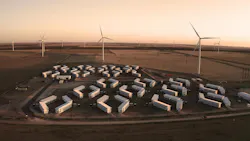
This is a “zig when others zagged” kind of story, where a unique company takes the round-about path that leads it directly into the current energy industry superhighway.
Where the past utility-scale renewable energy landscape found curtailment, John Belizaire and Soluna Holdings offered expansion. Where the grid system might withhold dispatch, a new digital infrastructure was securing connection.
Where science honored mainly great men, this entity offered tribute to equally great woman of engineering and mathematics.
Power and compute are morphing into one thing
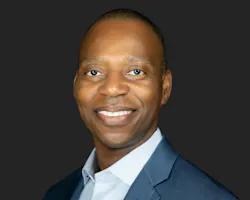
Those are some isolated but noteworthy examples of the work initiated by Bitcoin miner and data-center developer Soluna Holdings and its CEO, John Belizaire. What once was remote and intermittent is now gathering mass and momentum as immediate, critical and, most likely, perpetual.
That’s a lot of fancy words to highlight one simple and obvious thing: Digital Infrastructure location is not solely a telecom issue anymore, only seeking the best fiber optic connection, but has elevated into a mission-critical energy gauntlet.
“We’ve long been driven by the thesis that power and compute are quickly becoming one thing over time,” said Belizaire, who helped found Soluna Computing in 2018.
“We had surmised that eventually some big computing wave would come along that would accelerate that: Here we are with AI,” he added. “This technology is one of the biggest technology waves we’ve seen in a long time.”
Don’t stop me if you’ve heard this one before, because most educated sources are predicting there is no stopping the pace or scale of AI computing demand for potentially off-grid and behind-the-meter energy generation projects. Research as varied as BloombergNEF, GoldmanSachs, S&P Global and the International Energy Agency are forecasting 50 to 150+ GW or more of next-gen AI and data supercomputing capacity coming online in the next decade.
Soluna is not alone in shifting toward behind-the-meter for AI
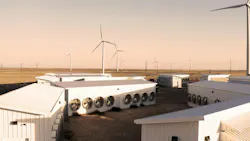
This next era has inspired new pivots by a lot of distributed and renewable energy companies. Soluna Holdings first advanced its foothold by developing Bitcoin computing facilities located close to utility-scale renewables which were not being fully utilized.
It names those computing sites after notable women in science, such as British computer architecture designer Sophie Wilson or NASA mathematician Dorothy Vaughan or AI pioneer Fei-Fei Li.
The Industrial Computing Age driven by this expansion of AI has motivated Soluna Holdings to shift its focus from a combination of Bitcoin mining and data center computing to focus more on dedicated AI factory projects of the future which will intertwine computing and power into one infrastructural fabric.
“They are becoming the same asset class,” Belizaire said. “This will create a new form of infrastructure: the intelligence platform, combining energy and compute at the cost of power.”
Soluna Holdings is not the only data center or distributed energy developer talking about this, and hype is always a concern when it comes to AI or any other rush. The proof of the power-and-compute intelligence platform future, perhaps, may show itself in the migration of hyperscale-level company leaders taking jobs with energy and AI developers.
Recently, former Microsoft executive Ryan Carver was hired and appointed as Soluna Holdings’ new chief development officer. Carver previously was a key decision-maker in Microsoft’s AI construction and site development, including the Ai-enabled Fairwater data computing campus in Wisconsin.
“It’s exciting to enter this big infrastructure wave where fantastic talent is coming in,” Belizaire noted.
This intersection of hyper-fast irresistible forces and immovable demand is pushing the talent migration both ways. Former bp CEO Bernard Looney took the same leadership role with high-density data center developer Prometheus Hyperscale, while private equity firms such as KKR and Brookfield are making billion-dollar-level commitments to power generation providers such as CleanPeak Energy and Bloom Energy, respectively.
Bringing your own generation moving into consensus today
Soluna Holdings is traveling its own path toward uniting computing and power. It finds renewable projects which are built or under development and which may not get to make full use of their top-level generation capacity, then locates its facilities to tap into those underutilized assets.
“Our whole strategy and model is that we bring the load to generation, bringing data centers to renewable energy centers,” Belizaire said about the Soluna vision.
Sometimes with some of the remote wind and solar projects “nearly half the energy was being wasted and never making it to the grid. There were wind farms dealing with curtailment, and we said, ‘we have a solution for you.’
“We built it right at the (power) asset,” he added. “We build an entire data center campus right next to the renewable energy, integrating into the same substation. That unlocks massive amounts of revenue for them (the renewable energy project owner).”
This new industrial-scale supercomputing push which Soluna is adapting to and shifting focus also will require certain changes to its own business model. The company will focus on meeting demand for AI capacity and march headlong in the macro movement toward behind-the-meter, collocated, off-grid and “speed to power.”
Soluna Holdings and its leadership, after all, has been working toward this for about eight years. Now, they believe, is the time to accelerate the pace of that mission.
“This wave creates a lot of pressure to create the infrastructure” of compute and power,” Belizaire said “Pain drives innovation. The problem here is constraint on power. We have to invest in innovation on the energy side, bringing the load to generation.”
Policymakers as high as the Federal Energy Regulatory Commission are onboard with this movement and pushing for faster interconnection and encouraging digital infrastructure developers to “bring its own generation” while keeping rates affordable for all electricity customers.
Meanwhile, investment giants such as Blackstone, BlackRock, KKR, Brookfield, Apollo and Goldman Sachs are partnering with AI equipment and graphic processing unit (GPU) giant NVIDIA on a $500 billion financing play for new data computing construction and connected power resources.
The industrial compute offensive is under way. Behind the meter is the tip of the spear.
“It’s a pretty old grid,” Belizaire noted. “The innovation is to build more off-grid power, self-consumption and behind-the-meter generation with all kinds of resources such as renewables, battery cells and linear generators,” to name a few, he added.
Those grid-edge build-outs could prove quite beneficial for the macro utility grid.
“You’re going to see scale deployments” of distributed energy projects,” Belizaire predicted. “Once you get interconnected to all of those disparate elements, then you’ll have an advanced, scaled, resilient and high-capacity grid.”
Fortifying the grid at the edge to help the grid at the center
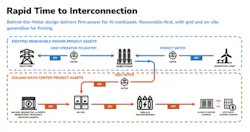
Doing this level of scaling up will necessitate some deployment of gas-fired generation assets to deliver prime power where possible for Soluna’s new AI campus focus. The company is looking at “all of the above” solutions to meet the power demand crisis head-on until the utility grid catches up.
This is where it’s worth noting that Soluna historically interconnects its computing sites into the available grid in addition to the renewable assets.
AI is a daunting taskmaster when it comes to energy, as the transient load can threaten power stability with MW leaps in milliseconds. To this end, Soluna Holdings is working with Siemens on a project to deploy and validate behind-the-meter power and control systems to manage the rapid GPU-driven swings in power demand when running AI supercomputing tasks.
“You don’t know when the AI training is going to come to an end,” Belizaire said. “You have huge swings up and down with power consumption, causing dangerous swings in frequency and support. You need voltage ride-through” and other protections.
The memorandum of understanding between Siemens and Soluna unites them in working on a series of potential solutions culminating in create a digital twin of each AI site, allowing visibility on fluctuations which can shield the grid.
Soluna Holdings has ridden through its own challenges keeping pace with a revolution in energy supply and demand. The work is expensive, but the company recently announced a fifth straight quarter of revenue growth and expansion of its project development pipeline to more than 6 GW.
Emerging Microgrid Technology
Speed to Power for Data Center Customers
Aug. 26 EnergyTech Webinar Featuring PowerSecure
About the Author

Rod Walton, EnergyTech Managing Editor
Managing Editor
For EnergyTech editorial inquiries, please contact Managing Editor Rod Walton at [email protected].
Rod Walton has spent 17 years covering the energy industry as a newspaper and trade journalist. He formerly was energy writer and business editor at the Tulsa World. Later, he spent six years covering the electricity power sector for Pennwell and Clarion Events. He joined Endeavor and EnergyTech in November 2021.
Walton earned his Bachelors degree in journalism from the University of Oklahoma. His career stops include the Moore American, Bartlesville Examiner-Enterprise, Wagoner Tribune and Tulsa World.
EnergyTech is focused on the mission critical and large-scale energy users and their sustainability and resiliency goals. These include the commercial and industrial sectors, as well as the military, universities, data centers and microgrids. The C&I sectors together account for close to 30 percent of greenhouse gas emissions in the U.S.
He was named Managing Editor for Microgrid Knowledge and EnergyTech starting July 1, 2023
Many large-scale energy users such as Fortune 500 companies, and mission-critical users such as military bases, universities, healthcare facilities, public safety and data centers, shifting their energy priorities to reach net-zero carbon goals within the coming decades. These include plans for renewable energy power purchase agreements, but also on-site resiliency projects such as microgrids, combined heat and power, rooftop solar, energy storage, digitalization and building efficiency upgrades.