South Dakota Utility Black Hills Expanding Gas-Fired Capacity to Match New Wyoming Google Data Center in $1.8B Plan

South Dakota utility Black Hills Corp. will expand its company-owned natural gas generation capacity by 590 MW of grid-connected electricity to serve a planned Google data center in Cheyenne, Wyoming.
As part of this $1.8 billion generation plan, Black Hills announced Tuesday that it will construct 564 MW of company-owned natural gas units, with the remaining 26 MW supplied via market energy purchases. Energy service to serve this planned data center via gas fired power is expected to begin in late 2027 in hopes of reaching peak load operating status by 2030.
Financing to support this project upfront will come through a combination of project-generated cash flow, debt and other financing alternatives, according to a company release.
By allowing the utility to coordinate and manage a 2.1-GW mix of third-party contracted resources or behind-the-meter assets, the project anticipates a total resource mix of 2.7 GW (excluding additional transmission system expansion investments) while providing roughly $150 million of net income in 2030.
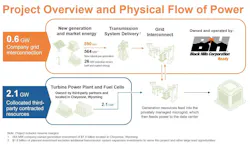
This aggregate generation to support Google’s massive power demand will also work in tandem with Black Hills’ Generation Facilities Agreement (GFA), which specifies the exact amount of infrastructure needed to support Google’s data center. Under the GFA framework, Black Hills will invest in and construct a 564 MW natural gas generation facility between 2027 and 2029 through a non-regulated affiliate at its Cheyenne Prairie Generating Station.
Other utilities such as Xcel Energy have successfully advanced similar tariff measures in other states, including Minnesota, Colorado and Wisconsin, to subject data centers and other major industrial users to commercial term regulations that aim to secure firm customer commitments with safeguards that reduce affordability risks, particularly for residential customers.
This framework legally isolates the $1.8 billion investment from the utility’s regular public utility rate base to further extend ratepayer protections, ensuring Google covers the costs of its energy footprint. Black Hills added that the project is expected to generate approximately $2.4 billion of unlevered free cash flow from microgrid management fees through 2048, net of its $1.8 billion capital expenditure for Google's generation facilities.
“The agreements demonstrate how innovative energy solutions can support economic growth while ensuring existing customers are protected. Importantly, these agreements and supporting regulatory mechanisms are structured so that Google bears all costs associated with serving the planned data center throughout the life of the project,” said Linn Evans, president and CEO of Black Hills Corp., in a statement.
Google is among numerous hyperscale AI and digital infrastructure firms seeking multiple paths to adequate power generation capacity. Earlier this week, Google and utility power producer Constellation announced plans to bring 890 MW of new, emissions-free generation onto the PJM Interconnection grid through a 20-year power purchase agreement.
About the Author
 Eric Moody