Nuclear Revival: DOE, Google Lead to Iowa Reactor's Restart Future
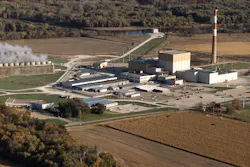
An Iowa nuclear power plant shut down six years ago is going to be restarted and connected to the grid through support by the U.S. government and Google.
The federal Department of Energy announced this week it had successfully closed a loan commitment of up to $1.9 billion to help utility owner NextEra Energy in restarting the Duane Arnold Energy Center near Cedar Rapids. The single 615-MW reactor facility was shut down in 2020 after a severe windstorm and amidst concerns that the nuclear plant was no longer economical to operate.
Times have changed like the wind. What’s happened since then is the rush of data centers, artificial intelligence (AI) and re-industrialization load projections across the nation. Nuclear energy provides baseload, carbon-free power, and the era of AI hyperscalers increasingly demands that anticipated new capacity.
The rising load also will threaten electricity affordability without new power generation capacity online.
“Returning 615 megawatts of reliable baseload generation will drive down electricity costs, while supporting thousands of American jobs,” U.S. Deputy Secretary of Energy James P. Danly said in a statement. “This Administration is pursuing a comprehensive nuclear strategy, restarting existing reactors, increasing the output of our nuclear fleet, and accelerating new construction, to build the abundant, affordable, and reliable power system required for American prosperity and reindustrialization.”
No timeline was given for the Duane Arnold nuclear plant restart. The work will create 1,500 jobs during construction to prepare the reactor for re-connection and some 450 workers during operations.
The DOE’s Office of Energy Dominance Financing, created during this second Trump Administration, leads the loan allocation to Florida-based majority owner NextEra Energy which acquired the 50-year-old Arnold plant in the early 2000s. Other minority owners include Central Iowa Power Cooperative and Corn Belt Power Cooperative.
Power was generated at the plant from a single GE boiling water reactor with two cooling towers along the west bank of the Cedar River. One of those cooling towers was heavily damaged during a freak derecho windstorm in the summer of 2020, leading to the facility’s shutdown.
Digital infrastructure hyperscalers such as Google, Microsoft, Meta and Amazon are investing in long-term power purchase agreements (PPA) and allocating venture capital to revive and build up U.S. nuclear energy generation. Microsoft and Constellation Energy are united on an agreement to restart Unit 1 at the retired Three Mile Island plant in Pennsylvania, while Facebook owner Meta and online retailer and cloud-services giant Amazon are committing to future development of small modular reactors.
Last year, Google announced a 25-year PPA with NextEra that also helps finance renewed generation at the Duane Arnold plant in Iowa. The reactor was licensed to operate through 2035 until the storm and economics caused its shutdown.
NextEra Energy CEO John Ketchum called it “America’s golden age of power demand.”
“Restarting Duane Arnold marks an important milestone for NextEra Energy,” Ketchum said when the Google PPA was announced. “Our partnership with Google not only brings nuclear energy back to Iowa — it also accelerates the development of next-generation nuclear technology.”
Google previously had announced $7 billion worth of investment in data center infrastructure in Iowa.
AI factories and supercomputing required for such models increase the density of energy demand, with future data centers requiring as much as 1 GW, or about the energy load of an entire city. Last year Goldman Sachs forecasted that global power load from data centers may increase 165% by 2030.
Data center giants aren't the only sectors seeking new nuclear to power their operations. On the manufacturing side, chemicals firm Dow contracted X-energy to deliver its SMR technology to provide carbon-free electricity for a plant located along the Texas coast with the Gulf of Mexico.
The U.S. Nuclear Regulatory Commission is studying the X-energy permit application to install its SMR powering Dow's chemicals facility.
About the Author
 Rod Walton, EnergyTech Managing Editor
Rod Walton, EnergyTech Managing Editor
Managing Editor
For EnergyTech editorial inquiries, please contact Managing Editor Rod Walton at [email protected].
Rod Walton has spent 17 years covering the energy industry as a newspaper and trade journalist. He formerly was energy writer and business editor at the Tulsa World. Later, he spent six years covering the electricity power sector for Pennwell and Clarion Events. He joined Endeavor and EnergyTech in November 2021.
Walton earned his Bachelors degree in journalism from the University of Oklahoma. His career stops include the Moore American, Bartlesville Examiner-Enterprise, Wagoner Tribune and Tulsa World.
EnergyTech is focused on the mission critical and large-scale energy users and their sustainability and resiliency goals. These include the commercial and industrial sectors, as well as the military, universities, data centers and microgrids. The C&I sectors together account for close to 30 percent of greenhouse gas emissions in the U.S.
He was named Managing Editor for Microgrid Knowledge and EnergyTech starting July 1, 2023
Many large-scale energy users such as Fortune 500 companies, and mission-critical users such as military bases, universities, healthcare facilities, public safety and data centers, shifting their energy priorities to reach net-zero carbon goals within the coming decades. These include plans for renewable energy power purchase agreements, but also on-site resiliency projects such as microgrids, combined heat and power, rooftop solar, energy storage, digitalization and building efficiency upgrades.