A Gigawatt Step for Mankind: Microgrid Knowledge Goes to the Moon

Watching the crewed flight of Artemis II not long ago was almost like seeing a time capsule and crystal ball at the same time. Experiencing coverage of the lunar capsule orbiting the moon and then landing safely in the Pacific Ocean brought many of us back more than 50 years.
Now fast forward. The next phase of U.S. lunar engagement is a moon shot aimed at a future like nothing before it.
The National Aeronautics and Space Administration is hoping to eventually create a lunar economy and eventually put a permanent base on the moon. To do that, NASA wants to install electrical generation systems, whether it’s solar, batteries, nuclear fission or regenerative fuel cells or all the above.
“It’s my belief that a power grid is the way we’re going to achieve this,” Jeffrey Csank, senior electrical engineer for NASA, said during his keynote address at the Microgrid Knowledge Conference this week in Orlando.
Lunar power infrastructure is just the beginning
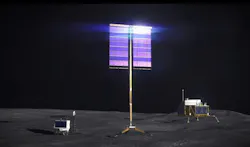
The vision is far bigger than the moon, but a lunar base is integral to those U.S. interstellar ambitions. Csank works out of the NASA Glenn Research Center in Ohio and serves as the agency’s lead for both Moon to Mars Power and Power Management and Distribution Portfolio for the Mars Campaign Office.
“We have a once in a generation opportunity to impact the future for all mankind,” Csank said. “To learn how to live and work off the earth. And the ultimate goals is one day seeing a human on Mars.”
First steps first. The Artemis mission still needs to return astronauts to the surface of the moon again and again and then figure out how to create a power generation system that will survive long-term within the unforgiving elements of lunar life.
Problems? Hmm, there’s the lack of an atmosphere or a strong magnetic field. Things come out of the sky and hit the moon with more regularity than hail storms in Oklahoma. There’s a nearly permanent dust that floats above the so-called group which includes some particles hardened like glass.
“There are surface power challenges,” Csank deadpanned at Microgrid Knowledge 2026.
And those are the high points. Challenges abound like high jumps in zero gravity, but NASA persists because it can. The American government and its people are naturally excited to someday possibly create a lunar civilization which can act as a type of frontier trading post while on the journey to Mars and beyond.
All of the above energy works well for the moon, too
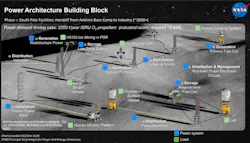
NASA and partners are studying the power generation options for the future lunar settlement. U.S. space travel has a long, successful heritage using batteries and solar panels, so those are under consideration if the engineers can figure out how to deal with the extreme cold and flying glass dust.
The lunar settlement likely would be located around the southern pole instead of the equatorial region favored by the Apollo missions. Vertical solar and miles of transmission lines would be necessary, while developing the option of baseload reliability with smaller next-gen fission reactors.
“Nuclear makes a lot of sense,” Csank said. “How do we supply power when it’s dark for four months?”
The NASA energy teams are still formally undecided on equipment particulars, but consensus is forming around utility three-phase alternating current and 50-kW lines. Direct current offers power advantages with lower mass, but Csank noted that AC likely would deliver greater efficiency over long distances and make fault protection simpler.
Talk about your throwback on the AC/DC debate. It’s like terra firma Thomas Edison and Nikola Tesla battling it out once again, but this time floating in spacesuits.

What is old is new again. Electrifying a lunar economy must clear some asteroid-level obstacles, but the American government and people are enthusiastic about manned moon and interstellar travel in a way they haven’t been since 1969.
NASA’s Csank, recognizing his audience in Orlando, noted that the project aligns well with priorities in the microgrid sector. These include focus on next-gen control technologies and multiple resource systems.
“We need all of those things,” he said. “It’s a system integration of loads and surfaces.”
One kilowatt-level leap for mankind, and a gigawatt leap for power generation of the future.
Unlock DER Value with Smart Use of DER Assets
New White Paper by PowerSecure
About the Author

Rod Walton, EnergyTech Managing Editor
Managing Editor
For EnergyTech editorial inquiries, please contact Managing Editor Rod Walton at [email protected].
Rod Walton has spent 17 years covering the energy industry as a newspaper and trade journalist. He formerly was energy writer and business editor at the Tulsa World. Later, he spent six years covering the electricity power sector for Pennwell and Clarion Events. He joined Endeavor and EnergyTech in November 2021.
Walton earned his Bachelors degree in journalism from the University of Oklahoma. His career stops include the Moore American, Bartlesville Examiner-Enterprise, Wagoner Tribune and Tulsa World.
EnergyTech is focused on the mission critical and large-scale energy users and their sustainability and resiliency goals. These include the commercial and industrial sectors, as well as the military, universities, data centers and microgrids. The C&I sectors together account for close to 30 percent of greenhouse gas emissions in the U.S.
He was named Managing Editor for Microgrid Knowledge and EnergyTech starting July 1, 2023
Many large-scale energy users such as Fortune 500 companies, and mission-critical users such as military bases, universities, healthcare facilities, public safety and data centers, shifting their energy priorities to reach net-zero carbon goals within the coming decades. These include plans for renewable energy power purchase agreements, but also on-site resiliency projects such as microgrids, combined heat and power, rooftop solar, energy storage, digitalization and building efficiency upgrades.