Solar Landscape Attracts $800M+ to Finance Commercial Rooftop Plans
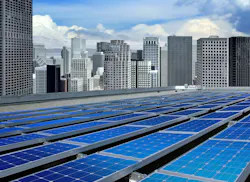
Whether U.S. commercial real estate owners and developers can truly tap into the full value of rooftop distributed energy may be the trillion-dollar question.
Researchers and market analysts from McKinsey, Wood Mackenzie and the U.S. Department of Energy all have estimated that commercial rooftops could add at least an additional 145 GW of solar and storage capacity if utilized efficiently and at scale. One of the nation’s top commercial solar developers is banking on that growth potential with more than $800 million of new financing announced in the first half of this year.
Funding commercial solar pipeline across four states
New Jersey-based Solar Landscape announced this month it has secured a $600 million senior debt facility to finance future construction over the next five years. Ranked by Solar Power World as the No. 1 U.S. commercial rooftop developer, Solar Landscape is linking the debt facility to a 145-MW portfolio of community solar assets under construction in Illinois, New Jersey, Maryland and Minnesota.
“This financing marks a meaningful evolution in how we fund and scale distributed energy,” said Clayton Avent, Chief Financial Officer of Solar Landscape, in a statement. “As our pipeline has grown, so has the need for a structure that can keep pace. This facility allows us to deploy capital more efficiently across multiple portfolios and markets, increasing the speed at which we can bring new capacity online.”
First Citizens Bank lead the debt facility transaction, with support from KeyBank National Association, National Bank of Canada, Atlas, Apterra Infrastructure Capital, Siemens Financial Services, BankUnited, Mitsubishi HC Capital America and Amalgamated Bank also participating in the funding.
Former U.S. Department of Energy Loan Programs Office leader and SunEdison founder Jigar Shah has argued that commercial building rooftop solar potential could reach more than 300 GW across the nation. In recent years, Solar Landscape has partnered with building solutions firm Prologis to develop more than 30 million square feet of commercial rooftop solar projects.
“This transaction reflects the continued growth of distributed generation as an asset class,” said Mike Lorusso, Head of Energy Finance, First Citizens Bank. “Solar Landscape has developed a scalable, repeatable model for deploying solar power on commercial real estate. This financing structure is well aligned with the company’s ability to execute at speed across multiple markets.”
One month earlier, Solar Landscape and investment firm Nuveen Energy Infrastructure Credit worked out an $117 million preferred tax equity financing package that will contribute to funding the 145-MW project pipeline. It was the second announced transaction between Solar Landscape and Nuveen Energy Infrastructure Credit.
There’s real money, potentially, in that sunlight hitting the business and industrial complext roofs. A recent report by on-site renewables developer Solect Energy highlighted the wishes of commercial real estate property owners to maximize their value proposition beyond square-foot lease revenues.
Plenty of room for growth
The commercial real estate sector covers close to 97 billion cubic feet in the U.S. alone, according to reports. Deploying rooftop solar and battery storage on-site would add potential GWs to the distributed energy resource mix nationwide.
A recent EnergyTech.com piece by ABB Electrification’s Brian Nelson noted that solar is entering a new phase without the benefit of investment and production tax credits, but the signs are promising for continued future growth.
“Costs are stable, technology is mature, storage is scaling, and the market is shifting from ‘if’ to ‘how fast.’ So what comes next?” wrote Nelson, who is ABB Electrification’s U.S. renewables segment lead.
The global rooftop solar market could double over the next seven years to between $90 billion and $175 billion estimated, according to forecasts from Grand View Research, Mordor Intelligence and others.
“Solar has seen massive growth since 2010, according to the Solar Energy Industries Association,” ABB’s Nelson wrote. “There are now 255 gigawatts (GW) direct-current of solar capacity installed in the United States, enough to power over 43 million homes.”
Unlock DER Value with Smart Use of DER Assets
New White Paper by PowerSecure
About the Author
 Rod Walton, EnergyTech Managing Editor
Rod Walton, EnergyTech Managing Editor
Managing Editor
For EnergyTech editorial inquiries, please contact Managing Editor Rod Walton at [email protected].
Rod Walton has spent 17 years covering the energy industry as a newspaper and trade journalist. He formerly was energy writer and business editor at the Tulsa World. Later, he spent six years covering the electricity power sector for Pennwell and Clarion Events. He joined Endeavor and EnergyTech in November 2021.
Walton earned his Bachelors degree in journalism from the University of Oklahoma. His career stops include the Moore American, Bartlesville Examiner-Enterprise, Wagoner Tribune and Tulsa World.
EnergyTech is focused on the mission critical and large-scale energy users and their sustainability and resiliency goals. These include the commercial and industrial sectors, as well as the military, universities, data centers and microgrids. The C&I sectors together account for close to 30 percent of greenhouse gas emissions in the U.S.
He was named Managing Editor for Microgrid Knowledge and EnergyTech starting July 1, 2023
Many large-scale energy users such as Fortune 500 companies, and mission-critical users such as military bases, universities, healthcare facilities, public safety and data centers, shifting their energy priorities to reach net-zero carbon goals within the coming decades. These include plans for renewable energy power purchase agreements, but also on-site resiliency projects such as microgrids, combined heat and power, rooftop solar, energy storage, digitalization and building efficiency upgrades.