Circular Paths to Linear Solutions: How 19th Century Technology May Innovate 21st Century Power Generation
Key Highlights
- The KARNO system is modular, fuel-agnostic, and designed for scalability, suitable for maritime, industrial, and emergency power needs.
- The company repurposed 19th-century heat engine technology with modern additive manufacturing to overcome traditional manufacturing challenges.
- Hyliion's strategic pivot from battery hybrid systems to linear generators was driven by market challenges like range anxiety and electrification economics.

Changing courses has proven critical to the survival and success of many transformative companies.
Netflix used to only mail DVDs. Amazon only sold books online. American Express only moved freight. What would have happened if they had only stuck to what they knew then?
The corporate trash heap is littered with companies that stayed the course and crashed upon the rocks of intransigence. The above companies are some who saw around the corner and bent their navigation to catch the current.
Speaking of currents, the U.S. Navy recently selected its unmanned vessel USX-1 Defiant to test propulsion from four linear power generators made by Hyliion Holding Corp. the USX1-Defiant project will onboard four of Hyliion’s 200-kW KARNO Core generators to power and test long-duration autonomous vessel operation in the open ocean.
“We are confident the Office of Naval Research work will become one of the most important validation arcs in our company’s history,” Hyliion CEO and founder Thomas Healy said in an exclusive interview with EnergyTech.com. “The same modular architecture scales to 2.4 and 3.2-MW systems, all built from the same 200-kW cores, which gives the Navy a path to larger vessel power needs without redesigning the underlying technology.”
This type of pioneering research, especially on the open seas, feels like a grand adventure. But it only tells a small part of the course-changing journey into previously uncharted waters by Hyliion and its founders.
From batteries to linear generators
The company was started 11 years ago with an e-mobility battle cry of a different kind. The name itself came from a combination of hybrid, lithium and ion, focused on electric powertrains for the Class 8 long-haul trucking industry.
The battery hybrid systems developed by Hyliion worked well and propelled the firm to go public in 2020. While trying to solve the still-persistent market challenge of range anxiety with battery-electric vehicles, Hyliion joined GE (now GE Vernova) on a joint venture to possibly develop an onboard linear generator which could serve as a range extender for electric trucks.
Meanwhile, the economics of heavy-duty truck electrification were accelerating at a much slower pace than anticipated. This roadblock and the concurrent research success with the linear generator inspired a different course chosen by Hyliion’s leadership at a critical moment.
“That collaboration is how we first encountered the linear generator technology in GE’s labs, and the more we worked with it, the clearer it became that the technology had implications well beyond the truck,” Healy said. “We acquired it from GE in 2022 and brought it in-house as KARNO.”
Four years later, the linear generator is finding e-mobile traction with the U.S. Navy and other maritime objectives. The future of KARNO—considering its modular, self-contained and fuel-flexible attributes—could move onto land to eventually power hospitals, data centers and industrial sites.
“The most interesting part of all of this is that the attributes the defense world values are not unique to defense,” Healy told EnergyTech. “Low maintenance, modular resiliency where the loss of a single 200-kW core in an 800-kW system does not bring down the whole platform, quiet operation, and fuel flexibility are valuable benefits across several segments.”
The innovations of KARNOS are not unique to GE, Hyliion, or even the industrial military complex. The linear generator technology adapted in modern times is certainly not new and, in fact, dates to heat engine works of the 19th century and earlier.
19th century technology now scaled by 21st century manufacturing

Scottish engineer Robert Stirling innovated his work into a closed-cycle regenerative heat engine in which the working fluid is permanently contained and converts heat energy into mechanical work via the expansion of the contained fluid.
Stirling developed the first 2-horsepower air engine in 1816. Initially used to pump water from an Ayrhire quarry,t later found many other uses.
Linear generators obviously are in use today, with Mainspring Energy as one of the leading developers for on-site power and microgrid solutions. The Stirling engine concept and linear generators are not exactly the same thing in every application. The former converts heat into mechanical energy and the latter takes mechanical energy and converts it directly into electrical energy by moving a magnet linearly through a wire coil.
Hyliion has taken the advancements from the Stirling engine into the KARNOS model. Essentially, nearly any type of fuel that can produce external heat will activate the self-contained fluid, which then drives the motion of pistons and generative work of the engine.
“The core appeal has always been simplicity and elegance: A working fluid expands and contracts as you alternatively heat and cool it, and that motion does the work,” Hyliion’s Healy pointed out. “Combustion happens outside the engine, never inside it.”
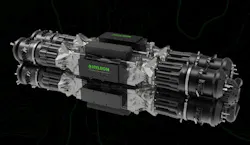
Each shaft of the linear motion machine produces roughly 50 kW of electrical energy, with the four shafts within KARNO creating a 200-kW core.
KARNOS can be activated by a variety of fuel resources, including natural gas, diesel, hydrogen, propane and ammonia, to name some. The fuel agnosticism could create versatility and flexibility for wherever use cases that the linear generator could serve.
“We envisioned it as a fully integrated, self-contained, closed-loop system. Fuel in, electricity out,” Healy said. “The working fluid is sealed helium that never leaves the system. No consumables, no lubrication oil, no after-treatment.
“And by choosing a linear shaft architecture over a traditional rotary one, we eliminated the conversion losses and wear surfaces that come with crankshafts and gearboxes.”
Sounds efficient and simple, right. Manufacturing linear generators such as the Stirling concept, however, are a formidable challenge for traditional manufacturing, Healy recalled.
“The internal heat exchanger performance the cycle requires is simply not manufacturable with traditional processes,” he added. “What Hyliion has done is take those fundamentals and design a modern-day Stirling engine using additive manufacturing-that is the key unlock.”
From sea to land: Linear futures for on-site power

Freed to pursue power generation opportunities where they emerge, Healy and Hyliion see giga-potential in the same places every other on-site power developer does: digital infrastructure, EV charging infrastructure, industrial electrification and mission-critical resiliency and sustainability demands.
In this era where environmental goals have collided with rising demand in an industrial and supercomputing age, the power dynamic requires new ideas.
“Automation, data center buildout, EV charging and rising outages from natural causes are converging at the same time, and the transmission and distribution system is not absorbing any of them effectively, let alone all at once,” Healy said. “The conversation today is no longer about finding the single best technology; it’s about matching the right solution to a set of problems that vary by application. Cost, flexibility, dispatchability and emissions all have to be solved together.”
Proverbially speaking, that collision course won't be charted by continuing to mail the DVDs or selling the books, harkening back to our story’s beginning. It requires a transformation of priorities and strategies to meet power generation demand where it is happening and as quickly as possible.
Hyliion’s Healy recently spent time around NVIDIA founder and CEO Jensen Huang, who heads what suddenly became the world’s biggest AI chipmaker and facilitator. Huang spoke to the immediacy and criticality of the digital and energy intersection challenges facing the world.
“He made a comment that stayed with me,” Healy said of Huang. “He said, ‘AI is not just creating a new computing industry, it is creating a new industrial era, and powering this new infrastructure will require enormous amounts of energy while also driving one of the largest investments in energy infrastructure in generations—modernizing the grid, expanding generation and accelerating sustainable energy.’”
The linear generator and 200-year-old Stirling engine concept may just offer the next-gen solutions right up there or even beyond the promises of small modular reactors, nuclear fusion and hydrogen-powered generation. The difference is that linear generation is already on the ground and doing the work.
What was old is new again in the newest way possible. Course changing is like that sometimes.
Mastering Requirements, Standards and Risk
In a Digitally Transformed Energy Sector
Our free EnergyTech webinar June 25 Featuring Siemens
About the Author

Rod Walton, EnergyTech Managing Editor
Managing Editor
For EnergyTech editorial inquiries, please contact Managing Editor Rod Walton at [email protected].
Rod Walton has spent 17 years covering the energy industry as a newspaper and trade journalist. He formerly was energy writer and business editor at the Tulsa World. Later, he spent six years covering the electricity power sector for Pennwell and Clarion Events. He joined Endeavor and EnergyTech in November 2021.
Walton earned his Bachelors degree in journalism from the University of Oklahoma. His career stops include the Moore American, Bartlesville Examiner-Enterprise, Wagoner Tribune and Tulsa World.
EnergyTech is focused on the mission critical and large-scale energy users and their sustainability and resiliency goals. These include the commercial and industrial sectors, as well as the military, universities, data centers and microgrids. The C&I sectors together account for close to 30 percent of greenhouse gas emissions in the U.S.
He was named Managing Editor for Microgrid Knowledge and EnergyTech starting July 1, 2023
Many large-scale energy users such as Fortune 500 companies, and mission-critical users such as military bases, universities, healthcare facilities, public safety and data centers, shifting their energy priorities to reach net-zero carbon goals within the coming decades. These include plans for renewable energy power purchase agreements, but also on-site resiliency projects such as microgrids, combined heat and power, rooftop solar, energy storage, digitalization and building efficiency upgrades.