SAF Travel: Deutsche Bank Invests in Decarbonizing Lufthansa Air Traffic
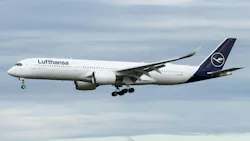
Europe’s second largest air carrier and Germany's biggest bank together are scaling up sustainable aviation fuel (SAF) to decarbonize airline operations across the continent and beyond.
Deutsche Bank is investing in deploying close to 1,600 metric tons of SAF to fuel air transport from fellow German company and aviation giant Lufthansa Group.
If successful, the deployment could reduce Lufthansa’s operations by close to 5,500 metric tons of carbon dioxide emissions. That amount is equivalent to emissions generated by about 520 flights between Frankfurt and London on an Airbus A320neo commercial jet.
"Deutsche Bank's decision to support the deployment of SAF with Lufthansa Group at this scale is a compelling demonstration that more sustainable flying is becoming increasingly important in the business travel sector,” Frank Naeve, senior vice president global sales and distribution at Lufthansa Group, said in a statement. “We are delighted to set a milestone together with Deutsche Bank—and to show that companies can make a measurable contribution to reducing the climate impact of their travel activities through concrete investments in SAF.”
Sustainable aviation fuel can be produced from biomass, animal and vegetable waste streams and refined to meet petroleum-based jet fuel performances. The SAF is often used as a drop-in fuel blended with conventional jet fuel and can help in reducing total lifecycle emissions from refinement to consumption.
Lufthansa, which transported close to 135 million passengers around the world in 2025, has accelerated its buy-in for SAF and offers its corporate customers so-called SAF bulk deals in which they are given Scope 3 emissions reduction certificates. The airliner estimates that corporate investment in SAF can help reduce future C02 emissions by 30%.
"Sustainable aviation fuel is an important instrument for Deutsche Bank in our efforts to nearly halve our CO₂ emissions along our supply chain by 2030 compared with 2019,” said Jörg Eigendorf, Deutsche Bank’s chief sustainability officer. “It is also important for us to send a signal: only if there is reliable demand will SAF producers invest in production and make alternative fuels more competitive.”
Approximately 1,700 companies took Lufthansa Group up on its offer and co-invested in SAF in 2025, according to the company. The German-based airline is second only to Ryanair in volume within Europe.
Lufthansa has signed major SAF supply deals with Shell, OMV, Neste, HSC and Varo. Corporate partners which signed up to invest in SAF through Lufthansa include Tata Communications, CEVA Logistics and Deutsche Bank.
Other airlines and corporate partners which have commenced SAF supply and investment deals are Southwest Airlines, Delta, Bank of America, LanzaJet, Virgin Atlantic, Boeing and Rolls-Royce, among others.
The U.S. Energy Information Administration (EIA) expects global commercial jet fuel consumption to more than double from 96 billion gallons in 2018 to 215 billion gallons in 2050.
Mastering Requirements, Standards and Risk
in a Digitally Transformed Energy Sector
Join us for July 21 EnergyTech Webinar with Siemens
About the Author

Rod Walton, EnergyTech Managing Editor
Managing Editor
For EnergyTech editorial inquiries, please contact Managing Editor Rod Walton at [email protected].
Rod Walton has spent 17 years covering the energy industry as a newspaper and trade journalist. He formerly was energy writer and business editor at the Tulsa World. Later, he spent six years covering the electricity power sector for Pennwell and Clarion Events. He joined Endeavor and EnergyTech in November 2021.
Walton earned his Bachelors degree in journalism from the University of Oklahoma. His career stops include the Moore American, Bartlesville Examiner-Enterprise, Wagoner Tribune and Tulsa World.
EnergyTech is focused on the mission critical and large-scale energy users and their sustainability and resiliency goals. These include the commercial and industrial sectors, as well as the military, universities, data centers and microgrids. The C&I sectors together account for close to 30 percent of greenhouse gas emissions in the U.S.
He was named Managing Editor for Microgrid Knowledge and EnergyTech starting July 1, 2023
Many large-scale energy users such as Fortune 500 companies, and mission-critical users such as military bases, universities, healthcare facilities, public safety and data centers, shifting their energy priorities to reach net-zero carbon goals within the coming decades. These include plans for renewable energy power purchase agreements, but also on-site resiliency projects such as microgrids, combined heat and power, rooftop solar, energy storage, digitalization and building efficiency upgrades.