Balancing Act: U.S. Battery Storage Capacity Races Ahead
There are many paths to intersect sustainability and resilience in a diverse power generation portfolio, but none are perfect.
Solar and wind deliver carbon-free electricity, but neither are fully dependable nor deliver high-capacity factors. Natural gas delivers flexible, peak-level power, but it emits numerous air pollutants. Nuclear is carbon-free and high capacity, but it’s massively expensive and slow to build.
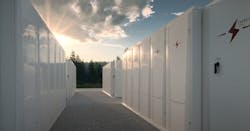
Smooth and balance are what the grid and off-grid generation resources need at the edge. Large-scale and interconnected battery energy storage systems (BESS) increasingly fill that void.
And the market dynamics are undeniable: The U.S. added a record estimated 15 GW of grid-scale and distributed battery capacity in 2025, outpacing 2024’s 12+ GW. The American Clean Power Association (ACP) and research partner Wood Mackenzie predict that nearly 100 GW of new BESS will be added over the coming five years.
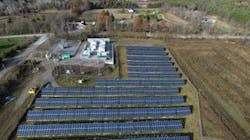
And while the One Big Beautiful Bill Act was aimed at stopping incentives for renewables and EVs, energy storage is racing ahead.
“Energy storage is being quickly deployed to strengthen our grid as demand for power surges and is helping to drive down energy prices for American families and businesses,” said Noah Roberts, ACP Vice President of Energy Storage, in a joint report. “Despite regulatory uncertainty, the drivers for energy storage are strong and the industry is on track to produce enough grid batteries in American factories to supply 100% of domestic demand. Energy storage will be essential to the expansion of the U.S. power grid and American energy production.”
2026 looks to be just as strong as the previous two years in terms of battery storage installed capacity momentum nationwide. Renewable energy developer Terra-Gen announced this week that its Lockhart CL I and II BESS projects reached commercial operations in San Bernadino County, California.
Added to Lockhart solar and BESS resources already in place, the CL I and CL II battery farms will add additional 69 MW and 59.7 MW of installed capacity, respectively. These lithium-ion batteries can generate enough electricity to more than 128,000 households for four hours, according to Terra-Gen.
“We designed this expansion to fit seamlessly with the existing facility and maximize the shared infrastructure,” said Gus Luna, chief development officer for Terra-Gen, in a statement. “The Lockhart complex is a testament to our team’s ability to deliver integrated projects, at scale, on time and to the highest performance and safety standards.”
One of the nation’s most active microgrid project developers and gen-set firms, Enchanted Rock, is increasingly deploying BESS in tandem with gas and renewable distributed energy projects. Providing renewables to energy-hungry data centers, in turn, requires the balance that batteries can bring, new Enchanted Rock CEO John Carrington pointed out in a recent interview with EnergyTech.
“We’re seeing more and more developers with solar and battery storage,” Carrington said. This is because many high-end customers want sustainability along with power resiliency, but solar alone cannot provide prime power.”
The U.S. is not alone in embracing battery energy storage in North America. Energy infrastructure developer PowerBank Corp. this week announced that its 5-MW SFF-06 BESS project was nearing commercial operations in Ontario, Canada.
The SFF-06 project is in the final stages of commissioning with EVLO, which includes several indicators with technical partners to ensure safe installation, interconnection, and commissioning with the Hydro grid for the nine EVLO battery containers, according to the PowerBank release.
Even traditional gen-set and manufacturing companies are creating new divisions to develop energy storage across microgrid, solar and data center energy parks. Those include Wärtsilä, Ford Motor Co., GM, Caterpillar, Siemens and Cummins.
On-Site Power Redefines Mission Critical Energy Strategies
QuickChat with Dinesh Balaji Ramarak of Cummins, Inc.
New at Microgrid Knowledge
About the Author

Rod Walton, EnergyTech Managing Editor
Managing Editor
For EnergyTech editorial inquiries, please contact Managing Editor Rod Walton at [email protected].
Rod Walton has spent 17 years covering the energy industry as a newspaper and trade journalist. He formerly was energy writer and business editor at the Tulsa World. Later, he spent six years covering the electricity power sector for Pennwell and Clarion Events. He joined Endeavor and EnergyTech in November 2021.
Walton earned his Bachelors degree in journalism from the University of Oklahoma. His career stops include the Moore American, Bartlesville Examiner-Enterprise, Wagoner Tribune and Tulsa World.
EnergyTech is focused on the mission critical and large-scale energy users and their sustainability and resiliency goals. These include the commercial and industrial sectors, as well as the military, universities, data centers and microgrids. The C&I sectors together account for close to 30 percent of greenhouse gas emissions in the U.S.
He was named Managing Editor for Microgrid Knowledge and EnergyTech starting July 1, 2023
Many large-scale energy users such as Fortune 500 companies, and mission-critical users such as military bases, universities, healthcare facilities, public safety and data centers, shifting their energy priorities to reach net-zero carbon goals within the coming decades. These include plans for renewable energy power purchase agreements, but also on-site resiliency projects such as microgrids, combined heat and power, rooftop solar, energy storage, digitalization and building efficiency upgrades.