Where the Money Flows: Mercom Report says Energy Storage Attracts Nearly $9B So Far in 2026
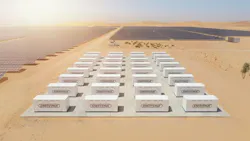
The rise of energy storage systems has taken shape globally as a vital solution for meeting the evolving electrification targets needed to power and sustain next-generation infrastructure.
That trend has held steady in the corporate sector as funding for energy storage companies remains highly resilient. According to research firm Mercom Capital Group’s latest Q2 and 1H 2026 report, energy storage funding climbed to $8.9 billion across 73 deals in the first half of the year.
Mercom highlights that energy storage M&A activity in the corporate sector also experienced a major surge of 275%, with 15 transactions (approximately 14 GW of battery storage capacity) announced in 1H 2026 compared to only four transactions in 1H 2025 (6.1 GW).
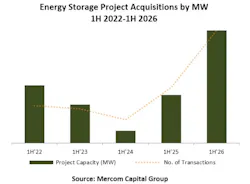
Alongside this acquisition boom, venture capital (VC) firms remained an important factor in growing energy storage companies early on, investing $1.6 billion across 51 financing rounds during the first half of the year.
"Despite continued policy, trade, and supply chain uncertainty, deal activity increased 33%, reflecting resilient investment activity across a broader range of transactions,” Mercom said in its report.
Some of the top VC deals Mercom highlighted in Q1 this year were led by Full Vision Capital, French private equity firm Eurazeo and private equity investor NGP Energy Capital Management. Those landmark rounds contributed to total corporate funding of a total of $2.3 billion across 38 corporate funding deals.
VC-backed innovators scaling next-gen energy storage
EnerVenue, a tech company developing and manufacturing battery systems for grid-scale energy storage, joins similar investments made by venture capitalists in other utility-scale ESS companies such as Colorado-based Liminal Energy and Germany-based Terralayr, highlighting this global momentum. These next-gen battery startups are among those leading the wave of VC-backed companies scaling beyond traditional generator-tied power to develop standalone battery hardware and storage systems to balance the growing level of new generation interconnecting on the grid.
EnerVenue has done so by stepping outside traditional lithium-ion hardware to the production of metal-hydrogen batteries. The firm claims this technology is capable of more than 30,000 cycles without wearing out, bringing a major breakthrough to the clean energy revolution.
Liminal Energy targets AI data center infrastructure, developing proprietary independent hybrid storage solutions. By combining utility-scale energy storage configurations with renewable or gas-powered generation, Liminal systems intend to resolve data center bottlenecks and prevent curtailments, relieving regional grid stress.
Battery energy is instantly deployable and can deal with transient load from AI factories. Underscoring this shift, researchers found that 52% of surveyed data center operators now cite managing AI power dynamics as a major infrastructure impact, representing an increase from 37% in 2025.
As for Terralayr, their focus surrounds a proprietary cloud-based software platform called LAYR that virtualizes battery storage. This approach allows grid operators and data center developers to book battery capacity ranging from a few hours to a number of years, providing instant grid flexibility and resilience without the timeline of adding physical on-site storage infrastructure.
While EnerVenue drives this shift through physical long-duration energy storage (LDES) hardware designed to discharge stored energy at full power for extended periods, Liminal and Terralayr match these principles through flexible project frameworks and virtual software pooling. Together, these complementary strategies highlight the energy sector's growing direction toward anchoring new generation and flattening peak load.
ESS installations outpacing gas-powered generation
As the integration of energy storage and renewables increases worldwide, a growing number of utility-scale projects are delivering longer off-grid power durations upon commissioning. The International Energy Agency (IEA) reports that new installations average four or more hours of storage duration, up from the two-to-three-hour average seen in 2023, specifically supporting longer off-grid operational capabilities.
For countries like Sierra Leone, this will help them sustain the electrification needed to expand their overall national electricity access by 20%, while supporting initial on-site loads of utility-scale operations. It has become critical for developers to tackle notable barriers, such as regulatory uncertainty and delays in grid connection and permitting, according to the IEA.
Within the last five years, battery storage has surged from covering less than 1% of hour-to-hour ramping needs to above 60% in California during the first quarter of 2026. The IEA states that annual global energy storage additions reached 108 GW last year, surpassing the historical peak for gas‑fired power capacity additions (107 GW), cementing ESS as a dominant force in the future energy sector.
About the Author
 Eric Moody