ARPA-E’s $30M 'SUPERHOT' Geothermal Push: How XGS Energy’s Water-Minimal Tech Aims to Unlock Untapped Baseload Power
Key Highlights
- The SUPERHOT program is funding eight U.S. projects, led by national laboratories, universities and private companies for up to a combined $30 million.
- ARPA-E aims to overcome well construction and heat-transfer barriers so superhot wells can generate up to 10 times more clean power per well than traditional geothermal systems.
- XGS Energy is developing a sealed, closed-loop system intended to reduce water loss and expand geothermal deployment in arid regions.
The U.S. Department of Energy’s (DOE) Advanced Research Projects Agency-Energy (ARPA-E) is actively working to accelerate the development of geothermal technologies to provide reliable carbon-free energy and expand access to reliable baseload power.
One of these key areas is deploying innovative approaches to harness “superhot” geothermal resources at temperatures above 705°F and pressures of 22 megapascals (3,191 PSI) or higher. For comparison, standard residential tap water runs at 50 PSI, or roughly 0.35 megapascals.
As a result, ARPA-E initiated the Stimulate Utilization of Plentiful Energy in Rocks through High-temperature Original Technologies (SUPERHOT) program. Originally introduced in January 2025, the program selected eight U.S. projects on Nov. 12, 2026, to receive up to a combined $30 million to accelerate the development of advanced geothermal approaches. As ARPA-E explains, superhot geothermal uses the Earth’s natural heat to generate up to 10 times more clean power per well than traditional geothermal systems.
Conventional geothermal wells max out around 5 to 10 MW of electrical output (rarely exceeding 400°F due to regional limitations), whereas superhot reservoirs can yield 30 to 50+ MW per well. Dr. Robert Mellors, ARPA-E’s program director, told EnergyTech that the U.S. holds at least 15,000 GW of this potential geothermal power beneath its surface, yet existing technologies currently generate less than 4 GW of this resource at utility scale.
A recently announced 50-MW power purchase agreement (PPA) between superhot geothermal project developer Quaise Energy and tech giant Google represents only a small fraction of this projected untapped capacity and momentum toward commercializing utility-scale superhot geothermal energy.
Mellors and his team, leading this ARPA-E SUPERHOT program, aim to “more than triple the output” of individual geothermal wells by overcoming superhot challenges in well construction and heat transfer. Mellors, a geophysicist and seismologist, noted these advancements could help meet growing U.S. energy demand by delivering 10–20 GW of baseload power at less than $30 per MWh by 2040.
“The magic thing about that is that at that point, water becomes supercritical; it has certain properties that make it advantageous for geothermal energy,” he explained. “The hope is that for superhot wells that are at these high temperatures and pressures, they can produce anywhere from three to five times the energy of a normal geothermal well.”
ARPA-E's ‘SUPERHOT’ cohort
The SUPERHOT program advances President Donald Trump’s executive order, Unleashing American Energy, which supports development of domestic geothermal resources to strengthen U.S. energy and national security and help power the nation for decades to come.
The eight selected project awardees are:
- Oak Ridge National Laboratory ($3 million)
- Pacific Northwest National Laboratory ($2.6 million)
- Lawrence Livermore National Laboratory ($5.5 million)
- Los Alamos National Laboratory ($3.5 million)
- XGS Energy ($3 million)
- The University of Oklahoma ($3.1 million)
- The University of Southern California ($3 million)
- Blade Energy Partners, Ltd. ($6.3 million)
“America has vast untapped geothermal resources with the potential to deliver reliable, around-the-clock power. The challenge is turning that potential into commercially viable energy,” ARPA-E director Conner Prochaska told EnergyTech in a statement. “Through ARPA-E’s SUPERHOT program, we are working with national laboratories, industry and research partners to overcome critical technical barriers, reduce development risks and accelerate the path to commercialization.”
Prochaska noted that by advancing these technologies that can withstand extreme geothermal conditions and unlock significantly more energy per well, ARPA-E is helping bridge the gap between “breakthrough research and real-world deployment.”
Overcoming bottlenecks of extreme heat and depth
Many of these eight SUPERHOT awardees are developing enhanced geothermal systems (EGS) to compete with modern power plants. EGS creates human-made geothermal reservoirs by injecting fluid deep underground to control conditions and engineer new fractures. This artificial network re-opens pre-existing fractures, allowing water to pass through hot subsurface rock more efficiently to generate electricity at the surface.
DOE explained that increasing this flow, known as permeability, allows fluid to circulate through the hot subsurface rock and absorb its heat. In many regions, traditional geothermal formations lack enough natural permeability, requiring engineered "man-made" solutions to tap into this vast global heat supply. This highlights the major differences in energy density and engineering requirements between superhot geothermal and conventional methods.
Getting more energy out of a single well, Mellors added, is an opportunity that is widely accessible nationwide.
“If you (dig) anywhere in the Earth, if you go deep enough, you'll hit high temperatures,” he said. “In Washington, if you go down 12 to 15 kilometers, you will hit these high, superhot temperatures. So in theory, it's available anywhere. And that's kind of part of the 15,000 (GW), the number of the estimates of the power available.”
The SUPERHOT program is leveraging these different tech approaches that the eight awardees have chosen to accomplish just that. And if they’re able to successfully develop wells three to five times the energy of conventional geothermal, ARPA-E stated, then that can provide baseload power for the grid.
“Right now, most of the effort is in areas where the high temperatures are a little bit shallower near volcanoes,” said Mellors. “But as the technology progresses, we hope it will expand geographically.”
There are some primary bottlenecks and environmental trade-offs at these depths, Mellors explained. Those main technical challenges include that a lot of this technology is based on oil and gas technology.
“The drill bits, the casing, everything like that. And oil and gas technology only really goes up to about 200°C, maybe 220°C (392°F to 428°F),” said Mellors. “And if the temperature is higher than that, it just starts to break. The electronics fail, the rubber seals fail, everything starts to fail.”
That is why Mellors explained that DOE’s ARPA-E is advancing the SUPERHOT program to establish new technology or revise technology that can survive these conditions for 15 to 20 years and produce power despite these hardware limitations.
According to DOE’s report, Pathways to Commercial Liftoff: Next-Generation Geothermal Power, existing grid infrastructure is well-suited to absorb early EGS capacity. But scaling up to 90 to 300 GW projected by 2050 will require major transmission upgrades. Mellors stated that each partner selected in the SUPERHOT program was chosen to address specific problems within the technology.
“Some of them are looking at the casing, which is the piping. Some of them are looking at the cement. Some of them are looking at the whole system. Some are looking at developing laboratory facilities to validate the technology,” he explained. “Because all that is new, we're addressing it all in pieces of the problem. And some of them are innovative solutions.”
Mellors anticipates that some of the three-year projects will be able to contribute commercially in that timeframe.
“We'll just see how it goes. Some of them are more so transformational, so it'll take longer than that,” he added. “But we're hoping we'll see some results in three years.”
Superhot solutions: XGS Energy’s ‘zero-loss’ closed-loop approach
Next-gen geothermal company XGS Energy is one of two private firms selected to take part in the DOE's ARPA-E SUPERHOT program. Headquartered in Houston, Texas, the company is developing solid-state, closed-loop geothermal systems designed to generate round-the-clock clean energy without relying on natural hot water reservoirs or specific rock permeability.
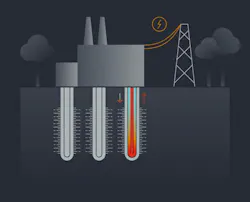
Instead, each single-well unit continuously recycles fluid (typically water) in a sealed, "zero-loss" closed loop. As the water circulates down the outer steel casing, XGS explains that its proprietary thermally conductive materials pull extra heat from the surrounding rock for optimized heat transfer. Once heated, the water returns to the surface through an inner insulated tube to generate power.
Lucy Darago, chief commercial officer at XGS Energy, told EnergyTech that while geothermal can already deliver clean, firm power around the clock, superhot technologies increase both the productivity and efficiency of clean baseload power.
“With 4 GW of geothermal operating in the U.S. today, unlocking even a fraction of the 15,000 GW of superhot potential would add a major source of baseload power that complements intermittent energy sources like wind and solar while strengthening grid reliability as power demand grows,” said Darago.
Water-minimal technology expanding superhot reach to arid regions
Darago explained that energy infrastructure is increasingly being scrutinized for its water footprint, especially in the water-scarce West where most of the U.S.’s best geothermal resources are located. States such as Nevada, Utah and California have increased geothermal initiatives through PPAs to supply growing data operations despite these constraints.
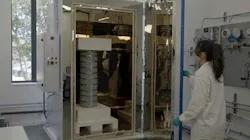
XGS claims its design tackles this challenge directly by producing clean power day and night with 99% less water than nuclear, coal, natural gas and other superhot geothermal designs to deliver water-minimal energy solutions across the U.S.
“The XGS design continuously circulates water within sealed, closed pipes, eliminating pathways for water loss,” she added. “This allows XGS to operate in arid, water-stressed regions like New Mexico and the broader desert Southwest, where geothermal resource is abundant.”
XGS’s partnerships with California Community Power (CC Power) and PNM (Public Service Company of New Mexico) aim to help bridge this water-stress gap to deliver continuous superhot power onto regional grids, where geothermal accounts for a small fraction of power generation today.
“The opportunity with each of these partners is enormous. CC Power brings demand from member agencies representing 2.7 million customers. In New Mexico, our 150 MW project will be 10 times the existing geothermal capacity operating in the state,” Darago said.
XGS views its role in the ARPA-E SUPERHOT program, alongside regional partners identifying local regulatory and grid needs, as a collaborative push to move geothermal from a “promising resource to power on the grid.”
About the Author
 Eric Moody