Liquid Hydrogen for Future Space Travel: CB&I Completes First Non-Vacuum LH2 Fill at NASA Test Facility

Global engineering, procurement and construction (EPC) contractor CB&I is celebrating the completion of its first liquid hydrogen (LH2) fill of its large-scale storage tank as part of testing at NASA’s Marshall Space Flight Center Hydrogen Test Facility (HTF).
The Texas-based company, formerly known as Chicago Bridge & Iron Co., is leveraging over six decades of experience in cryogenic insulation—maintaining at extremely low temperatures to liquify gases—and LH2 storage. The engineering consortium states that liquefying gas is productive in this collaboration due to massively improving energy density, while reducing the need for high compression in heavy systems, enabling the storage of up to 100,000 cubic meters (m3) of fluid.
In 2025, CB&I established a joint program with NASA, Shell, GenH2 and the University of Houston to develop an affordable pathway for large-scale LH2 storage solutions in real-world operational environments, including liquefied natural gas systems, low-temperature applications and long-term tank performance.
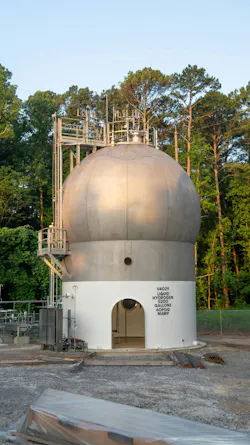
CB&I claims its 20-cubic-meter non-vacuum insulation technology integrated into NASA’s Hydrogen Test Facility helps reduce capital costs and shortens project field testing schedules.
“The successful first fill of our demonstration tank marks an important step toward validating a more cost-effective approach to large-scale liquid hydrogen storage,” said Yogesh Meher, vice president of engineering at CB&I, in a statement. “By demonstrating this technology under real operating conditions at NASA’s Hydrogen Test Facility, we are accelerating the path to commercial deployment and helping enable the hydrogen economy at scale.”
CB&I highlights that traditional LH2 storage tanks rely on a double-walled vacuum insulation system. This requires extensive on-site structural welding, precise field testing and specialized equipment to ensure a deep vacuum seal around the system.
CB&I is bypassing these structural vacuum logistics by installing solid or foam insulation materials on-site instead of testing for microscopic vacuum leaks. The company adds that these non-vacuum insulated components can be easily assembled in an off-site workshop and shipped to the location, reducing on-site labor hours at a project’s facility.
During the demonstration, CB&I’s 20 m3 tank tripled the total LH2 storage capacity of NASA’s HTF, refilling as frequently as once per day. This enhanced capability creates a unique platform for accelerated testing of insulation systems through repeated thermal cycles, while simultaneously expanding the HTF’s capacity to conduct long-duration LH2 tests.
The demonstration tank is fully integrated with the facility’s existing LH2 infrastructure. Data gathered through repeated thermal cycles over the coming months will reportedly support technology advancements for existing and large-scale LH2 infrastructure, serving both fuel storage and aeronautics research and development.
This technological push comes at a critical time for NASA's supply chain as the agency hopes to create a lunar economy and perhaps eventually travel to Mars as part of a manned mission. In late 2025, NASA awarded LH2 supply contracts of more than $147 million combined to Plug Power, Inc. and Air Products and Chemicals, Inc., of Allentown, Pennsylvania, to supply up to roughly 37 million pounds of liquid hydrogen for use across its U.S. facilities.
CB&I built the first LH2 storage sphere in 1960 for NASA’s Gemini and Apollo programs. This includes the world’s largest LH2 storage sphere completed in 2022 to support NASA’s Artemis program. Since then, CB&I has constructed more than 130 LH2 storage spheres worldwide.