Texas LNG Nears Final Investment Decision with Major European Offtake Agreement
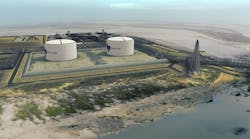
In another global deal proving global interest in U.S. liquefied natural gas, Glenfarne’s latest LNG terminal project planned off the Texas Gulf Coast is now fully subscribed after a long-term purchase deal committed by a European energy customer.
Texas LNG Brownsville, part of Glenfarne Group, has signed a definitive 20-year sales and purchase agreement with RWE Supply & Trading for the supply of 1 MTPA of LNG, equivalent to approximately 13 cargoes of LNG and 1.4 billion cubic meters (BCM) per year of natural gas, respectively.
Deliveries will be shipped by RWE to locations in Europe and worldwide. Glenfarne has agreed on conversion of all of Texas LNG’s previously announced heads of agreements to fully bind long-term definitive offtake agreements.
Glenfarne secured an earlier 20-year sales and purchase agreement with Gunvor Singapore in September 2025 for 500,000 metric tons per year. The owners are nearing a final investment decision on Texas LNG.
“With the completion of offtake negotiations, Glenfarne is now focusing on finalizing the financing process as we advance toward a final investment decision in early 2026,” said Vlad Bluzer, Partner at Glenfarne Group, LLC and Co-President Texas LNG.
The Federal Energy Regulatory Commission has given a final order authorization for construction and operation of Texas LNG and approved the project’s schedule, with completion expected by 2029.
Texas LNG utilizes electric drive motors for LNG production, which will help the project become one of the lowest-emitting LNG terminals in the world. The RWE agreement provides a framework to monitor, report and verify GHG from the well head to LNG loading to document the role of LNG cargoes produced from the Texas LNG terminal in supporting the reduction of GHG emissions across the LNG value chain.
Kiewit will be responsible for the engineering, procurement, and construction of Texas LNG under a turnkey structure.
The LNG terminal is planned to be constructed on a 625-acre site with direct link to the Permian Basin and Eagle Ford gas reserves. It is designed to produce four million metric tons of exportable LNG annually. LNG is natural gas chilled and liquefied to reduce gas pressure and make it stable for long-distance shipping.
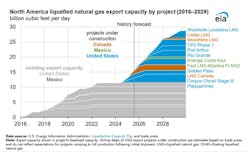
The U.S. is the world’s largest exporter of LNG at more than 10 billion cubic feet per day (bcfd), with new projects such as Texas LNG, Golden Pass and Woodside Louisiana projected to add at least another 13 bcfd before 2030.
Glenfarne is also the developer behind the pending Alaska LNG project.
About the Author

Rod Walton, EnergyTech Managing Editor
Managing Editor
For EnergyTech editorial inquiries, please contact Managing Editor Rod Walton at [email protected].
Rod Walton has spent 17 years covering the energy industry as a newspaper and trade journalist. He formerly was energy writer and business editor at the Tulsa World. Later, he spent six years covering the electricity power sector for Pennwell and Clarion Events. He joined Endeavor and EnergyTech in November 2021.
Walton earned his Bachelors degree in journalism from the University of Oklahoma. His career stops include the Moore American, Bartlesville Examiner-Enterprise, Wagoner Tribune and Tulsa World.
EnergyTech is focused on the mission critical and large-scale energy users and their sustainability and resiliency goals. These include the commercial and industrial sectors, as well as the military, universities, data centers and microgrids. The C&I sectors together account for close to 30 percent of greenhouse gas emissions in the U.S.
He was named Managing Editor for Microgrid Knowledge and EnergyTech starting July 1, 2023
Many large-scale energy users such as Fortune 500 companies, and mission-critical users such as military bases, universities, healthcare facilities, public safety and data centers, shifting their energy priorities to reach net-zero carbon goals within the coming decades. These include plans for renewable energy power purchase agreements, but also on-site resiliency projects such as microgrids, combined heat and power, rooftop solar, energy storage, digitalization and building efficiency upgrades.