The Rise of Battery Storage, Constraints in Supply Chain and a Holistic Path Forward: Jacobs Perspective

Dallas-based engineering and solutions provider Jacobs is working on utility-scale, distributed energy and digital infrastructure projects worldwide. The greatest benefit of that diverse workload is seeing generational technology evolution up close on many fronts.
And that evolution is diversifying as demand rises and solutions multiply, growing from the singularity of past coal-fired power generation to a diverse set of options with natural gas, solar, wind, hydrogen and large-scale batteries.
Energy and infrastructure-sector companies aiming at long-term success must multiply their work in a so-called Industrial Compute Age involving exponential data computing, automation and re-industrialization growth. The commercial and industrial energy transition is scaling up at a pace perhaps not in action since the manufacturing glory days of the 1950s.
The only thing slowing down this acceleration might be the supply chain to feed it.
“It’s no surprise to see some supply chain constraints,” said Fiachra Ó’Cléirigh, executive vice president and general manager for Energy and Power at Jacobs, in an exclusive interview with EnergyTech.com. “OECD (Organization for Economic Co-Operation and Development) countries are competing for the same supply chain. High demand can cause scarcity.”
Time to power: Double-edged sword must swung with care

This pressure on the global supply chain is across the board. It might be grid constraint in one sector and lack of resource adequacy in another. The documented shortfall in utility-scale generation is helping drive a movement toward “behind-the-meter” and off-grid power solutions for cloud-based and AI-enabled data facilities which do not want to be chained to delayed utility interconnections for energy.
And yet those developers need reasoned counsel on how to do these power connections with safety, resiliency, sustainability and affordability in mind. Time to power is a double-edged sword which must be swung carefully.
Some of it might be hype or a bubble, but the overall challenge is critically real and immediate.
“One of the challenges for utilities is understanding the load and scaling up to meet what the connected load will be,” Ó’Cléirigh of Jacobs noted. “At the fringes you will see some speculation . . . but . . . utilities are smart people who recognize what the hyperscalers and credible developers look like.”
No universal answers, not even behind the meter
Next-gen digital infrastructure surely requires vast amounts of energy capacity to empower what AI does, but those companies also are bound by the rules of accounting and affordability like any other business. Projects must meet the cost-benefit threshold as well as the cost curve.
So behind-the-meter might not always provide the universal answer, but energy storage certainly plays a part, Ó’Cléirigh told EnergyTech.
“You’ve got a very special time in the market, recognizing the value in the market for batteries,” he said. “They can be solutions to problems they couldn’t solve a number of years ago, simply on cost.”
Battery storage emerges as a versatile energy jack of all trades
Battery storage has long provided balancing services in intermittent renewables such as solar and wind, helping to smooth the so-called “duck curve” as it is known in California, describing when electricity demand is highest and solar capacity is lowest, or vice versa. Installation is never cheap, but lithium-ion battery and storage costs have fallen nearly 90% in the past two decades, according to Bloomberg NEF and other research.
These days, battery storage plays in grid services markets, direct-current applications and can respond to transient load fluctuations in AI factories within milliseconds. It matches that versatility with a very competitive price point these days below $80 per MWh, compared to $1,000/MWh in the early 2010s.
“The real catalyst” in the growth of battery storage applications “is the cost curve,” Ó’Cléirigh pointed out. “As batteries are more cost-effective, they can provide more solutions. If you go back two decades, the financial cases didn’t stack up because where they were in the cost curve.”
Lithium-ion is predominant but only one of the battery technology options available as demand drives innovation and innovation drives new methods.
Energy storage project developer BaroMar has contracted Jacobs to develop the preliminary design for a first-ever underwater, long-duration energy storage pilot project off the coast of Cyprus. The 4-MWh pilot utilizes marine technologies and compressed air storage to take excess electricity off the nearby grid and store it below the sea surface at a relatively low levelized cost of energy.
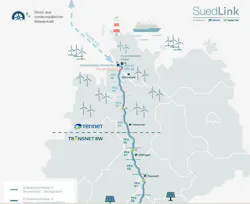
Equally exciting on the energy storage versatility front are projects involving Jacobs in Europe and Australia. The former is the 700-kilometer SuedLink high voltage transmission line which is designed to move wind-generated electricity in the North Sea to northern German and its southern states. That’s not all—SuedLink also is designed to move solar power generated in southern Germany up north to other markets.
Jacobs also is working on an Australian project which moves hydropower one direction and solar the other.
The macro grid still matters
Ó’Cléirigh, who is based in Ireland, sees that kind of capability as universal for battery storage in the future. He does see the currently hyped “behind-the-meter” movement as viable within critical limits, but not a universal solution in itself.
“Grid-tied and on-site solutions can co-exist,” he said, a viewpoint shared by at least one hyperscaler in Amazon Web Services. AWS is maintaining its utility relationships as it builds out the next generation in its cloud-based networks.
The grid is indispensable for what’s coming, even if it is playing catch-up.
“It’s a grid buildout, and that’s the bread and butter of what we’ve got to do,” Ó’Cléirigh added.
Better Midstream Decisions Start with Better Data
New White Paper by Siemens: Download here
About the Author
 Rod Walton, EnergyTech Managing Editor
Rod Walton, EnergyTech Managing Editor
Managing Editor
For EnergyTech editorial inquiries, please contact Managing Editor Rod Walton at [email protected].
Rod Walton has spent 17 years covering the energy industry as a newspaper and trade journalist. He formerly was energy writer and business editor at the Tulsa World. Later, he spent six years covering the electricity power sector for Pennwell and Clarion Events. He joined Endeavor and EnergyTech in November 2021.
Walton earned his Bachelors degree in journalism from the University of Oklahoma. His career stops include the Moore American, Bartlesville Examiner-Enterprise, Wagoner Tribune and Tulsa World.
EnergyTech is focused on the mission critical and large-scale energy users and their sustainability and resiliency goals. These include the commercial and industrial sectors, as well as the military, universities, data centers and microgrids. The C&I sectors together account for close to 30 percent of greenhouse gas emissions in the U.S.
He was named Managing Editor for Microgrid Knowledge and EnergyTech starting July 1, 2023
Many large-scale energy users such as Fortune 500 companies, and mission-critical users such as military bases, universities, healthcare facilities, public safety and data centers, shifting their energy priorities to reach net-zero carbon goals within the coming decades. These include plans for renewable energy power purchase agreements, but also on-site resiliency projects such as microgrids, combined heat and power, rooftop solar, energy storage, digitalization and building efficiency upgrades.