Power Generators Get it. The Grid Gets It. Batteries are Multi-Tool Players
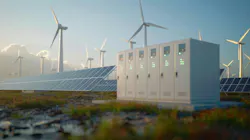
Once upon a time energy industry integrators struggled mightily to figure out if grid-connected or distributed battery storage was worth the investment and defining exactly what it offered.
Is it a transmission resource for frequency regulation? Generation Resource for peak demand? Distribution assets for home resiliency? Does it deliver a return on investment?
Time has answered all those questions and even delivered more answers than previously asked. Yes, yes, yes and yes. Costs for utility-scale and distributed batteries have gone down dramatically, while energy storage installations skyrocketed to an all-time high of nearly 19 GW or 57.6 GWh of generation capacity in the U.S. last year, according to Solar Energy Industries Association and Benchmark Mineral Intelligence.

“This record-breaking year for energy storage is just the beginning of its rise as a cornerstone of America’s energy future,”said Darren Van’t Hof, Interim President and CEO of the Solar Energy Industries Association, when those statistics were announced earlier this year. “Whether it’s paired with solar or standing on its own, energy storage lowers consumer costs, makes the grid more reliable, and keeps the power on in homes during outages. Deployment is rising fast, but without a course correction from federal actions targeting the industry, Americans will face higher electricity prices and a less resilient energy system.”
The federal response now seems to be trending positive, such as the U.S. Department of Energy’s announcement of $500 million in grants to fund development of domestic critical mineral and battery supply chains. Thursday’s DOE release included details of $100 million grants to both Waterleaf P1 Holdco and Jervois. The projects are focused on developing lithium and cobalt refining—two key components of battery energy storage systems (BESS)—in the U.S.
"For too long, America has depended on foreign actors for critical materials essential to modern life that underpin our economy, energy security, and national security," said U.S. Secretary of Energy Chris Wright.
Even political leaders of both parties are now recognizing the versatility of battery storage whether it’s grid-scale or distributed deployment, whether it’s paired with gas-fired power near digital infrastructure or integrated with renewable energy to iron out intermittency challenges.
Power generators, on-site power developers embracing the battery
What might have started out as singular solar smoothing has muscled up as a grid-level resource which can handle the transient load swings of artificial intelligence. Solar, wind, gas and nuclear all have their place in the power generation firmament, but battery storage is rising on a multi-faceted star in its own right.
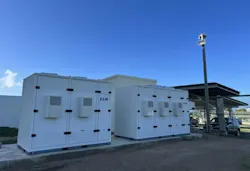
One big sign is that nearly all the major turbine and power generation firms have or are creating battery storage divisions of their own. Cummins, Caterpillar, GE Vernova, Hitachi Energy, Mitsubishi Power and Siemens, through its Fluence Energy joint venture formed with AES, have created macro-scale battery storage products for inclusion either in hybrid or standalone variations.
“We need energy as fast as we can from all sources, and storage is a key component,” Bobby Butler, director of sales at project developer ELM Microgrid, said during a Microgrid Knowledge Quickchat interview earlier this year. He noted that systems such as these can be deployed in a year or two, which is considerably faster than the time it takes to build and commission a traditional power plant.
No longer just an add-on to renewables, battery storage can be paired with any generation source to strengthen and improve efficiency — even nuclear or gas-fired power plants.
“They add a safety net that’s needed,” Butler pointed out.
In a separate Quickchat, Cummins Inc.'s Chetan Chandore, new energy solutions marketing leader for the power generation equipment firm, highlighted the evolving battery energy storage landscape. Microgrids are a huge mover driving that scaling up, he noted.
"We are seeing 50% to 70% of new microgrids include battery energy storage, and that jumps to 70% to 90% for remote off-grid systems where storage is absolutely making the renewable viable," Chandore said. "In a nutshell, BESS is an essential element of microgrids for the customer."
Getting a charge out of grid versatility
The latest evidence of that global demand for that safety net comes from GE Vernova, which today announced it was chosen to provide 3.075 GWh of battery storage for Quinbrook’s Supernode BESS project in Queensland, Australia. The Stage 3 contract builds on the power generator’s earlier work at Supernode, which is one of the largest battery storage sites in that nation.
“Battery storage is becoming part of the operating foundation of modern electricity systems,” said Ed Torres, Business Leader Power Conversion & Storage, GE Vernova’s Electrification segment, in a statement. “Supernode shows what is possible when storage, power conversion and intelligent controls work together at scale. Our engineering and integration work helped Supernode Stage 3 secure Generator Performance Standards acceptance. This important grid-connection milestone demonstrates the strength of our technology and our ability to support complex projects in Australia’s demanding grid-connection environment.”
State of the Market:
Power Quality Fluctuations
New White paper by Ubicquia
Supernode is defined as a “grid-forming” battery storage project, strategically located within Queensland’s electricity network to perform as a buffer for the power system. It stores electricity when supply is high and can discharge during peak demand or renewable generation fluctuations.
“From the outset, Supernode was designed as more than just a battery storage project. Its unique location at the heart of Queensland's transmission network makes it ideally placed to support the state’s transitioning power system well into the future,” James Allan, senior director at Quinbrook, said. “The site also has capacity for a further 520 MW of expansion, which could include battery storage, data centers or a combination of both. Opportunities to develop infrastructure at this scale, in such a strategically connected location, are exceptionally rare.”
GE Vernova will provide Supernode’s power conversion system, shifting the direct current produced from the battery storage unit into alternating current for the Australian grid transmission system. The company also will handle plant controls, system integration and grid-connection support.
Google this: BESS can deliver home or grid-wide services
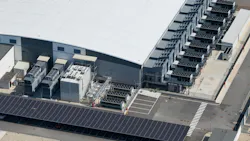
Large-scale battery configurations are certainly making an impact worldwide, but the energy storage resource is raising its profile on the residential level, as well. Virtual power plant (VPP) integrator Voltus has partnered with home solar and battery firm Sunrun with residential-scale capacity which can be aggregated into the grid to support Voltus’ “Bring Your Own Capacity” offering for hyperscaled AI data centers.
Sunrun now manages 4.6 GWh of residential battery storage which is capable of transferring to the grid and providing resilience and demand response services.
Voltus is aggregating enough potential distributed energy resource (DER) capacity that Google signed a three-year “Bring Your Own Capacity” agreement. Voltus will aggregate up to 100 MW of grid-connected DERs into a Google-funded VPP flowing into the PJM grid system in the eastern U.S.
PJM is the largest U.S. grid operator and regional transmission operator (RTO) and is struggling with constraints in matching rising AI and data center electricity demand with new generation. The interconnection’s latest resource auction procured almost 150 GW of capacity, but its reserve margin fell to only 14.4%, 6% lower than needed to confidently protect against historic peak load or outage events.
“The RTO, as a whole, failed the market structure test...resulting in the application of market power mitigation to all existing generation capacity resources,” read PJM’s executive summary of that auction result.
Finding viable use cases at homes, utilities and cooperatives
Microgrid developers such as PowerSecure are increasingly integrating battery storage into their grid-edge project planning. Wyoming electric cooperative Power River Energy has contracted PowerSecure to develop a utility-scale energy storage and solar generation project in Moorcroft.
The Labelle Prairie solar-storage hybrid will aid Powder River Energy in handling grid-level peak demand challenges driven by industrial and rural load expansion, the company said. The grid smoothing system centered around the solar and batteries may help Powder River reduce annual wholesale power costs by $1 million, according to the release.
PowerSecure’s solution will install a 5-MW KORE Power battery storage system with total discharge capacity of 21.6 MWh, coupled with a 1.25-MW ground-mounted solar array.
PowerSecure will launch a new webinar at EnergyTech.com next Wednesday, August 26, at 11 a.m. Eastern time (10 CT). “The Emerging Microgrid Technology for Speed to Power for Data Centers” will feature Todd Jackson, vice president of corporate development at PowerSecure, discussing holistic and hybrid approaches to meet the unique challenges of digital infrastructure demand.
The webinar is free and will be on demand for several months after Wednesday’s live webcast. Click here to learn more and register.
EnergyTech covers the World of C&I Energy Transition
Follow us on LinkedIn
About the Author
 Rod Walton, EnergyTech Managing Editor
Rod Walton, EnergyTech Managing Editor
Managing Editor
For EnergyTech editorial inquiries, please contact Managing Editor Rod Walton at [email protected].
Rod Walton has spent 17 years covering the energy industry as a newspaper and trade journalist. He formerly was energy writer and business editor at the Tulsa World. Later, he spent six years covering the electricity power sector for Pennwell and Clarion Events. He joined Endeavor and EnergyTech in November 2021.
Walton earned his Bachelors degree in journalism from the University of Oklahoma. His career stops include the Moore American, Bartlesville Examiner-Enterprise, Wagoner Tribune and Tulsa World.
EnergyTech is focused on the mission critical and large-scale energy users and their sustainability and resiliency goals. These include the commercial and industrial sectors, as well as the military, universities, data centers and microgrids. The C&I sectors together account for close to 30 percent of greenhouse gas emissions in the U.S.
He was named Managing Editor for Microgrid Knowledge and EnergyTech starting July 1, 2023
Many large-scale energy users such as Fortune 500 companies, and mission-critical users such as military bases, universities, healthcare facilities, public safety and data centers, shifting their energy priorities to reach net-zero carbon goals within the coming decades. These include plans for renewable energy power purchase agreements, but also on-site resiliency projects such as microgrids, combined heat and power, rooftop solar, energy storage, digitalization and building efficiency upgrades.