CPV Shay Energy Center 2031: Coming to Partial Rescue for PJM's Grid Capacity Challenges

The largest U.S. grid system operator will be persistently challenged by fast-growing data centers and artificial intelligence load from now through the early 2030s, at least.
Future help is on the way in the form of a massive new well-supplied West Virginia gas-fired power plant where crews are starting construction next year.
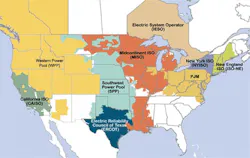
Independent project developer Competitive Power Ventures announced this week that it has secured a 10-year, natural gas supply agreement for the 2.1-GW CPV Shay Energy Center. Once completed by 2031, the combined cycle gas turbine plant in Doddridge County is being designed to deliver wholesale electricity directly into the PJM Interconnection Grid, which serves 13 states in the eastern U.S.
PJM anticipates that data centers, AI factories and other large industrial loads will add as much as 70 GW of new electricity demand by the mid- to late 2030s. Recently, the independent system operator announced its 2028-2029 capacity auction procured close to 150 GW of power commitment, although that’s a stretch in an interconnection system which serves more than 60 million customers and hundreds of data center loads.
In fact, PJM leadership has warned that its secured grid capacity was below expectations and could decrease its installed reserve margin to less than 15%, 5 percentage points below the desired 20% needed to protect the grid against an extreme peak event or other crisis.
PJM’s territory also includes northern Virginia, which contains the highest density of data centers in the U.S.
The Shay Energy Center will not come along for another two years later than that 2029 period, but its generation capacity should make a strong impact on the beleaguered PJM.
CPV’s natural gas burn assured by vast Marcellus reserves
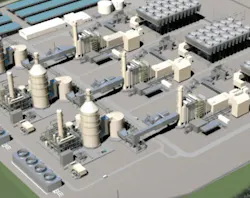
CPV will be supplied with ample natural gas through its power setback gas sale agreement with EQT Corp. The $3 billion CPV Shay power plant could burn about 100 billion cubic feet of gas per year, which seems like a tremendous amount but pales in comparison to the 9 trillion cubic feet produced annually in the gas-rich Marcellus Shale which lies beneath West Virginia and much of Appalachia.
“This is a strong partnership and sets the foundation for the project’s commercialization,” said Peter Podurgiel, President of CPV, in a statement. “Since first announcing our plans to develop CPV Shay, we have understood the critical need for new generation that continues to increase in the PJM region. Together with EQT, we will be able to provide dispatchable generation to help support a responsible energy transition in an area with increasing power demands.”
The Utica Shale, which lies underneath the same region at different depths than the Marcellus formation, raises Appalachia’s gas production to about 33 billion cubic feet per day or close to 12 trillion cubic feet annually, according to the U.S. Energy Information Administration.
Under the terms of the deal, EQT will cover all of Shay’s anticipated gas burn.
EQT owns and manages close to 2 million net acres of natural gas production and midstream assets in the Appalachian Basin including West Virginia. The producer holds about 27.6 trillion cubic feet of proved reserves within the Marcellus Shale, according to reports.
Gas fits the pace of Speed to Power
This kind of power capacity can meet data center load with power generation which reduces carbon dioxide emissions compared with historical coal-fired power. Grid operators and utilities are struggling to keep pace with advancing data center capacity after close to a decade of flat load growth.
“Partnerships like this demonstrate what’s possible when producers and power generators work together to meet America’s growing energy needs,” said EQT President and CEO, Toby Z. Rice. “We look forward to working alongside CPV to help deliver affordable, reliable energy for years to come, while advancing our shared commitment to fostering new, lower-carbon generation technologies.”
The “speed-to-power” push for faster generation project development is increasingly utilizing the vast U.S. natural gas resources to expand flexible electricity generation more quickly to meet data center growth. While many project developers are adding battery storage and solar with an eye toward future small modular reactor nuclear plants, the availability and timing of natural gas connection is dominating the current power generation build-out plans.
The CPV Shay Energy Center will revolve around three 1x1 combined cycle configurations using GE Vernova’s 7HA.03 gas turbines and carbon capture technologies to reduce emissions.
CPV has built multiple gas-fired, solar and wind energy projects across the nation. It is owned by Israeli-based OPC Energy.
Emerging Microgrid Technology
Speed to Power for Data Center Customers
Aug. 26 EnergyTech Webinar Featuring PowerSecure
About the Author

Rod Walton, EnergyTech Managing Editor
Managing Editor
For EnergyTech editorial inquiries, please contact Managing Editor Rod Walton at [email protected].
Rod Walton has spent 17 years covering the energy industry as a newspaper and trade journalist. He formerly was energy writer and business editor at the Tulsa World. Later, he spent six years covering the electricity power sector for Pennwell and Clarion Events. He joined Endeavor and EnergyTech in November 2021.
Walton earned his Bachelors degree in journalism from the University of Oklahoma. His career stops include the Moore American, Bartlesville Examiner-Enterprise, Wagoner Tribune and Tulsa World.
EnergyTech is focused on the mission critical and large-scale energy users and their sustainability and resiliency goals. These include the commercial and industrial sectors, as well as the military, universities, data centers and microgrids. The C&I sectors together account for close to 30 percent of greenhouse gas emissions in the U.S.
He was named Managing Editor for Microgrid Knowledge and EnergyTech starting July 1, 2023
Many large-scale energy users such as Fortune 500 companies, and mission-critical users such as military bases, universities, healthcare facilities, public safety and data centers, shifting their energy priorities to reach net-zero carbon goals within the coming decades. These include plans for renewable energy power purchase agreements, but also on-site resiliency projects such as microgrids, combined heat and power, rooftop solar, energy storage, digitalization and building efficiency upgrades.