Elementl Power Partners with GE Vernova Hitachi to Advance Future 1.5 GW SMR Project in Southeast Ohio
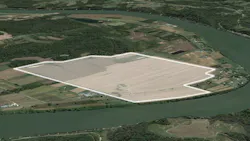
Independent power plant developer Elementl Power is planning to build a utility-scale small modular reactor (SMR) nuclear facility with up to 1.5 GW of capacity in Southeast Ohio.
Elementl plans to team up with GE Vernova Hitachi Nuclear Energy through an Early Works Agreement, which allows limited preparation work before the finalization of the main construction contract.
By utilizing GE Vernova Hitachi’s BWRX-300 small modular reactor design for this project, Elementl is pushing to bring the first new SMR projects online in the U.S. No commercial microreactors or SMRs are yet built or operational in the U.S., but multiple demonstration projects are in design phases for deployment in the late 2020s and early 2030s.
Construction on the first unit for Elementl’s project is expected to begin in 2030 with hopes of completion in 2034, subject to a final investment decision and regulatory approvals.
Elementl has agreed to purchase the roughly 700-acre site along the Ohio River in Meigs County, approximately 100 miles southeast of Columbus, from non-profit wholesale power supplier American Municipal Power, according to a release. The company adds it anticipates creating thousands of jobs in Ohio to work on the project.
“Elementl builds partnerships to accelerate the financing and delivery of reliable, clean, around-the-clock nuclear power, and we're committed to working closely with Letart Township, Meigs County, the state of Ohio and beyond throughout this process,” Elementl CEO Chris Colbert said in a statement.
If constructed, it will not be funded through electric customer rates but funded by Elementl itself. Instead, the company will generate revenue through a private developer merchant model, primarily utilizing Power Purchase Agreements (PPA) with a corporate customer.
Partnerships with corporate tech giants such as Google allow Elementl to bypass traditional utility rate-basing methods, avoiding charges to everyday electric consumers while strategically structuring and monetizing nuclear projects.
“Nuclear projects are substantial economic anchors,” added Colbert. “With a proud industrial legacy, southeast Ohio brings the foundation and workforce needed for a project of this magnitude.”
"Nuclear energy will play an essential part of the future energy mix and projects like this will strengthen the foundation for long-term energy security, economic growth, and reliable electricity generation in the United States,” said GE Vernova CEO Scott Strazik.
Grid operator PJM Interconnection is expected to review and respond to Elementl's application later this year. Elementl recently filed a request with PJM to connect the proposed facility to the regional transmission system for the first 600 MW of output.
If the project moves forward, the site will require regulatory approvals from multiple state and federal agencies, including the U.S. Nuclear Regulatory Commission (NRC) and the Ohio Power Siting Board.
According to the Nuclear Energy Institute, nuclear energy currently generates 76.2% of Ohio’s carbon-free electricity capacity, powering 1.5 million homes. This vastly outperforms the state’s combined output from wind and solar generation, representing 9 million metric tons of carbon emissions avoided by nuclear energy.
In 2024, Ohio lawmakers passed House Bill 308, legislation that defines nuclear energy as "green energy” because it generates no carbon emissions. The designation declares Ohio—which currently has two nuclear plants, the Perry Nuclear Power Plant and Davis-Besse Nuclear Power Station—as a partner in this fast-growing next-gen nuclear renaissance.
Connect Formulation, Manufacturing and Quality
Across the Digital Enterprise
New Executive Brief from Siemens
About the Author
 Eric Moody