The Promise of Mesa del Sol: Nuclear Fusion Startup Plans New Mexico Demonstration Site by 2030
Key Highlights
- - The collaboration with Lawrence Livermore National Laboratory has achieved a record of 3,000 high-voltage pulses, delivering 60 GW in 100 nanoseconds, a milestone toward power-scale fusion.
- - Achieving sustainable fusion requires temperatures of about 100 million degrees Celsius and advanced magnetic confinement, with current efforts focusing on tokamak and stellarator designs.
- - Investment in nuclear fusion has exceeded $4.5 billion in the past year, reflecting growing private sector confidence in fusion as a future energy source.
- - Major tech companies like Google and Microsoft are interested in fusion's potential to meet rising electricity demands for AI and data centers, signaling commercial viability.

Developing and harnessing nuclear fusion on a commercial scale is certainly years, maybe a decade or more away as researchers strive to advance the same reaction which powers the sun to achieve net energy gain in laboratories around the world.
This timely and cosmically daunting challenge, however, has not stopped eager fusion startups and their backers from making universally ambitious plans to tap into the power generation promise by the end of this decade or early 2030. One physical sign of that enthusiasm is the move to start building facilities for testing and manufacturing fusion reactors.
In a field where intentions are grand and progress is slow and steady–putting it gently–startup Pacific Fusion is considered one of the industry leaders. The company Tuesday announced it is ceremonially breaking ground on a $1 billion research and manufacturing campus in Albuquerque, New Mexico.
The campus at Mesa del Sol is intended to be where Pacific Fusion houses its demonstration system, aiming at net energy gain by 2030. Net energy gain is a fusion term for producing more energy than what is already stored in the fusion machine.
“America pioneered the breakthroughs that brought fusion within reach. Pacific Fusion is focused on converting that scientific leadership into industrial capability and infrastructure that strengthens U.S. energy leadership and national security,” Keith LeChien, co-founder and chief technology officer, said in a statement. “Today’s groundbreaking shows that America can still build the hard things, and build them faster than any other country, including China.”
3,000 high-voltage shots and counting
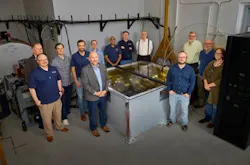
LeChien and the team at Pacific Fusion hold some industry credibility in working toward commercial-scale net energy gain. The company is part of a collaboration with the Lawrence Livermore National Laboratory in California, working together on the Sirius prototype, called a four-stage prototype impedance-matched Marx generator.
Last month, the partnership between Livermore National Lab and Pacific Fusion celebrated a fusion experimental milestone of 3,000 “shots,”or that many high-voltage electrical discharges, which is reportedly a record output for pulses. According to Pacific Fusion and Livermore National Lab, the pulses achieved in the Sirius experiment delivered 60 GW to a resistive load in a 100-nanosecond pulse.
This milestone is still symbolically a galaxy away from turning fusion into gigawatt-scale controllable carbon-free power with high capacity factors, but it’s a duly noted sign of progress toward the goal of commercial nuclear power to match the fission reactors operating all across the world. Fission creates energy by splitting atoms, while fusion uses critical materials to fuse the nuclei and generate high-intensity power in the same general way that the sun uses hydrogen and converts H2 into helium.
"We are at a unique moment in time when science and technology advances have made the possibility of commercial fusion energy very real,” Livermore National Lab Director Kim Budil said in a statement around the earlier 3,000-shot achievement. “This is a place where our critical national security missions and the goal of energy dominance are truly aligned."
Crossing the 100-megajoule threshold soon?
Such progress is motivating Pacific Fusion and other similar startups to move ahead with building plans for when fusion net energy gain becomes the norm. When construction is completed, the Pacific Fusion demonstration system at Mesa del Sol will aim for producing bursts of high-energy fusion output exceeding 100 megajoules, or close to 28 kWh each.
The promise of fusion certainly has the attention of data center and artificial intelligence hyperscalers such as Google and Microsoft. In fact, the six-year-old Pacific Fusion has former Google CEO and chairman Eric Schmidt on its board of directors.
“Electricity demand is already rising rapidly, and today’s energy system was not built for what comes next,” Schmidt said. “Powering the AI era will require bold investment in technologies that can meet that demand at scale. Pacific Fusion is showing how America can turn scientific breakthroughs into real infrastructure and economic opportunity.”
The state’s largest electric utility, Public Service Co. of New Mexico, also is working with Pacific Fusion and championing efforts to produce a carbon-free grid for the state.
Google also has signed a deal with another startup Commonwealth Fusion for a 200-MW offtake agreement if and when that company’s generation site is completed and operational in Virginia.
Pacific Fusion and Commonwealth Fusion are not the only startups trying to fuse investor enthusiasm with real-world progress on net energy gain. Helion, which is based out of Everett, Washington, has secured two nuclear-focused licenses approved by the state’s Department of Health, granting Helion both a Radioactive Materials License (RML) and Radioactive Air Emissions License (RAEL) for Helion’s planned Orion production site in Chelan County.
How exactly would nuclear fusion work at commercial scale?
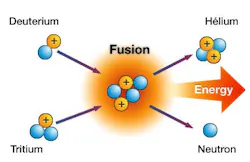
Great question, but of course the biggest barrier is actually achieving a sustainable net energy gain, a task so far out of reach.
Those fusion reactors must achieve temperatures of about 100 million degrees Celsius, for instance. If that doesn’t melt the power generation site walls, the fusion process then must be focused on converting gases into a plasma state and overcoming the so-called “Coulomb barrier,” which occurs because all nuclei are positive charged and naturally repel each other, according to Stanford University’s information on the process.
It also requires massive magnetic confinement to control the neutron mass and create baseload electricity via steam generation. Livermore National Lab is using high-powered lasers to perform its fusion experiments, but utility-scale confinement would require tokamak or stellarator-type reactor vessels.
The sun fuses nuclei simply as a function of its crazy high temps and massive gravitational force. Achieving this through man-made technology is closer than ever, but still years away at the very least.
Nonetheless, investment in commercial-scale and private-sector nuclear fusion work topped $4.5 billion in the past year from venture capital and private equity firms. Twenty-first century nuclear fusion investment may exceed $15 billion so far.
Emerging Microgrid Technology for Speed to Power for Data Centers
Wednesday EnergyTech Webinar with PowerSecure
About the Author

Rod Walton, EnergyTech Managing Editor
Managing Editor
For EnergyTech editorial inquiries, please contact Managing Editor Rod Walton at [email protected].
Rod Walton has spent 17 years covering the energy industry as a newspaper and trade journalist. He formerly was energy writer and business editor at the Tulsa World. Later, he spent six years covering the electricity power sector for Pennwell and Clarion Events. He joined Endeavor and EnergyTech in November 2021.
Walton earned his Bachelors degree in journalism from the University of Oklahoma. His career stops include the Moore American, Bartlesville Examiner-Enterprise, Wagoner Tribune and Tulsa World.
EnergyTech is focused on the mission critical and large-scale energy users and their sustainability and resiliency goals. These include the commercial and industrial sectors, as well as the military, universities, data centers and microgrids. The C&I sectors together account for close to 30 percent of greenhouse gas emissions in the U.S.
He was named Managing Editor for Microgrid Knowledge and EnergyTech starting July 1, 2023
Many large-scale energy users such as Fortune 500 companies, and mission-critical users such as military bases, universities, healthcare facilities, public safety and data centers, shifting their energy priorities to reach net-zero carbon goals within the coming decades. These include plans for renewable energy power purchase agreements, but also on-site resiliency projects such as microgrids, combined heat and power, rooftop solar, energy storage, digitalization and building efficiency upgrades.