European SMR Goals: GE Vernova, Hitachi and Samsung C&T Sign Development MoU with SGE
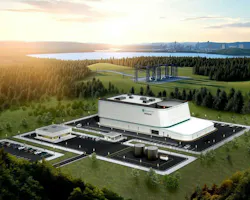
Nuclear reactor partners GE Vernova and Hitachi are extending their small modular reactor (SMR) development collaboration with engineering and construction firm Samsung C&T throughout Europe.
Poland’s SMR development group SGE has signed a memorandum of understanding with the other partners to pursue future market and commercial sites for the BWRX-300 SMR in Europe and the United Kingdom. The GE Vernova-Hitachi joint venture is currently designing and testing the BWRX SMR version of its reactor technology.
Although some countries were shunning conventional nuclear energy only a few years ago due to cost and safety fears in the wake of the Fukushima disaster, the dramatic rise of electrification demand from manufacturing and digital infrastructure is leading a new movement seeking baseload and sustainable power. Nuclear reactors generate electricity at high-capacity factors and do not emit carbon dioxide into the atmosphere.
“Europe and the UK need a scalable commercial model for new nuclear, built on proven technology, established supply chains and world-class delivery partners,” SGE founder Michal Solowow said in a statement.
“By combining GE Vernova Hitachi’s BWRX-300 technology, Hitachi’s industrial capabilities and Samsung C&T’s global construction expertise, SGE is creating a platform to deploy standardized nuclear fleets across multiple markets,” Solowow added. “We believe this can become one of the most competitive commercial solutions for Europe’s energy system — delivering reliable, clean energy 24/7, reducing execution risk, strengthening the supply chain and supporting long-term industrial growth.”
The BWRX-300 is a scaled-down, SMR version of boiling water reactor technology which has been built by GE for decades. These advanced reactors would generate from 60 to 300 MW per unit and be built partially underground with passive safety features. Some believe that SMR construction and commissioning can be done quicker and less expensively than recent nuclear power plants which have taken more than a decade and $30 billion each such as the Vogtle units in Georgia.
No SMRs have yet been commercially completed or put into operation in North America or Europe, although one testing version is under construction in Ontario, Canada. Most SMR designs are still awaiting final regulatory approvals and hope to enact projects by the early 2030s.
European nations also are shifting away from using Russian natural gas in the wake of that country’s invasion and war with Ukraine since 2022.
"As European countries pivot to nuclear, we are committed to working with our close partners to help deploy small modular reactors at the scale they need to deliver on their ambition," GE Vernova Chief Corporate and Sustainability Officer Roger Martella said. "GE Vernova has a long-standing history and presence across the European continent. This collaboration brings together complementary capabilities to help advance BWRX-300 deployment across multiple markets and build on the momentum already behind the technology."
GE Vernova Hitachi Nuclear Energy and Samsung C&T announced their strategic alliance last year to focus on global markets. The focus is on building out a project and operational supply chain to facilitate a wider adoption of the BWRX-300 technology.
In the U.S. earlier this month, startup Blue Energy submitted its first construction permit application to the U.S. Nuclear Regulatory Commission (NRC) for build a BWRX-300 SMR project in the Port of Victoria region in south Texas. When completed, the reactor would power data center developer Crusoe’s AI factory and potentially other industrial loads in the area.
Blue Energy’s collaboration with GE Vernova would also include the latter’s natural gas-fired turbine technology as a first step generation resource and bridge fuel to power AI supercomputing.
“This is what fleet deployment looks like: projects advancing on common technology, licensing work and supply chain capabilities, allowing us to apply lessons from one project to the next,” GE Vernova Hitachi Nuclear Energy CEO Jason Cooper said earlier this month. “With Blue Energy moving forward and the first U.S. BWRX-300 construction permit approaching a decision at Clinch River, we are seeing the foundations of a BWRX-300 fleet take shape in the United States.”
The Tennessee Valley Authority also is collaborating with GE Vernova Hitachi on BWRX-300 development and testing at the TVA’s Clinch River site.
Opponents say that SMR and any nuclear power plants are still too expensive, time-consuming and represent health and safety dangers.
Increase Tank Terminal Throughput
Without Expanding Infrastructure
New White Paper from Siemens
About the Author
EnergyTech Staff
Rod Walton is head of content for EnergyTech.com. He has spent 17 years covering the energy industry as a newspaper and trade journalist.
Walton formerly was energy writer and business editor at the Tulsa World. Later, he spent six years covering the electricity power sector for Pennwell and Clarion Events. He joined Endeavor and EnergyTech in November 2021.
He can be reached at [email protected].
EnergyTech is focused on the mission critical and large-scale energy users and their sustainability and resiliency goals. These include the commercial and industrial sectors, as well as the military, universities, data centers and microgrids.
Many large-scale energy users such as Fortune 500 companies, and mission-critical users such as military bases, universities, healthcare facilities, public safety and data centers, shifting their energy priorities to reach net-zero carbon goals within the coming decades. These include plans for renewable energy power purchase agreements, but also on-site resiliency projects such as microgrids, combined heat and power, rooftop solar, energy storage, digitalization and building efficiency upgrades.