Nuclear Startup Project Omega Raises $80M in Series A Round to Advance ‘Closed’ Fuel Cycle, Repurposing Used Fuel
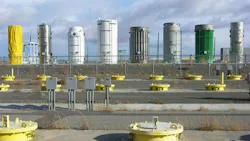
Advanced nuclear energy and recycling startup Project Omega announced on Monday the completion of an $80 million Series A funding round to advance America’s nuclear fuel cycle for multiple uses behind the reactor.
The Series A round, led by global venture capital firm B Capital, will enable the Rhode Island-based startup to further its transition of traditional spent fuel uses into opportunities for long-duration power systems, advanced reactor feedstock and strategic isotopes for commercial, scientific and medical use.
According to the U.S. Energy Information Administration, the U.S. currently utilizes an “open” fuel cycle, meaning uranium is mined, enriched and used only once in a reactor before being stored indefinitely at the reactor site as radioactive waste. Project Omega aims to integrate a “closed” cycle that recycles and reprocesses this spent fuel to keep it within the energy loop.
One primary application planned by Project Omega is extracting radioactive isotopes like Strontium-90 (an alkaline earth metal) for specialized modular power systems designed for long-duration operations. The company looks to recover these elements for use in remote military and defense installations.
This month, founder and CEO Dr. Stafford Sheehan of Project Omega presented examples to the Defense Investment Forum in Newport, Rhode Island. During the forum, he demonstrated how the company recycles spent nuclear fuel to build long-duration power sources from the isotopes it contains.
“Autonomous systems and subsea infrastructure are only as capable as their energy supply, and you cannot swap batteries on the ocean floor,” said Sheehan in a social media post recapping his visit with Sen. Jack Reed and Captain Kevin Behm of the Naval Undersea Warfare Center Newport.
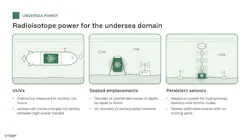
Underwater systems, such as submarines and seabed equipment, reportedly face an industry-wide bottleneck: they are constrained by conventional batteries that drain quickly and are extremely challenging to replace on the ocean floor. Project Omega's solution is to leverage recycled nuclear fuel isotopes (like Strontium-90) to create a solid, stationary, long-duration power source that can run uninterrupted for decades at extreme ocean depths.
Beyond power generation, Project Omega is deploying advanced recycling techniques for advanced reactor fuel to reduce reliance on foreign uranium and leverage recycled strategic materials for cancer treatment research and other medical applications.
“The country’s nuclear renaissance will not happen without the fuel. We have a domestic source for this, nearly 100,000 metric tons of used nuclear fuel, which is one of America’s largest untapped energy resources,” said CEO Sheehan in a statement. “We are building a vertically integrated strategy around an abundant domestic feedstock, with a non-aqueous recycling process that recovers useful isotopes and products with clear strategic demand.”
Sheehan noted the combination could create an “entirely new nuclear innovation economy” and pave the way for America's first commercial pyroprocessing facility. As the U.S. Department of Energy’s Argonne National Laboratory (ANL) noted, pyroprocessing uses electrochemistry to perform chemical separations.
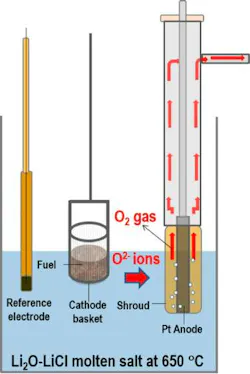
By utilizing a molten (lithium oxide–lithium chloride) salt as the working fluid, the process separates reusable elements (like uranium) from used nuclear fuel to collect as a purified metal on an electrode (an electrical conductor). This allows the uranium to be reused as fuel for advanced nuclear reactors, while the remaining waste materials stay in the salt for later disposal.
DOE’s ANL explained that these benefits allow researchers to recover more energy from the originally mined uranium and can significantly reduce the time high-level nuclear waste has to be isolated, from 300,000 years to just 300 years.
Founded in 2025, Project Omega has already partnered with the Idaho National Laboratory through ARPA-E’s CURIE program to advance used nuclear fuel recycling. A pilot program at the Pacific Northwest National Laboratory demonstrated stable electrical current from strontium-90. Project Omega claims this process can reduce the total volume of nuclear waste by up to 90%.
Alongside its recycling efforts, the company also launched its X Series modular power systems, which integrate battery storage and generators with an intelligent control system. The systems are reportedly designed to support solar and wind power initially, then allow for isotope power in the future.
Some critics like Dr. Allison Macfarlane, an environmental geologist and former Chair of the U.S. Nuclear Regulatory Commission, have pointed out that security could be a concern from mixtures pulled from molten salt baths. These mixtures (like plutonium) are still considered highly attractive and usable for crude nuclear weapons or radiological agendas.
Auditing international safeguards and physical material tracking could become difficult, she explained in previous commentary.
Macfarlane also detailed a common misconception regarding waste minimization: It never eliminates the absolute necessity of a deep geological repository (an excavated, underground facility). Even with highly efficient recycling loops, Macfarlane said heavy transuranic elements (beyond uranium) remain in the waste stream. They generate intense heat and long-term radioactivity, which is why critics like Macfarlane emphasize that a deep geological repository remains unavoidable, meaning multi-billion-dollar subterranean storage sites remain mandatory.
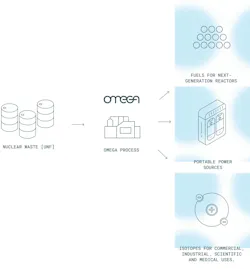
Despite some of these regulatory and proliferation warnings, commercial interest in closed-loop recycling continues to accelerate. As for Project Omega, the Series A capital will further advance the company’s X Series technology and manufacturing, as well as kickstart construction of Project Omega's nuclear fuel recycling facility. Further deployment details are expected in the coming months.
Next-gen nuclear power is emerging as a resilient, low-volatility solution for powering future large-scale computing and industrial infrastructure despite current supply chain bottlenecks for raw uranium. The U.S. is reportedly home to one of the world's largest stockpiles of spent nuclear fuel, but while multiple nations like France, Japan and Russia actively recycle it, America does not.
Project Omega plans to shift that trajectory to align with a broader push by the DOE, which is currently exploring “Nuclear Lifecycle Innovation Campuses” to co-locate fuel production, advanced reactor research and commercial recycling.
Meeting America’s compounding energy demand, driven by AI and advanced manufacturing, will require significantly more nuclear power and a secure domestic fuel supply chain, Project Omega added.
“America’s growing demand for reliable power is colliding with a nuclear fuel cycle that remains dependent on foreign supply and leaves enormous value stranded in used fuel,” said Jeff Johnson, general partner and global head of energy at B Capital, who will join Project Omega’s Board of Directors. “We’re excited to support Staff Sheehan and his highly experienced team as they scale this platform and unlock economic potential across the nuclear value chain.”
About the Author
 Eric Moody
Staff Writer
Related
 dreamstime_nuclear