Offshore Wind Developers Back to Work After Federal Injunctions Granted Against Interior Pause Orders
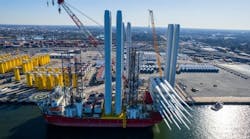
Work is restarting, at least temporarily, on numerous multi-GW U.S. offshore wind farms which were stopped by the Department of the Interior late last year even though the projects were fully invested and well into construction at the time.
Federal judges in Virginia and Washington, D.C. granted injunctions against two of the Trump Administration’s pause orders issued in December to five offshore wind developments. Those five included Revolution Wind, Coastal Virginia Offshore Wind, Vineyard 1, Sunrise and Empire Wind 1.
Revolution, Vineyard and Coastal Virginia offshore wind farms are deep into their construction phases with plans to come online next year. Sunrise Wind and Empire are scheduled for commissioning in 2027.
The judge’s rulings allowed for resumption of wind turbine installation for the 2.6-GW Coastal Virginia Offshore Wind (CVOW) project led by Virginia-based utility Dominion Energy. The utility, like the other impacted offshore wind project developers, is pressing on with lawsuits challenging the Trump DOI orders.
“While our legal challenge proceeds, we will continue seeking a durable resolution of this matter through cooperation with the federal government,” reads the Dominion Energy statement after the Virginia federal judge’s injunction in the utility's favor. “CVOW will consist of 176 offshore wind energy turbines generating a total of 2.6 GW—enough energy to power up to 660,000 homes. CVOW is a critical part of Dominion Energy’s all-of-the-above diverse energy supply strategy to meet our region’s growing demand.”
Meanwhile, a federal judge in the U.S. District Court for the District of Columbia granted a preliminary injunction for the Revolution Wind project being built off the coast of Rhode Island. The Interior stop-work order motivated opposition from numerous state officials on the east coast, including Connecticut Attorney General William Tong.
“This project is on the finish line to begin delivering clean, affordable energy to Connecticut families. With yet another clear defeat, it is my hope that Donald Trump will drop his lawless and erratic attacks for good,” the state attorney general said in a statement. “We’re prepared to keep fighting—and winning-- for as long as it takes to protect Connecticut ratepayers, workers and our environment.”
Danish energy firm Ørsted has led development of the $6.2 billion Revolution Wind project. The wind farm only has seven turbines left to install and is close to generating commercial-scale electricity for U.S. markets, Ørsted CEO Rasmus Errboe told the New York Times in a recent interview.
The Trump Administration’s public reasoning for the stop-work orders on developing offshore wind projects pointed to national security and an aversion to renewable energy previously incentivized by production tax credits and other parts of the Biden-Era Inflation Reduction Act.
“The prime duty of the United States government is to protect the American people,” said Secretary of the Interior Doug Burgum, in a statement at the time of the orders against offshore wind. The action by the Trump Administration reportedly “addresses emerging national security risks, including the rapid evolution of the relevant adversary technologies, and the vulnerabilities created by large-scale offshore wind projects with proximity near our east coast population centers. The Trump administration will always prioritize the security of the American people.”
The Interior Department statement also cited previous federal investigatory declassified reports determining that the movement of large turbine blades and the “highly reflective towers” create radar interference called “clutter” which could confuse radar accuracy.
Interior Secretary Burgum previously posted on his official X social media account that the security concerns are causing the pause for “five expensive, unreliable, heavily subsidized offshore wind farms.
The DOI acted last month after a previous stop-work order was thrown out by another federal judge.
The presidential order was “arbitrary and capricious,” according to Judge Patti B. Saris of the Federal District Court in Massachusetts. She ruled that the DOI failed to provide a “reasoned explanation for reversing decades of offshore wind permits.
“Whatever level of explanation is required when deviating from longstanding agency practice, this is not it,” the judge wrote in late 2025.
Dominion Energy has noted its Coastal Virginia Offshore project is more than 10 years in development, design and now construction. Planning on the CVOW involved extensive collaboration with the military, since Virginia is home to many of the nation’s warships and also is a national leader in data center location.
The Trump Administration Department of Energy last year terminated $7.6 billion in previous conditional loan guarantees for decarbonizing energy projects formerly granted under the DOE Loans Program Office.
Creating a Stable Digital Footprint in Dynamic Field Environments
New Microgrid Knowledge Webinar Featuring Fulcrum
2 p.m. (ET) Thursday, Jan. 29
About the Author

Rod Walton, EnergyTech Managing Editor
Managing Editor
For EnergyTech editorial inquiries, please contact Managing Editor Rod Walton at [email protected].
Rod Walton has spent 17 years covering the energy industry as a newspaper and trade journalist. He formerly was energy writer and business editor at the Tulsa World. Later, he spent six years covering the electricity power sector for Pennwell and Clarion Events. He joined Endeavor and EnergyTech in November 2021.
Walton earned his Bachelors degree in journalism from the University of Oklahoma. His career stops include the Moore American, Bartlesville Examiner-Enterprise, Wagoner Tribune and Tulsa World.
EnergyTech is focused on the mission critical and large-scale energy users and their sustainability and resiliency goals. These include the commercial and industrial sectors, as well as the military, universities, data centers and microgrids. The C&I sectors together account for close to 30 percent of greenhouse gas emissions in the U.S.
He was named Managing Editor for Microgrid Knowledge and EnergyTech starting July 1, 2023
Many large-scale energy users such as Fortune 500 companies, and mission-critical users such as military bases, universities, healthcare facilities, public safety and data centers, shifting their energy priorities to reach net-zero carbon goals within the coming decades. These include plans for renewable energy power purchase agreements, but also on-site resiliency projects such as microgrids, combined heat and power, rooftop solar, energy storage, digitalization and building efficiency upgrades.