1-GWh Iron-Air Battery Storage Deployment to Support Wind Power on Dutch Grid
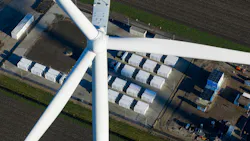
A long duration alternative to lithium-ion battery storage is gaining a huge opportunity to prove its value proposition by providing up to 1 GWh of generation capacity into the Dutch grid.
Netherlands-based Ore Energy has been contracted by fellow Dutch energy supplier Budget Thuis for what it calls the largest iron-air energy storage offtake agreement in Europe so far. The first phase of the offtake deal begins with 400 MWh committed for delivery in 2028.
Once deployed, the Budget Thuis system will operate as a multi-day battery storage asset integrating into the Dutch electricity grid. Ore Energy’s 40-foot containerized iron-air battery architectures are designed to provide from 24 to 100 hours of duration, compared to only two four hours typical of lithium-ion storage chemistries.
Grid-scale battery storage, typically lithium-ion, historically has been deployed to help balance and extend generation from utility-scale solar generation. However, Europe has embraced both onshore and offshore wind with close to 304 GW of capacity, nearly double the U.S. portfolio of about 161 GW, according to reports.
Wind power in the Netherlands is roughly 25 percent of the nation’s clean electricity supply, according to reports. This type of renewable portfolio creates unique pressures on the grid, including the need for curtailment, or intentional reduction of electricity output during periods when generation exceeds demand.
"European grids are already curtailing clean power at scale, wasting electricity that costs billions to generate, while we stay dependent on fossil fuels to cover the gaps. Short-duration batteries alone can't fix this. They shift solar by a few hours, but wind-heavy European grids need storage that works across days, not hours,” said Aytaç Yilmaz, Co-Founder and CEO of Ore Energy.
The European Commission's Joint Research Centre forecasts that up to 310 TWh of renewable energy will be curtailed annually because of grid congestion. This could lead to additional grid costs of more than $100 million annually.
“Our long-duration iron-air batteries are built for exactly that: they capture wind when it blows and make it available when it doesn't, displacing the gas plants that fill those multi-day gaps today and using a supply chain that Europe controls. We believe iron-air will become as important for wind as lithium-ion has been for solar,” Yilmaz added.
Battery storage also has demonstrated greater power flexibility in supporting gas-fired and renewable power for data centers, responding instantaneously to the transient load fluctuations of artificial intelligence tasks.
Ore Energy uses iron, water and air in its system to store and discharge energy. The iron-air batteries work by the electrochemical oxidation of the metal at the anode and reduction of oxygen at the cathode.
Budget Thuis is an energy management provider which also bundles electricity, gas and telecom services for households. It is part of Nuts Groep.
“Iron-air is especially compelling because it is designed for the long-duration use cases that conventional batteries are not built to cover, with a cost structure suited to multi-day storage,” said Annemarie Buitelaar, CEO of Budget Thuis. “For us, this is about reducing exposure to volatile fossil fuel prices while giving customers access to cleaner and more predictable electricity over time.”
Other companies working on iron-air battery storage in the U.S. include Form Energy and ESS.
Iron air batteries are too heavy for electric vehicles applications but has shown use case success in stationary and grid-scale projects. Other companies are working on sodium-ion and zinc-based batteries as long-duration alternatives to the more temporary discharge capabilities and fire risks of lithium-ion.
Connect Formulation, Manufacturing and Quality
Across the Digital Enterprise
New Executive Brief from Siemens
About the Author

Rod Walton, EnergyTech Managing Editor
Managing Editor
For EnergyTech editorial inquiries, please contact Managing Editor Rod Walton at [email protected].
Rod Walton has spent 17 years covering the energy industry as a newspaper and trade journalist. He formerly was energy writer and business editor at the Tulsa World. Later, he spent six years covering the electricity power sector for Pennwell and Clarion Events. He joined Endeavor and EnergyTech in November 2021.
Walton earned his Bachelors degree in journalism from the University of Oklahoma. His career stops include the Moore American, Bartlesville Examiner-Enterprise, Wagoner Tribune and Tulsa World.
EnergyTech is focused on the mission critical and large-scale energy users and their sustainability and resiliency goals. These include the commercial and industrial sectors, as well as the military, universities, data centers and microgrids. The C&I sectors together account for close to 30 percent of greenhouse gas emissions in the U.S.
He was named Managing Editor for Microgrid Knowledge and EnergyTech starting July 1, 2023
Many large-scale energy users such as Fortune 500 companies, and mission-critical users such as military bases, universities, healthcare facilities, public safety and data centers, shifting their energy priorities to reach net-zero carbon goals within the coming decades. These include plans for renewable energy power purchase agreements, but also on-site resiliency projects such as microgrids, combined heat and power, rooftop solar, energy storage, digitalization and building efficiency upgrades.